
Aromatherapy for Beginners: How It Works and the Evidence
Aromatherapy, in practice, is deliberately smelling a plant oil, usually on purpose and usually in a routine, and the honest summary of the evidence is that it moves mood and self-rated stress in some small trials while the better-controlled comparisons often show little beyond what expectation and pleasant smell already do. It is a low-cost habit worth trying if you like the scent. It is not a way to manage a medical condition, and the sections below show where the evidence is firmer, where it is thin, and how to start without making the common mistakes.
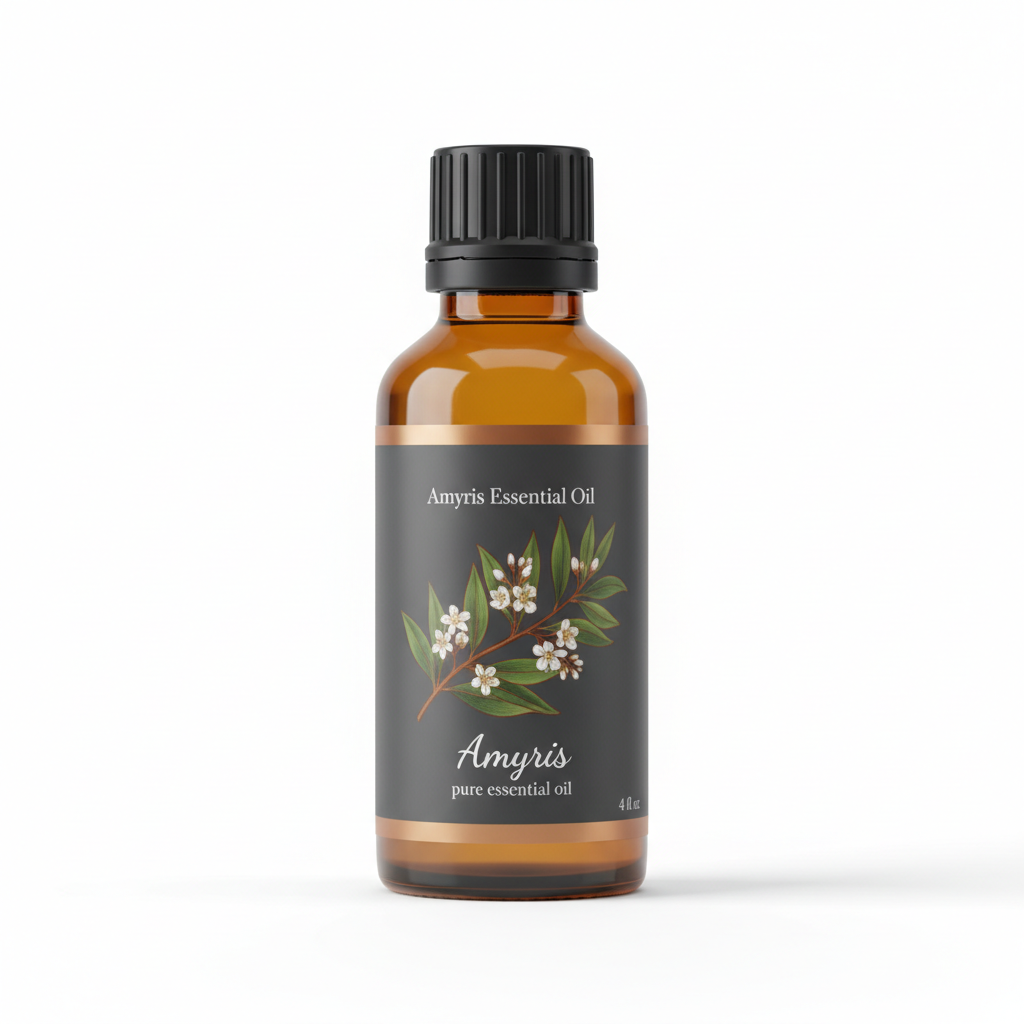
Amyris Essential Oil
Our own Amyris Essential Oil, in sizes from 0.5 oz to bulk.
From $20.99
Shop Now →What actually happens when you smell an oil
The mechanism is better established than the health claims. In a 2013 review in Frontiers in Systems Neuroscience, Kadohisa describes how signals from the olfactory bulb reach the piriform cortex and the amygdala without passing through the thalamic relay that most other senses use. The same review describes a second route from the bulb and piriform cortex to the entorhinal cortex and hippocampus, which supports odor-linked episodic memory, and a route through the amygdala to the hypothalamus that could let odors touch autonomic and endocrine responses. That is the reason a smell can bring back a memory or a feeling quickly.
Two cautions come from the same review. It is a narrative review, so it does not say how studies were selected or rate their quality, and much of the mechanistic evidence comes from rodents and macaques, so applying it to people is an inference. It also concludes that effects vary by odor, by individual and by sex, which means the pathway tells you that smell can influence feeling, not that any particular oil will do it for you.
What the trials say, with the numbers
The National Center for Complementary and Integrative Health (NCCIH, aromatherapy page, updated January 2020) defines aromatherapy as the use of essential oils from plants as a complementary health approach, usually inhaled or applied diluted to the skin. For insomnia it says it is unknown whether aromatherapy helps because rigorous research is limited. A short look at four sources shows how much the picture depends on the question and on the comparison group.
- Sleep, pooled trials. A 2025 meta-analysis by Shen, Zhang and Zhu pooled 11 randomized trials with 628 adults using lavender oil and reported a standardized mean difference of -0.56 on sleep quality scales (95% CI -0.96 to -0.17). That figure is a unit-free difference in standard deviations. The authors rated overall risk of bias as moderate, found most trials gave too little information to judge blinding, reported heterogeneity of 82%, and wrote that the conclusion needs verification in higher-quality studies. Our sleep article goes through that paper and its subgroups.
- Anxiety scores, lavender inhalation. A 2023 systematic review by Yoo and Park covered 11 randomized trials with 972 participants; 10 reported significantly lower anxiety after inhaling lavender oil. None of the participants had a clinical anxiety disorder (most were people facing a medical procedure), the review reports no formal quality-appraisal tool, and adverse events were mostly "none" or "not assessed". The authors call their conclusions provisional.
- Test anxiety in college students. A 2023 meta-analysis by Luan and colleagues pooled 7 trials with 425 students (SMD -0.67, 95% CI -1.05 to -0.28). Its placebo-controlled subgroup was not significant (SMD -0.65, p = 0.25). A smell compared against no smell looks good; a smell compared against another smell looks much less clear.
- A direct test of lavender against water. In a 2008 randomized trial of 56 healthy adults, Kiecolt-Glaser and colleagues had each person smell lavender, lemon and water across three visits, with a brief cold-pressor stressor each time. Lemon raised positive mood more than lavender or water. Lavender was no better than water on the mood, hormone and heart-rate measures the authors report. The sample was young and small, and exposures were short.
The pattern across these is useful. Pooled trials with a no-odor or no-treatment control tend to be positive. Trials that control the smell itself are mixed to null. That does not prove the oils do nothing; it means the effect, where there is one, may be hard to separate from the experience of a pleasant ritual.
Expectation and pleasantness are not noise to be removed
Two small studies illustrate why. Chamine and Oken (2015) randomized 81 adults aged 50 to 85 to lavender, coconut oil or water, and separately to a card claiming a strong stress-reducing effect or a neutral card. The aroma type had no specific effect on stress or cognition, while the group given the claim showed a larger post-stress drop in reaction time (P = .037). The study was small (about 27 per aroma group) and several brain-response findings did not survive correction for multiple comparisons.
Hoenen and colleagues (2016) exposed 78 analyzed participants to limonene, vanillin or diethyl phthalate while a helplessness task was induced. Limonene had no odor-specific mood advantage, but people who rated their odor as more pleasant showed a smaller drop in happiness (p = 0.019). The link is correlational, but it points at a practical rule: the oil you actually like smelling is the one most likely to do anything.
Reasoning from those two findings, the practical consequence is to choose by preference first. An oil that is "best for calm" on a list but smells unpleasant to you is a poor first purchase.
Inhaled, diffused or on the skin: three different exposures
Inhalation puts a small amount of vapor in the air you breathe. Topical use puts the oil on the skin, which is where most adverse reactions occur. The Tisserand Institute safety guidelines say skin reactions are the most common adverse reaction to essential oils and the most common cause is undiluted use; they describe an allergic reaction as one where the immune system has been primed, "usually for life", so that oil may need to be avoided indefinitely. For ambient diffusing the same page advises 30 to 60 minutes on and then 30 to 60 minutes off, with some fresh-air exchange, and says direct intensive inhalation such as steam inhalation should not go beyond 15 to 20 minutes.
On the skin, our shop guidance for our own oil is to dilute to 0.5% to 2% in a carrier oil, patch test first, keep it away from eyes, children and pets, and not take it internally. If you want the percentage worked out in drops, the dilution chart does the arithmetic and the patch test guide shows how to do the test.
Why sellers cannot say "for sleep" or "for stress", and why you should be wary when they do
The FDA's aromatherapy page says an aromatherapy product's regulatory category depends mainly on its intended use. A product intended only to cleanse or beautify is a cosmetic; one intended for a therapeutic use, such as treating or preventing disease, is a drug, and the page lists claims such as easing pain or helping with sleep as drug claims, even for plant-derived products. It also says the FDA has no regulations defining "natural" or "organic" for cosmetics. That is why you will not find a sleep or stress promise on our pages: we make no medicinal claim for amyris. When a retailer does attach a health outcome to an oil, you are reading either marketing or a drug claim the product has not been approved to make.
A first-purchase framework (reasoning, not a ranking)
There is no source that can tell you your "first five oils". What follows is our reasoning from the sources above, and we have not trialled it.
- Pick by scent preference. Smell the oil before buying where possible, and favor a scent you already enjoy, because of the pleasantness finding above.
- Require a Latin name on the label. The Yoo and Park review excluded 12 studies because they did not name the lavender species. If researchers cannot compare products without a species, neither can you. Lavandula angustifolia and Lavandula latifolia are different oils; "lavender" is not an ingredient list.
- Add one oil at a time. NCCIH (lavender page, updated February 2025) says inhaled lavender is considered possibly safe but may cause headache or coughing. If you add three oils in the same week you cannot tell which one gave you the headache.
- Check your household first. NCCIH (peppermint oil page, updated May 2025) says menthol in peppermint oil can affect breathing and should not be inhaled by or applied to the face of infants or small children. Pets and pregnancy have their own pages: see pets and pregnancy.
- Buy from someone who can tell you the lot. A lot number, bottling date and independent lab report on request are the minimum. How to choose essential oils covers that decision in full.
Where this leaves a starter kit: a small number of oils that you like, one species each, in glass bottles, with a diffuser or a tissue as the delivery method. You do not need blends, a collection or a diffuser with colored lights.
Where amyris fits, and where it does not
Our oil is Amyris balsamifera, steam distilled from aged heartwood, and the one product we sell. Its scent is described in our shop copy as creamy, woody and balsamic with a soft vanilla undertone, and it is a base note, meaning it is slow to fade and helps citrus and floral top notes hold. A search for human trials of amyris oil on sleep, stress or cognition found none in October 2026, so nothing on this page should be read as saying amyris does any of those things. It is also probably not the right first oil for most beginners: it is a supporting scent more than a signature one, and a beginner is better served learning which of lavender, a citrus or a mint they actually like. If you already like deep woody scents, a bottle of ours is a reasonable fit for a diffuser or, diluted, for skin. The base-note guide explains what that role means, and our amyris benefits article describes what we can and cannot say.
Who should not self-direct with oils
Several groups should talk to a clinician before starting: anyone with asthma (Tisserand Institute advises consulting a doctor before using pure essential oils, and notes anecdotal reports of some oils triggering attacks), anyone who is pregnant or breastfeeding, anyone taking sedatives or other medication, and the parents of infants and small children. For persistent low mood, persistent anxiety or poor sleep for months, see a physician or a licensed mental health professional rather than adjusting your oil collection. In the United States, the 988 Suicide and Crisis Lifeline accepts calls and texts at 988 or chat at 988lifeline.org around the clock for emotional distress, not only for emergencies.
Next steps by goal
Each of these goes into the evidence for one use: sleep, stress, focus, meditation, using a diffuser, choosing a diffuser type, making a personal inhaler, and the wider evidence summary. The one set of habits that applies to all of them is in the safety guide.
Think of aromatherapy as a small, optional pleasure with an honest evidence base: pick a scent you like, use it sparingly, change one thing at a time, and take health concerns to a physician.
Amyris Essential Oil
Amyris Essential Oil from our own shop, in sizes from 0.5 oz to bulk.
From $20.99
Shop Now →Sources & Further Reading
- Kadohisa M., 2013. Effects of odor on emotion, with implications. Frontiers in Systems Neuroscience 7:66. pmc.ncbi.nlm.nih.gov
- NCCIH, updated January 2020. Aromatherapy. nccih.nih.gov
- NCCIH, updated February 2025. Lavender: usefulness and safety. nccih.nih.gov
- NCCIH, updated May 2025. Peppermint oil: usefulness and safety. nccih.nih.gov
- Shen H., Zhang L.-J., Zhu W.-Y., 2025. The sleep-enhancing effect of lavender essential oil in adults: a systematic review and meta-analysis. Holistic Nursing Practice. pmc.ncbi.nlm.nih.gov
- Yoo O., Park S.-A., 2023. Anxiety-reducing effects of lavender essential oil inhalation: a systematic review. Healthcare 11(22):2978. pmc.ncbi.nlm.nih.gov
- Luan J. et al., 2023. Aromatherapy with inhalation effectively alleviates the test anxiety of college students: a meta-analysis. Frontiers in Psychology 13. frontiersin.org
- Kiecolt-Glaser J.K. et al., 2008. Olfactory influences on mood and autonomic, endocrine, and immune function. Psychoneuroendocrinology 33(3):328-339. pmc.ncbi.nlm.nih.gov
- Chamine I., Oken B.S., 2015. Expectancy of stress-reducing aromatherapy effect and performance on a stress-sensitive cognitive task. Evidence-Based Complementary and Alternative Medicine. pmc.ncbi.nlm.nih.gov
- Hoenen M. et al., 2016. Fancy citrus, feel good: positive judgment of citrus odor, but not the odor itself, is associated with elevated mood during experienced helplessness. Frontiers in Psychology 7:74. pmc.ncbi.nlm.nih.gov
- Tisserand Institute, undated page, read October 2026. Safety guidelines. tisserandinstitute.org
- U.S. Food and Drug Administration, undated page, read October 2026. Aromatherapy. fda.gov
- 988 Suicide & Crisis Lifeline, undated page, read October 2026. 988lifeline.org