Amyris Oil Benefits: What the Evidence Does and Doesn't Show
The honest benefit of amyris oil is its aroma: a woody, balsamic base note for diffusers, perfume and body products. Everything beyond that is either laboratory work on bacteria, fungi, ticks and fish, or sandalwood research borrowed from a different oil. A PubMed search for the species name returns 11 records, and by title none is a human trial. This page grades each commonly repeated claim by what actually exists, so you can see where the evidence stops.
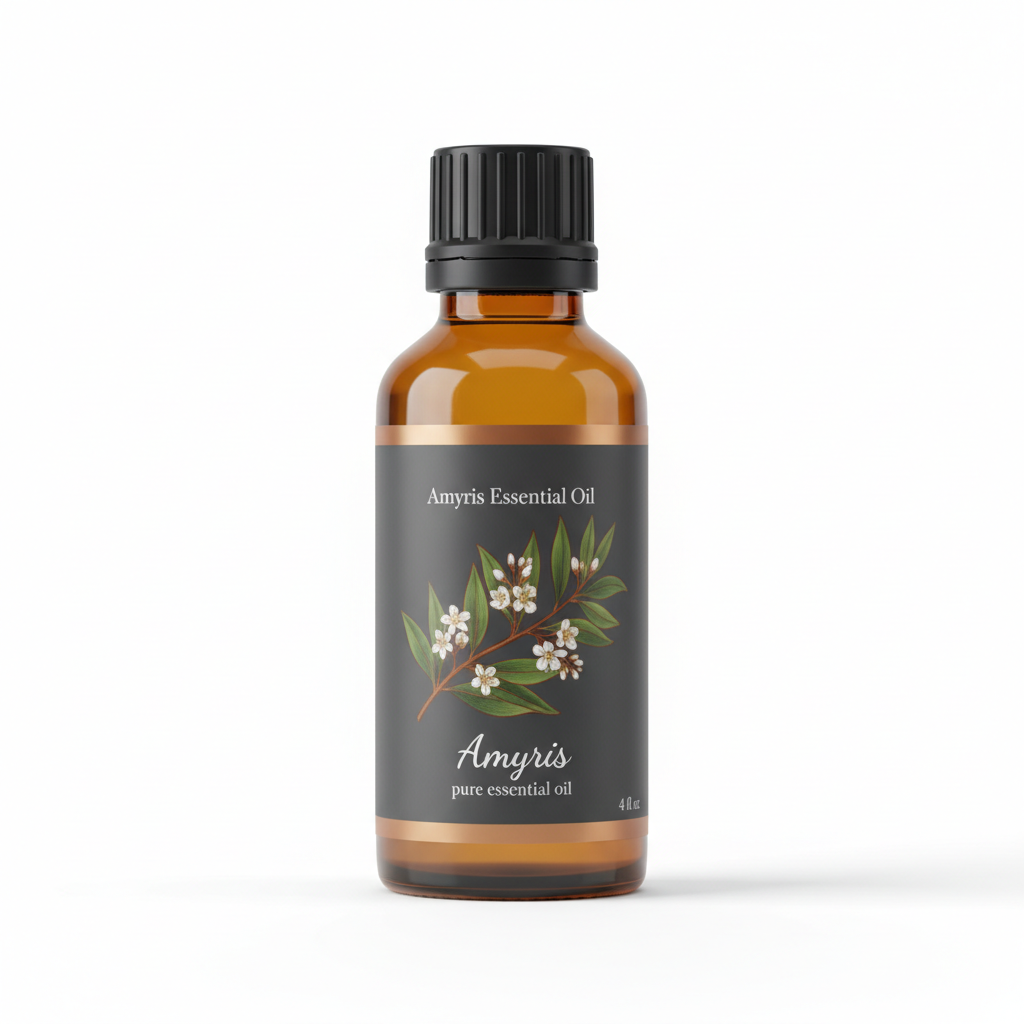
Amyris Essential Oil
Our own Amyris Essential Oil, in sizes from 0.5 oz to bulk.
From $20.99
Shop Now →The claims ledger
The labels below are ours, and they describe the existence and type of evidence, not whether a claim is true or false. "Amyris itself" means the study tested amyris balsamifera oil. "Constituent only" means it tested a molecule found in the oil. "None found" means we looked in PubMed and Europe PMC in October 2026 and found nothing on amyris for that claim.
| Claim you will see | What exists | Evidence label |
|---|---|---|
| Antibacterial, antifungal | Culture-dish assays (2013, 2014, 2018, 2020, 2021) | Amyris itself, in vitro only |
| Insect and tick repellent | Laboratory bioassays (2010, 2024) | Amyris itself and elemol, lab only |
| Muscle relaxant, sedative | One 2025 immersion study in fish | Amyris itself, animal only |
| Helps sleep or calm the mind | No amyris study found | None found |
| Skin benefits (anti-aging, blemishes, moisture) | No amyris study found | None found, marketing claim only |
| Antioxidant | One enzyme-assay claim in a 2013 paper, no numbers in the abstract | Amyris itself, in vitro, thin |
| Inflammation or tumor-related claims | Sandalwood (S. album) research, not amyris | None found for amyris |
| Fixative that makes scents last | No measurement of scent longevity in any source we opened | None found; reasoning only |
| Pleasant woody base-note aroma | Odor descriptions in a pharmacopeial monograph and on our certificate | Descriptive, not measured |
Lab antimicrobial results: real, and a long way from a shelf product
Several groups have put amyris oil on microbes in a dish. Dahiya and Manglik (2013) reported activity against multidrug-resistant bacterial isolates, with the widest inhibition zone, 20 mm, against Klebsiella pneumoniae, and among the fungal isolates only Candida albicans was inhibited. Abrão and colleagues (2014), in a conference abstract, tested 15 Cryptococcus neoformans isolates and reported minimum inhibitory concentrations of 128 to 256 micrograms per milliliter. A 2021 screen by Rapper et al. of 49 commercial oils against nine respiratory pathogens named amyris, coriander and a New Caledonian sandalwood as the most active, with MIC values of 0.03 to 0.13 milligrams per milliliter.
Two cautions keep these results in proportion. First, a minimum inhibitory concentration is the strength at which growth stops in a controlled culture; it says nothing about what happens when the oil is diffused into a room or diluted to 1% in a carrier oil and put on skin. Reasoning from the arithmetic, a 1% dilution is 10 milligrams of oil per milliliter, which is far above the dish concentrations, but the oil on skin is not sitting in a growth medium and the studies did not test it there. Second, results are not uniform. A 2018 screen of 35 oils against a Lyme-disease spirochete culture by Feng et al. listed amyris among ten oils with strong activity at 0.1%, yet amyris was one of the oils that failed to clear the culture in a 21-day subculture. Even the authors called for further work before any claim in living systems. These are interesting data about the chemistry; they are not a basis for saying the oil protects against anything, and we do not say it.
Repellency: the best-documented result, still not a product claim
The amyris studies with the most concrete numbers are about arthropods. In a 2010 laboratory study by Carroll et al., amyris oil and elemol (a major constituent of amyris, and of Osage orange oil) were repellent to nymphs of two tick species, and elemol did not differ significantly from DEET against the lone star tick. At 827 micrograms of amyris oil per square centimeter of filter paper, 80% of lone star nymphs were repelled at 2 hours and 55% at 4 hours. A 2024 sand fly study by Temeyer et al. tested 1% amyris in a static-air olfactometer and reported it as an effective spatial repellent at lower concentrations than DEET.
The fall from 80% to 55% in two hours is the useful detail: repellency in these tests fades. These were filter paper, cloth and chamber tests, not people outdoors, and a bottle of amyris oil is not a registered insect repellent. If ticks are the concern, the sources to follow are public health ones, and a pharmacist or physician can advise on products that have been evaluated for the purpose.
Muscle relaxant: one fish study and a claim that travels
You will see amyris described as a muscle relaxant because of its valerianol. The one direct paper we found is a 2025 study by Lins et al. in which tambaqui fish were held in baths at 20 to 40 microliters per liter of water. The oil caused a reversible loss of the postural reflex, with recovery time depending on dose, and lowered heart rate. That is an anesthesia model in fish, with the oil dissolved in the water the animals were breathing. It cannot be turned into advice for a person with a tight shoulder. Elsewhere the claim is repeated: Kucharska et al. call amyris oil an excellent natural muscle relaxant because of its valerianol, citing earlier literature we did not trace. We found no human or mammal study that tested it.
Sleep and the skin: what to make of silence
We searched for amyris in sleep, anxiety and skin studies and found none. That is a finding, not a gap to fill with a general claim. Inhaled-aroma sleep research exists for other oils, and our sleep page says what that evidence is and is not, while does aromatherapy work covers the broader literature. For skin, amyris for skin treats the oil as a fragrance ingredient with a dilution limit, because that is what the evidence supports: sensitization is the main documented risk of any essential oil on skin, and Sukakul, Bruze and Svedman (2024) review how common fragrance contact allergy is worldwide.
Sandalwood research is not amyris research
Many benefit lists for amyris quietly import findings from true sandalwood. The introduction of Kucharska et al. (2021) does cite anti-inflammatory and anti-carcinogenic effects, but they are about Santalum album oil and its alpha-santalol, a molecule amyris does not contain at detectable levels, as the 2024 analysis by Abd Algaffar et al. showed. In that same paper, the amyris oil they tested was active against a fungus in vitro at about the same order as most of the Santalum oils, which illustrates the problem: oils with different chemistry can look alike in a dish, and a dish result does not transfer to a bottle on your shelf.
Where the law draws the line
The FDA's aromatherapy page says a product's category depends on its intended use, and it lists claims about pain, depression, anxiety, muscle relaxation or sleep as drug claims, which would require approval. That is why we describe amyris as an aromatic and cosmetic ingredient, why our Origin page states that no medicinal claim is made for amyris, and why the antimicrobial and relaxant findings above are reported as what a study did, not as what the oil does for you.
What we would tell you to buy it for
Buy amyris if you want a woody, creamy, balsamic base note: that is what our shop description says, the certificate records woody, earthy and smoky, and the smell is the point. We sell the oil pure and undiluted, with a lab report per lot available on request, and that is the extent of the claim. Do not buy it to address a health complaint. For a symptom, a physician or pharmacist is the right person; for a skin condition, a dermatologist. Dilute it to 0.5% to 2% in a carrier oil for skin (lower on the face), keep it from eyes, children and pets, and do not take it internally. The wider picture, including how to use it, is in the complete amyris guide, how to use amyris oil and amyris oil safety.
If a page lists ten benefits for amyris with no study named, count how many of its sentences could have been written about any wood oil. The ones that cannot are the ones that cite a paper.
Amyris Essential Oil
Amyris Essential Oil from our own shop, in sizes from 0.5 oz to bulk.
From $20.99
Shop Now →Sources & Further Reading
- Dahiya P, Manglik A, 2013. Evaluation of antibacterial, antifungal and antioxidant potential of essential oil from Amyris balsamifera against multi drug resistant clinical isolates. Asian J Pharm Clin Res 6(9):57-60. journals.innovareacademics.in
- Abrão F, et al., 2014. Antifungal activity of essential oil of Amyris balsamifera against Cryptococcus neoformans. BMC Proceedings 8(Suppl 4):P32 (conference abstract). pmc.ncbi.nlm.nih.gov
- Rapper SL, Tankeu SY, Kamatou G, Viljoen A, van Vuuren S, 2021. The use of chemometric modelling to determine chemical composition-antimicrobial activity relationships of essential oils used in respiratory tract infections. Fitoterapia. pubmed.ncbi.nlm.nih.gov
- Feng J, Shi W, Miklossy J, Tauxe GM, McMeniman CJ, Zhang Y, 2018. Identification of Essential Oils with Strong Activity against Stationary Phase Borrelia burgdorferi. Antibiotics. pubmed.ncbi.nlm.nih.gov
- Carroll JF, Paluch G, Coats J, Kramer M, 2010. Elemol and amyris oil repel the ticks Ixodes scapularis and Amblyomma americanum in laboratory bioassays. Exp Appl Acarol. pubmed.ncbi.nlm.nih.gov
- Temeyer KB, Schlechte KG, Coats JR, Cantrell CL, et al., 2024. In Vitro Evaluation of Essential Oils and Saturated Fatty Acids for Repellency against the Old-World Sand Fly. Insects. pubmed.ncbi.nlm.nih.gov
- Lins ATLA, de Araujo DB, Eiro-Quirino L, et al., 2025. Amyris balsamifera essential oil promotes anesthesia in Colossoma macropomum. Fish Physiol Biochem. pubmed.ncbi.nlm.nih.gov
- Kucharska M, Frydrych B, Wesolowski W, Szymanska JA, Kilanowicz A, 2021. A Comparison of the Composition of Selected Commercial Sandalwood Oils with the International Standard. Molecules. pmc.ncbi.nlm.nih.gov
- Abd Algaffar SO, Seegers S, Satyal P, Setzer WN, Schmidt TJ, et al., 2024. Sandalwood Oils of Different Origins Are Active In Vitro against Madurella mycetomatis. Molecules. pmc.ncbi.nlm.nih.gov
- Sukakul T, Bruze M, Svedman C, 2024. Fragrance Contact Allergy: A Review Focusing on Patch Testing. Acta Derm Venereol. pubmed.ncbi.nlm.nih.gov
- FDA, undated page, read October 2026. Aromatherapy. fda.gov