
Essential Oils During Pregnancy: What the Evidence Covers
Nobody can honestly tell you that essential oils are "safe" or "unsafe" in pregnancy as a blanket rule, because the evidence sits in the gap between the two. What exists is a handful of small trials that reported no adverse effects, and no study large enough to show that an uncommon harm does not happen. So the sensible position is neither fear nor reassurance: ask your OB-GYN or midwife before you use any oil, and bring the bottle and the dilution.
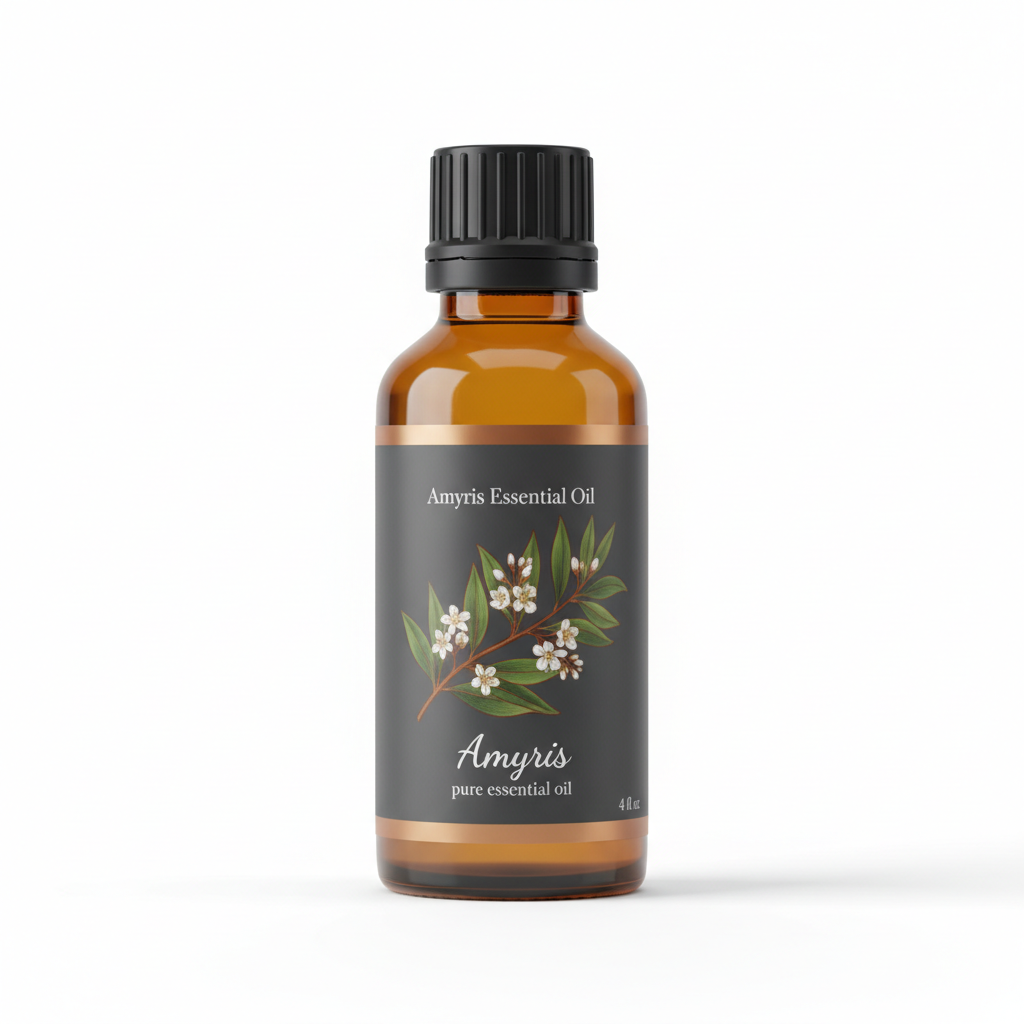
Amyris Essential Oil
Our own Amyris Essential Oil, in sizes from 0.5 oz to bulk.
From $20.99
Shop Now →Are essential oils safe during pregnancy?
The only direct statement from the Tisserand Institute's safety guidelines (undated page, read October 2026) is that people who are pregnant should consult a doctor or suitable practitioner before using pure essential oils. That is not a ban and not a clearance. It is a referral, and we repeat it for the same reason: the person who knows your pregnancy history, your medicines and your risk level is your provider, not a shop and not a website.
What gets quoted as "evidence of safety" online is usually one of three things, so here is what each one is.
- A lemon oil inhalation trial. Yavari Kia and colleagues (2014, Iran Red Crescent Medical Journal) randomized 100 women at 6 to 16 weeks of gestation (mean about 10 to 11 weeks) to two drops of lemon oil on cotton or a placebo for nausea and vomiting, and reported no adverse effects. The paper describes lemon oil as "considered as a safe drug in pregnancy," but supports that with a secondary source from 2000, not with its own safety data. Nausea scores differed on day 2 and day 4 only.
- A peppermint skin trial. The Tisserand Institute's write-up of a 2012 Iranian triple-blind trial describes 96 women in the second or third trimester using sesame oil with 0.5% peppermint oil twice daily for two weeks for itching. The page states there is "no indication that Peppermint oil carries any risk in pregnancy," while a commenter advises keeping topical dilutions below 2% and seeing a doctor, since some pregnancies are higher risk. The page gives no numerical results for the itch scores.
- A lavender review. Vidal-García and colleagues (2024, Healthcare) pooled six trials with 413 participants on lavender for stress, insomnia and anxiety, and none reported adverse effects. The review says lavender "may be safe" under the conditions used, but that safety in early pregnancy is unknown because all the included trials started in the second trimester or later, and that none used the oral route. It also cites the WHO monograph, which accepts inhaled lavender but says it should not be used orally during pregnancy.
Where the sources disagree, and why that is informative
These three do not contradict each other so much as ask different questions. The lemon trial included first-trimester women and reported no harm. The lavender review calls first-trimester safety unknown. Both can be true: the lemon trial was built to measure nausea, not to detect harm, and reported none among 100 women.
Reasoning from those numbers, the practical consequence is that a trial of 100 or even 413 people can tell you that common, obvious problems did not appear. It cannot tell you that an uncommon outcome, something that occurs in a small percentage of pregnancies, is absent. "No adverse effects reported" is therefore a weaker statement than "shown safe," and the authors of the lavender review say as much when they call for more research. This is our reading of the study sizes, not a conclusion any of the cited papers state.
The sources also differ on caution. Tisserand Institute material on peppermint reads as reassuring for that oil in pregnancy, while the same Institute's general guidance routes everyone to a doctor. The lemon trial authors call aromatherapy a possible alternative approach; the lavender reviewers stress limits. We side with the cautious end: when the downside is a pregnancy and the upside is a pleasant scent, the threshold for "just try it" should be high.
The "ask your provider" table
This table is not a list of permitted uses. It shows, by route, what the sources we could open say, and what to ask. Nothing here replaces your OB-GYN or midwife.
| Route | What the sources we read say | What to ask |
|---|---|---|
| Inhaled or diffused, first trimester | Lemon trial included weeks 6-16 with no adverse effects reported; lavender review says early-pregnancy safety is unknown | Which oil, how long, how often, and whether your history changes the answer |
| Inhaled or diffused, second and third trimester | Lavender trials all began in the second trimester or later; no adverse effects reported (413 participants) | Whether anything about your pregnancy, such as asthma or high blood pressure, changes the answer |
| Topical, diluted | A 0.5% peppermint-in-sesame trial in 96 women in the second or third trimester; a commenter on the Tisserand Institute page advises under 2% (a comment, not a guideline) | Whether to use it, what dilution, which body area |
| Swallowed | WHO monograph (as cited in the lavender review): not orally during pregnancy for lavender; poison control lists poisoning and drug-interaction risks for oral use generally | Nothing: do not, and call poison control (1-800-222-1222) if it happens |
We could not open guidance from the American College of Obstetricians and Gynecologists on essential oils, and we did not find an ACOG statement in our search, so we do not attribute one to it. The National Association for Holistic Aromatherapy publishes pregnancy lists, but its website refused our access, so we have not read them and do not quote them.
Which oils should I avoid while pregnant?
Any list we gave you would have to come from a source we could read. Lists circulate widely, and they differ: one body's "avoid" is another's "fine at low dilution." None of the sources we opened gives a list of oils to avoid, and the one oil-specific statement that is firmly sourced is that lavender should not be taken by mouth. The practical move is to hand your provider the exact oil and the plan for using it, and let them answer for your case. See the essential oil safety guide for the general rules on dilution, oxidation and storage that apply regardless.
Can I use amyris oil while pregnant?
We found no pregnancy data specific to amyris, and the sources above say nothing about it, so we cannot tell you it is safe or unsafe in pregnancy. We do not recommend it as a pregnancy product and we do not sell it as one. Our own shop guidance is to dilute to 0.5% to 2% in a carrier oil, patch test first, keep it away from eyes, children and pets, and not take it internally. If you are pregnant, the low end of that range, or no use, is the safer reading, and your provider has the final word. We make no medicinal claim for amyris.
For related questions about the household, see essential oils and kids for what to do once a baby is born and the dilution chart if your provider approves a topical use and you need to work out what a given percentage means in drops.
What if I already used oils and did not know?
Do not panic and do not guess. Tell your OB-GYN or midwife which oil, how much, how often and in what form (diffused, on skin, swallowed). If any oil was swallowed, call poison control at 1-800-222-1222, which the National Capital Poison Center describes as free, confidential and available 24 hours a day. Its essential oil page also notes that oils may interact with medications, which is one more reason the conversation with your provider matters.
The short version: for something that is a scent preference and not a medical need, waiting costs little. If you want it for a symptom such as nausea or sleep, that is a conversation to have with your provider, who has options we do not.
Amyris Essential Oil
Amyris Essential Oil from our own shop, in sizes from 0.5 oz to bulk.
From $20.99
Shop Now →Sources & Further Reading
- Tisserand Institute, undated page, read October 2026. Safety guidelines. tisserandinstitute.org
- Tisserand Institute, undated page, read October 2026. New research: peppermint helps with pregnancy itch. tisserandinstitute.org
- Yavari Kia P, Safajou F, Shahnazi M, Nazemiyeh H, 2014. The effect of lemon inhalation aromatherapy on nausea and vomiting of pregnancy. Iran Red Crescent Medical Journal 16(3):e14360. pmc.ncbi.nlm.nih.gov
- Vidal-Garcia E, Vallhonrat-Bueno M, Pla-Consuegra F, Orta-Ramirez A, 2024. Efficacy of lavender essential oil in reducing stress, insomnia, and anxiety in pregnant women: a systematic review. Healthcare 12(23):2456. pmc.ncbi.nlm.nih.gov
- National Capital Poison Center (Poison Control), undated page, read October 2026. Essential oil poisoning. poison.org