
Essential Oil Safety Guide: Skin, Air, Swallowing, Kids, Pets
"Are essential oils safe?" has no single answer, because the risk sits in how an oil is used, not in the bottle. Undiluted skin contact, swallowing, oxidized oil, enclosed rooms with a diffuser running all day, and use around infants, pregnant people and animals each carry different risks, and each has a different person to ask. This guide sorts them in the order you would meet them: the skin first, then the air, then the stomach, then the people and animals who need extra care, then what to do when something goes wrong.
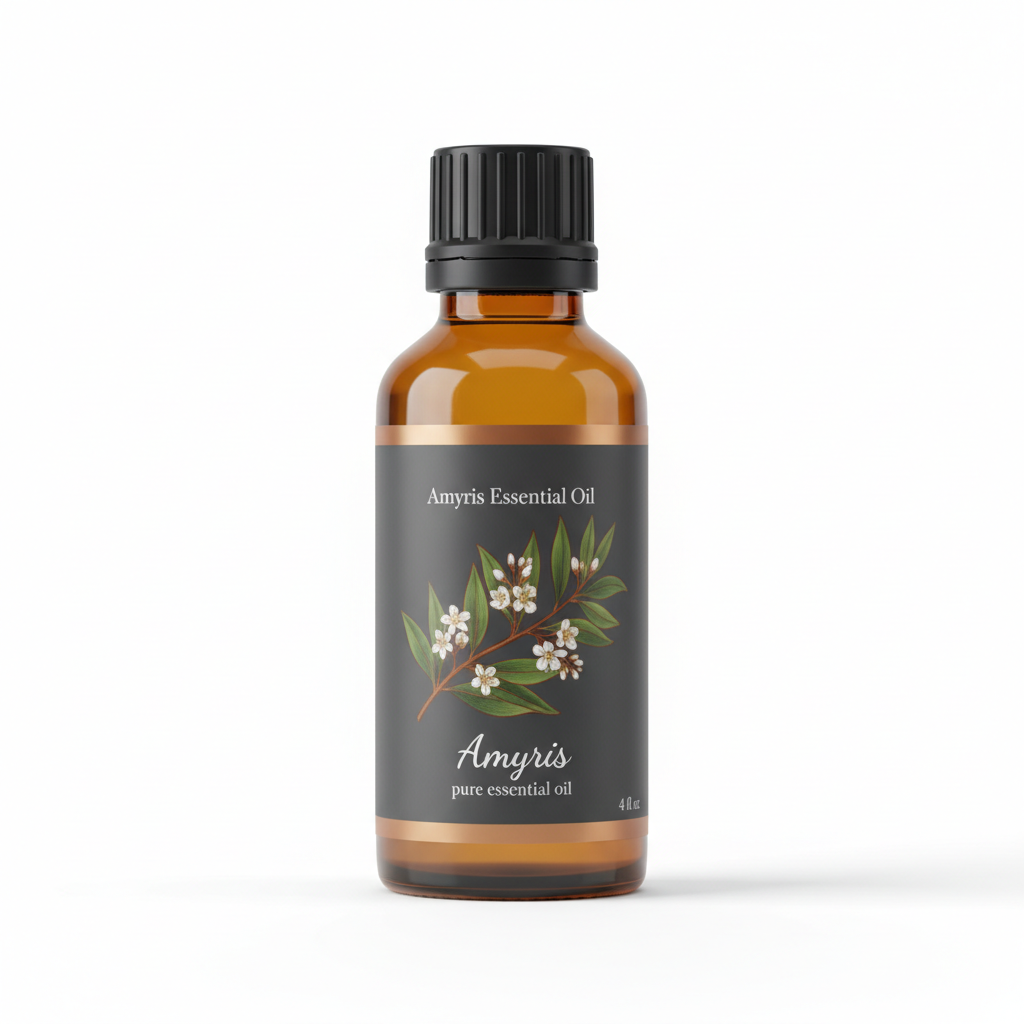
Amyris Essential Oil
Our own Amyris Essential Oil, in sizes from 0.5 oz to bulk.
From $20.99
Shop Now →The position we start from
Our advice is to regard every essential oil, including ours, as a concentrated material and not as a plant-flavored product. The Tisserand Institute, safety guidelines (undated page, read October 2026) puts the concentration in the bottle at "50-100 times more concentrated" than in the plant, and calls undiluted application the most common cause of skin reactions. Reasoning from that figure, the practical consequence is that a drop of oil on a hand is a much larger dose of the plant's chemistry than the plant itself would ever deliver, so the default is dilution, not "a little neat to be sure."
The FDA makes a related point from the regulatory side. Its aromatherapy page says plant-derived materials can be toxic, irritating or allergenic on the skin, that cumin oil is food-safe but can blister skin, and that some citrus oils that are fine in food can be harmful in cosmetics, especially on sun-exposed skin. "Natural" is a description of origin. It is not a safety property.
Skin: irritation and sensitization are different problems
Most online advice treats "a reaction" as one thing. It is two, and they call for different responses. Per the Tisserand Institute, irritation does not involve the immune system and usually results from improper use, mainly too strong a dose. An allergic reaction (sensitization) does involve the immune system, and after it the immune system is "primed, usually for life," so you may have to avoid that oil, and sometimes related oils, indefinitely. Irritation fades if you stop and dilute. Sensitization does not reset.
The step that most guides skip is oxidation. A review by Uter (2017, Allergologie Select) of fragrance contact allergy concluded that hydroperoxides formed when limonene and linalool autoxidize are the major allergens for those two terpenes, that oxidized terpenes were much stronger allergens than the fresh material in animal tests, and that patch tests with oxidized terpenes showed significantly higher sensitization rates. The review is available from PubMed Central. The consequence we draw from it (reasoning, not a finding about any particular bottle) is that an old, warm, half-empty citrus or lavender bottle is a different skin risk from a fresh one, and a bottle that has smelled "off" is better discarded than diluted. For storage specifics see our piece on essential oil shelf life and storage.
Dilution levels belong to the dilution chart, not to a rule of thumb here: see drops per 10 ml, per ounce, and how to calculate your own. For checking a new oil before a full application, see how to patch test essential oils. One limit worth stating plainly: a home patch test can show that a given dilution irritates you today. It cannot rule out an allergy that develops after repeated use, and a dermatologist or allergist is the person who can do clinical patch testing if you have had a reaction and need to know why.
Light: some oils turn on sun-exposed skin
The FDA warning above about citrus on sun-exposed skin is the short version of phototoxicity: certain compounds in some oils, applied to skin that then meets sunlight, can cause burns or lasting discoloration. Which oils, at what levels, is a list problem, and it is covered in phototoxic essential oils. We have not found a source naming amyris on a phototoxicity list, and absence from the sources we read is not a clearance. If a product you use on skin has a citrus component, ask a dermatologist or pharmacist about sun exposure.
Air: diffusing is not the same as inhaling a bottle
The Tisserand Institute's guidance for diffusers is "30-60 minutes on, then 30-60 minutes off," some fresh-air exchange whenever oils are used, and no direct, intensive inhalation (steam inhalation, for example) for longer than 15 to 20 minutes. It also says oils have not been recorded as triggering asthma in the way perfumes have, while noting anecdotal reports that some oils may trigger attacks in people with asthma. That is a cautious, hedged position, and we would read it that way: no one has shown that a diffuser is harmless to a person with reactive airways, and no one has shown that it is dangerous for everyone. A pulmonologist or allergist is the right person for anyone whose asthma is active. We take the questions of babies, pets and run times further in is diffusing essential oils safe.
Essential oils are also flammable, and the same Tisserand page says not to use them near open flames. That matters for people who warm oils on a stove or burn them in a candle-style burner.
Swallowing: where the sources disagree with each other
This is the one place where our position is stricter than a source we otherwise rely on. The Tisserand Institute page states that "one or two drops of most essential oil can be safely taken in a day," but advises against ingestion unless a qualified practitioner recommends it. Poison control sees the other end of the same story: the National Capital Poison Center's essential oil poisoning page notes that swallowed oils can be toxic, that oil entering the lungs while choking or vomiting can cause pneumonia, that oils can interact with medications, and gives the case of a 22-month-old who had a seizure lasting over an hour after eating camphor and spent four days in hospital. We do not recommend swallowing any essential oil, and our amyris is not sold or described for internal use. Reasoning from the two sources together: even if a "drop or two" is tolerable for some adults, the margin disappears when the drop is not measured, when the oil is camphor or wintergreen, or when the swallower is a toddler. The long version is in can you ingest essential oils. The professional to ask is a pharmacist or physician, particularly if you take medication.
The one-page summary
| Situation | What the sources we read say | Who to ask |
|---|---|---|
| Skin, undiluted | Most common cause of reactions (Tisserand Institute); not for damaged skin (National Capital Poison Center) | Dermatologist |
| Skin, after a reaction | Allergy is usually permanent for that oil (Tisserand Institute); stop, wash with soap and water (National Capital Poison Center) | Dermatologist or allergist |
| Old or oxidized oil | Oxidized limonene and linalool are stronger allergens than fresh (Uter, 2017) | Discard; pharmacist for questions |
| Sun after citrus oils | Some citrus oils harmful on sun-exposed skin (FDA) | Dermatologist |
| Diffuser | 30-60 minutes on, then off; ventilate (Tisserand Institute) | Pulmonologist or allergist for asthma |
| Swallowing | Aspiration pneumonia, seizures, drug interactions (National Capital Poison Center) | Poison control, pharmacist |
| Pregnancy | Consult a doctor first (Tisserand Institute); evidence thin | OB-GYN or midwife |
| Children | Keep out of reach; ingestion is the main hazard | Pediatrician, poison control |
| Pets | Cats most at risk; concentrated oil never on pets (Pet Poison Helpline) | Veterinarian |
The people and animals who need extra care
Three groups get their own pieces because the answers do not fit in a paragraph. For pregnancy, the evidence is thin and the sources split, so the honest summary is to ask your OB-GYN or midwife before use: see essential oils during pregnancy. For children, the data are mostly poisonings, which makes storage the first control: see essential oils and kids. For animals, cats are the species most often named as at risk: see essential oils and pets.
Two numbers show why storage deserves its own line. A 2001 review in Paediatrics & Child Health by Flaman and colleagues (PubMed Central) examined poison centre calls from Toronto over December 1995 to March 1997 and found 251 children aged 1 to 5 years who had swallowed an essential oil or an oil-based product, such as eucalyptus oil or camphorated oil; 76 of them (29%) were referred to acute care and two had seizures. Separately, the Tennessee Poison Center at Vanderbilt reported in 2016 that essential oil exposures there had doubled between 2011 and 2015, with about 80 percent involving children (Vanderbilt University Medical Center news, 2016). That second figure comes from a poison center's own reporting, not a published study, and it covers one state, so read it as a signal and not a national rate.
People taking prescription medicines, or with a liver, kidney or seizure condition, belong in a fourth group. The poison center page above notes that essential oils may interact with medications, and none of the sources we read gives a general rule for it. The person to ask is a pharmacist, who can check a specific oil against your specific list.
Storage, and what we do on our side
Here we can say only what is documented. Our oil is pure Amyris balsamifera, undiluted and with nothing added, and it ships in amber glass with a lot number and two dates (still date and fill date) on the bottle. The lot number is what lets us send the independent laboratory report for that lot on request. Our shop guidance is a typical shelf life of 4 to 6 years unopened, kept cool and dark; to dilute to 0.5% to 2% in a carrier oil; to patch test first; to keep it away from eyes, children and pets; and not to take it internally. We make no medicinal claim for amyris.
One honest note on that dilution range. Our shop copy gives 0.5% to 2% for skin. The sources we could read do not give an amyris-specific maximum: the Tisserand Institute's age-by-age dilution chart is an image we could not read, and its text carries no percentages. Where skin is sensitive, damaged, or belongs to a young child or a pregnant person, use the low end of our range or less, and ask the professional named above.
We have no child-resistant cap claim to make, and we do not state cap type. The Tisserand Institute advises that oils be sold with child-proof caps and kept where young children cannot reach them, so if the bottle you hold has no such cap, keep it up high or locked away regardless.
If something goes wrong
- Swallowed, or on a child's mouth: call poison control at 1-800-222-1222 (free, confidential, 24 hours, per the National Capital Poison Center) or use its online tool. Do not wait for symptoms.
- Skin reaction: stop using it, wash the oil off with soap and water. The poison center page adds that hydrocortisone can be considered if a rash persists. Any allergic reaction with difficulty breathing is an emergency.
- Eyes: the Tisserand Institute says undiluted oil should not go in the eyes. We did not find a first-aid protocol for eye splash in the sources we opened, so go straight to poison control or an eye-care professional.
- Pet exposed: do not induce vomiting because of aspiration risk, and call a veterinarian or the Pet Poison Helpline at (855) 764-7661, which the helpline lists as available 24 hours.
What this guide cannot tell you
It cannot clear any oil for a person with a medical condition, because that is a judgment for your own physician or pharmacist. It cannot give an amyris-specific toxicity figure, because we did not find one in a source we could read. And it cannot replace the label of whatever else is in your cabinet: the poisoning sources above name camphor, eucalyptus, wintergreen and tea tree, not woody base notes, and an oil that is lower-risk is not a risk-free one. If you are choosing between oils, how to choose essential oils covers what to look for, and our own amyris safety basics applies this to a single oil.
Amyris Essential Oil
Amyris Essential Oil from our own shop, in sizes from 0.5 oz to bulk.
From $20.99
Shop Now →Sources & Further Reading
- Tisserand Institute, undated page, read October 2026. Safety guidelines. tisserandinstitute.org
- FDA, undated page, read October 2026. Aromatherapy. fda.gov
- National Capital Poison Center (Poison Control), undated page, read October 2026. Essential oil poisoning. poison.org
- Uter W, 2017. Contact allergy to fragrances: current clinical and regulatory trends. Allergologie Select 1(2):190-199. pmc.ncbi.nlm.nih.gov
- Flaman Z, Pellechia-Clarke S, Bailey B, McGuigan M, 2001. Unintentional exposure of young children to camphor and eucalyptus oils. Paediatrics & Child Health 6(2):80-83. pmc.ncbi.nlm.nih.gov
- Vanderbilt University Medical Center, 2016. Tennessee Poison Center news on essential oil exposures. news.vumc.org
- Pet Poison Helpline, undated page, read October 2026. Essential oils and cats. petpoisonhelpline.com