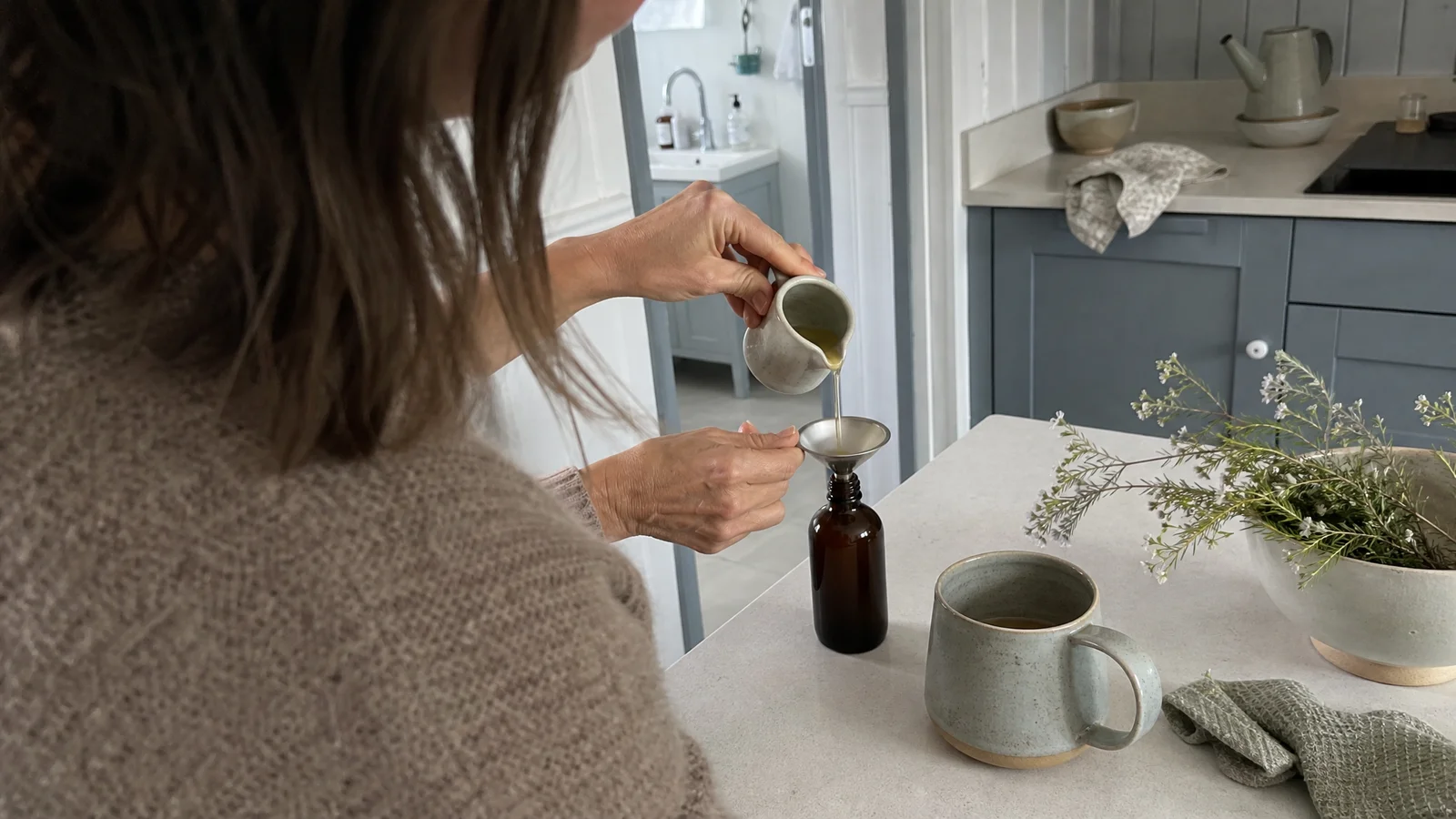
Essential Oil Dilution Chart: Drops per 10 mL, Ounce and 60 mL
The percentage is the safety number on an essential oil dilution chart. The drop count is only a way of reaching it, and drops are not a fixed unit: the Tisserand Institute's own review found that the number of drops in a milliliter ranged from about 20 to 40 across the studies it looked at. This page gives the arithmetic, a table you can rebuild for any bottle, the percentages published for different uses, and the most common way a correct-looking recipe ends up at the wrong strength.
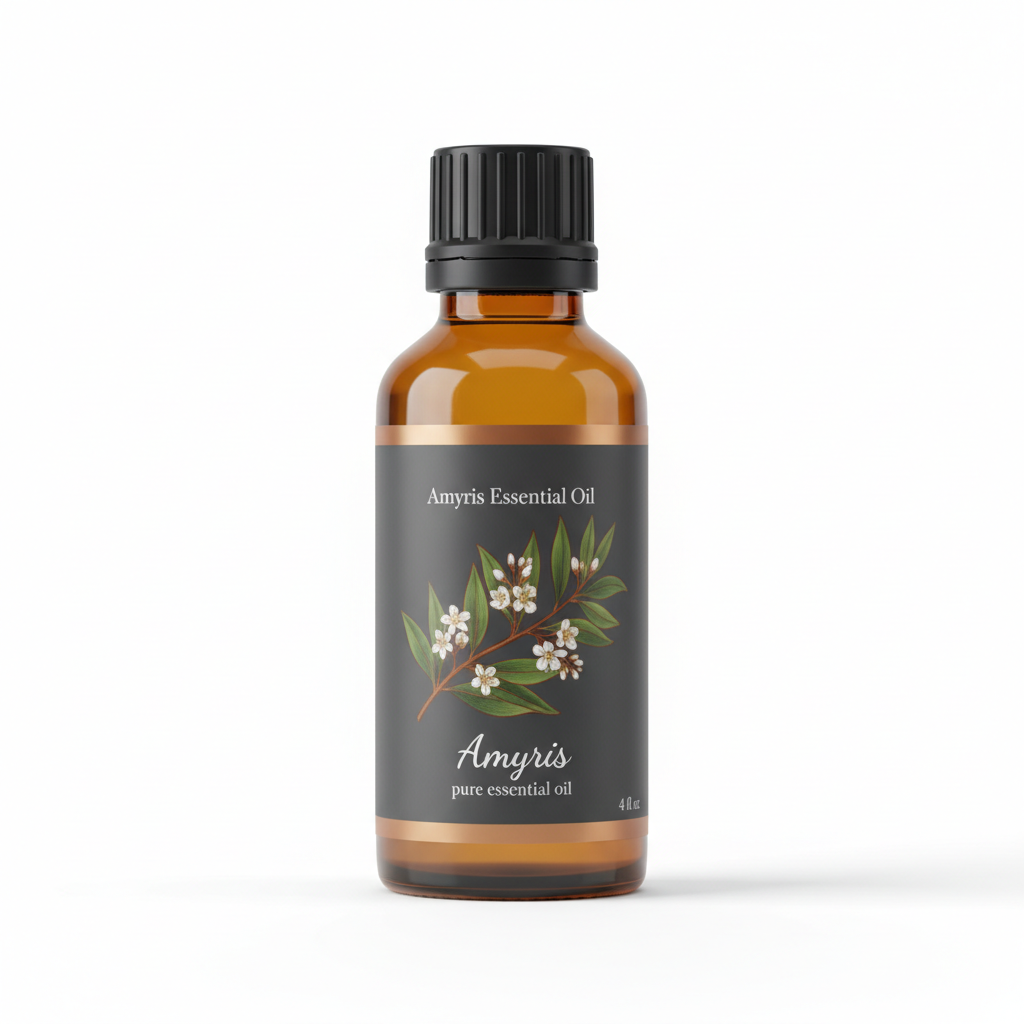
Amyris Essential Oil
Our own Amyris Essential Oil, in sizes from 0.5 oz to bulk.
From $20.99
Shop Now →The formula, and the one assumption behind every chart
Drops of essential oil = (volume of finished blend in mL) x (drops per mL) x (percent / 100).
Everything hangs on "drops per mL." Tisserand Institute, “How big is a drop?” reports three studies (from 1999, 2000 and 2016) in which 20 drops of essential oil averaged 0.66 g regardless of dropper style, which at 30 drops would be about 0.99 g, "a close equivalent to 1ml." The Tisserand Institute's dilution chart is built on 30 drops per mL, and the article calls a drop "never a precise measure" while saying that outside clinical settings the average is safe to use. It also advises picking weight or volume for a given formulation and not mixing the two. One US fluid ounce is 29.57 mL (NIST SP 811, Appendix B.8), so in the 30 mL column below an "ounce" bottle is very slightly smaller than the column.
The table, at 30 drops per mL
Values are drops of essential oil for the finished volume shown, calculated with the formula above. Where the answer ends in .5, round to a whole drop and accept the small error, or switch to weighing.
| Dilution | 10 mL | 30 mL (about 1 oz) | 60 mL (about 2 oz) |
|---|---|---|---|
| 0.5% | 1.5 | 4.5 | 9 |
| 1% | 3 | 9 | 18 |
| 1.5% | 4.5 | 13.5 | 27 |
| 2% | 6 | 18 | 36 |
| 3% | 9 | 27 | 54 |
| 5% | 15 | 45 | 90 |
Our bottle sizes start at 0.5 oz, but the chart does not depend on the brand or size of your oil bottle: it is the size of your finished blend that matters, and the same arithmetic works for any oil.
Where the common mistake comes from
A recipe or chart that gives drop counts without stating its drop size cannot be checked. Compare the same blend at 20 drops per mL:
| Dilution | 10 mL | 30 mL | 60 mL |
|---|---|---|---|
| 0.5% | 1 | 3 | 6 |
| 1% | 2 | 6 | 12 |
| 1.5% | 3 | 9 | 18 |
| 2% | 4 | 12 | 24 |
| 3% | 6 | 18 | 36 |
| 5% | 10 | 30 | 60 |
Worked example, from the arithmetic alone. A recipe built on the 30-drop assumption says 18 drops in 30 mL for 2%. If your dropper delivers 20 drops per mL, 18 drops is 0.9 mL of oil in 30.9 mL of blend, which is about 2.9%, not 2%. If your dropper delivers 40 drops per mL, the same 18 drops is about 1.5%. Both errors are within the 20 to 40 range the Tisserand Institute reports. A single dropper can therefore move you across one of the published ranges in the next section.
Our advice, reasoning from that arithmetic: pick the percentage first, then measure the oil by weight with a 0.01 g scale if you have one (the Tisserand Institute names this as acceptable), or measure it by volume with a graduated pipette, and use drops only for small trial batches. Count the drops of your own dropper into a measured 1 mL once, and use that number in the formula.
Which percentage for which use
In his article on dilution, Robert Tisserand, Tisserand Institute sets out six ranges and calls them guidelines, not rules, with exceptions possible. They are:
| Use | Range | Note from the source |
|---|---|---|
| Reaction-prone or impaired skin | 0.2-1% | Monitor closely |
| Facial cosmetics, deodorants, underarms | 0.5-1.2% | Face and underarms are sensitive areas |
| Body oils and lotions | 1-3% | Used for body massage; matches fragrance levels in commercial personal care |
| Bath and wash-off products | 2-4% | Soap, body wash, bath or shower products |
| Spot application (acne, wounds) | 2-10% | Based on concentrations in research; reported as a guideline, not a recommendation from us |
| Rollerballs for pain or "feel good" | 3-10% | Small areas assumed |
Two cautions on that table. The upper bands (2-10% and 3-10%) come from the source's reading of research and use on small areas; we would not make them a starting point, and we are not recommending any oil as a treatment for acne, wounds or pain. See a dermatologist for skin problems and a physician for pain. Second, the same article says that the figures given for specific oils, such as the 2% lemon oil limit set to avoid phototoxicity, are "the safe maximum, not a recommended amount."
The Tisserand Institute also publishes a dilution chart by age for children, which it describes as general guidelines with exceptions. The figures are in an image on its page that we could not read as text, so we do not reproduce them. Use Tisserand Institute, recommended dilutions for children directly, and ask a pediatrician before putting any essential oil on a child. For a broader view, see essential oils and children.
Oils that need a lower number than the table
The ranges above are not licenses. The Tisserand Institute dilution chart page lists some oils with lower caps: clove bud no more than 0.5% and holy basil up to 1%, to avoid skin allergy, and lemon no more than 2% and grapefruit up to 4% to avoid phototoxicity (see phototoxic essential oils). A Tisserand Institute survey of cinnamon bark and cassia oils reported 27% adverse reactions among respondents, and said undiluted use raised the risk. That is a self-selected survey, not a population rate, but it shows why a per-oil check beats a single number. With any new oil, look up its own limit before you use a general range.
A related point from the Tisserand Institute's irritation and allergic reactions page: irritation usually resolves within hours, while an allergic reaction may persist for days or weeks and can appear after an earlier uneventful use. A greater dilution usually prevents irritation from recurring but may not prevent a subsequent allergic reaction. Frequency matters too: the same page advises against using the same oil or blend above 5% for months or years, and suggests that high-risk people start near 1% and raise in 0.5% steps. Do a patch test first (how to patch test).
What we say about amyris
For our own oil, our shop guidance is to dilute to 0.5% to 2% in a carrier oil, patch test first, keep it away from eyes, children and pets, and not take it internally. That is our guidance for our product, not a published limit from Tisserand or IFRA; we have not verified an amyris-specific maximum from those sources, so the general ranges above and your own skin are the checks. Reasoning from the table, we would use the lower end for the face and for anyone whose skin reacts easily, because the Tisserand Institute's face range tops out at 1.2%, below our 2% ceiling. In the 30 mL column that means 4 to 5 drops of amyris at 0.5% and 9 at 1%, with the caveat about dropper size above. More on the oil in amyris oil safety basics.
Amyris is not a replacement for professional advice in pregnancy, for children, or for a skin condition, and we do not claim a safe level for those cases; talk to an OB-GYN or midwife, a pediatrician, or a dermatologist. A carrier oil is something you buy elsewhere, since we sell only amyris oil; choose one in our carrier oil guide. For roll-on formats, which usually run stronger than massage oils, see essential oil roller blends, and for the wider safety picture, the essential oil safety guide.
The practical takeaway: decide the percentage for the use and the skin, calibrate your dropper once, and treat every chart, including this one, as arithmetic on an average drop.
Amyris Essential Oil
Amyris Essential Oil from our own shop, in sizes from 0.5 oz to bulk.
From $20.99
Shop Now →Sources & Further Reading
- Tisserand Institute. How big is a drop? tisserandinstitute.org
- Tisserand, R. Dilution for essential oils. Tisserand Institute. tisserandinstitute.org
- Tisserand Institute. Essential oil dilution chart. tisserandinstitute.org
- Tisserand Institute. Irritation and allergic reactions. tisserandinstitute.org
- Tisserand Institute. New survey reveals dangers of not diluting essential oils. tisserandinstitute.org
- Tisserand Institute. Recommended dilutions for children. tisserandinstitute.org
- NIST. Special Publication 811, Appendix B: conversion factors (B.8). nist.gov