Base Note Essential Oils: What the Label Means and Nine to Know
A base note oil is one whose scent is still there at the end, after the brighter materials have gone. That is a statement about lasting power, not about depth or warmth, and it is why some oils sold as "base notes" are really middle notes with a long tail. This list covers nine materials that perfumery references treat as base or fixative materials, says which ones are essential oils at all, and says where our own amyris oil fits and where it does not.
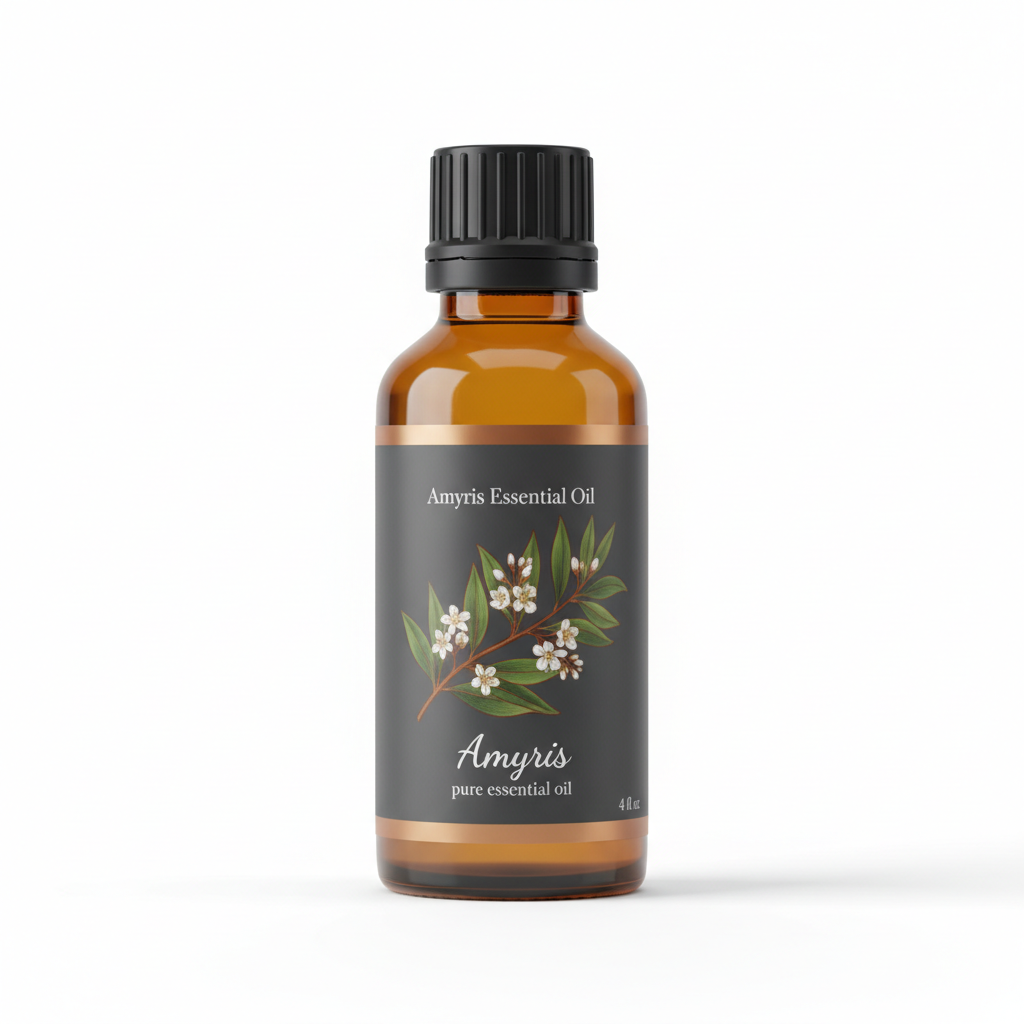
Amyris Essential Oil
Our own Amyris Essential Oil, in sizes from 0.5 oz to bulk.
From $20.99
Shop Now →What "base note" is really saying
Steffen Arctander's 1960 reference on natural perfume materials does not use the word "base." He tracks an oil on a perfume blotter through three stages: the topnote, the body-note and the dry-out. The dry-out, he writes, "tells us about the Tenacity of the perfume material," and for some oils it does not show within the day: patchouli, vetiver and a few others, he says, need "at least 24 hours of study." So a base note, in his terms, is a material with a body-note and dry-out that outlast the others.
Online databases try to put a number on this. The Good Scents Company, a perfumery reference database, gives a "substantivity" in hours for most materials. The values we read there are in the table below. They are listed without any stated method, and four unrelated materials share the same figure, so treat them as entries, not measurements.
| Material | Listed substantivity |
|---|---|
| Amyris wood oil | 400 hours |
| Vetiver oil, Haiti | 400 hours |
| Patchouli oil | 400 hours |
| Sandalwood oil (Santalum album) | 400 hours |
| Cedarwood oil, Virginia | 388 hours |
| Cedarwood oil, Atlas | 192 hours |
Reasoning from those entries: an identical 400 hours (about 17 days) for four different materials looks like a ceiling or default, not a measurement, and it sits well under Arctander's report that patchouli stays "perceptible on a perfume blotter for weeks or months." We would use the table to see that these oils are all at the slow end, and not to rank them against each other.
The nine, in the order you would meet them
Amyris (Amyris balsamifera)
Our oil, and the one we can speak to as a process: wood gathered as fallen branches and pruning by-product from farms in Haiti, aged in the sun, heartwood only, steam distilled by us. Our own description of the scent is creamy, woody, balsamic with a soft vanilla undertone. Arctander's 1960 description is different in emphasis: "faintly woody, not dry," slightly oily-sweet and balsamic, with a "very tenacious" body odor that "rapidly loses the rich, complex odor, fading out in a very weak, woody-balsamic note," varying with the age of the oil and the wood. He lists amyris among "so-called fixatives" whose effect is physical, and calls it a "mild blender." Where it fits: a quiet foundation under citrus, floral or spice oils, as in our guides to amyris in perfumery and blending amyris. Where it does not: when you want the base to supply a strong, distinctive dry-out by itself.
Vetiver (Vetiveria zizanoides, root oil)
Arctander describes the oil as "sweet and very heavy woody-earthy, reminiscent of roots and wet soil." He attributes the faint but tenacious sweet-woody odor to vetiverol and the bitter earthiness to vetiverone. He also records a 1960 trade convention that deserves a plain mention: "5% amyris oil is added to all locally produced vetiver oils before these are exported from Haiti." That is a historical statement about one trade in one year, not a claim about any oil sold today. Our amyris versus vetiver post compares the two directly.
Patchouli (Pogostemon cablin, leaf oil)
Arctander: "extremely rich, sweet-herbaceous, aromatic-spicy and woody-balsamic," with "tenacity in odor" as "one of the typical virtues." He adds that the oil "improves significantly upon ageing," and that distillation location matters: European or American distilled oil differs from the locally distilled oil. Strength is the practical issue; he calls the sweetness "almost sickening in high concentration."
Cedarwood, Atlas (Cedrus atlantica)
Arctander finds it "not exactly pleasant when undiluted": "slightly camphoraceous-cresylic with a sweet and tenacious woody undertone, reminiscent of cassie and mimosa." It is, he says, "widely used in perfumery for its fixative effect," and "one of the most inexpensive essential oils entering the European market."
Cedarwood, Virginia (Juniperus virginiana)
Oily-woody and almost sweet at first, becoming "drier and more woody, less balsamic" as it dries out on a blotter. His main perfumery use for it: a "fixative and cost-reducer" for vetiver, sandalwood and patchouli oils. The two cedarwoods are different trees and different oils; Arctander calls the Atlas oil "entirely different, chemically and olfactory," from the American ones.
Sandalwood, East Indian (Santalum album)
"Extremely soft, sweet-woody and almost animal-balsamic," with "little or no particular topnote" and uniform for a long time because of its tenacity. Two supply facts matter for a buyer. The Tisserand Institute page by Robert Tisserand (undated page, read October 2026) calls it a threatened species in Asia after decades of over-harvesting and smuggling and says wild trees need at least 30 years to mature enough for oil. Arctander lists amyris among the oils sometimes used to adulterate it. For that reason we say plainly that our oil is not sandalwood and we will not price or describe it as though it were.
Benzoin (resin, not an essential oil)
Arctander's example of a "true fixative," and he describes Siam benzoin as "sweet-balsamic with a distinct note of vanillin." He also states that the volatile content of benzoin is negligible and that an essential oil is not commercially available. If a product is labeled "benzoin essential oil," ask the supplier what it actually is. We do not sell benzoin or any resin product.
Labdanum and frankincense (resins; the oils behave differently)
Labdanum appears in Arctander as resin absolutes and resinoids, used as "a general fixative with a distinct sweetening effect and an ambra-type odor." Olibanum (frankincense) is the instructive case. The resinoid he calls "a valuable fixative." The oil, though, he describes as "strongly diffusive, fresh-terpeney, almost green-lemon-like," with a sweet-woody balsamic undertone, and a dry-out whose tenacity depends on how it was distilled. So frankincense is a base note in resin form and closer to a middle note as an oil.
Which "base notes" are really middle
Based on Arctander's descriptions, the clearest examples are frankincense oil (diffusive and terpene-fresh, as above) and cypress oil, which he says has a refreshing odor but "a unique dryout of delicate and tenacious sweetness." If you want a dependable foundation, choose from the woods, roots and resin-derived materials, and test the oils sold as bases on a blotter for a full day, as he advises for patchouli and vetiver. For how to evaluate across a day and keep a log, see how to blend essential oils.
Safety lines, from what we could read
None of this replaces the supplier's safety data sheet for the specific lot. The Good Scents Company compiles supplier and older IFRA data, so confirm any limit against a current sheet. As listed there: sandalwood oil carries skin irritation, skin sensitization, eye irritation and respiratory irritation hazard statements; Atlas cedarwood oil has a recommended maximum of 8% in a fragrance concentrate with dermal sensitization as the critical effect and a warning that it may be fatal if swallowed and enters the airways; Virginia cedarwood, Haiti vetiver and amyris wood oil are each listed as irritants to skin and eyes. The patchouli page we read lists no hazard classification. For amyris on skin, our guidance is a dilution of 0.5% to 2% in a carrier oil, patch tested first, away from eyes, children and pets, and not taken internally; see the dilution chart. Ask a pharmacist or dermatologist if you have a skin condition, and an OB-GYN or midwife if you are pregnant.
Choosing among them
- You want a quiet, rounded foundation that does not take over: amyris or Virginia cedarwood, by Arctander's descriptions.
- You want a dry-out that is itself a feature: vetiver or patchouli, with the 24-hour test, and patience for aging.
- You want sandalwood itself: buy it from a source that publishes a gas chromatography report and can explain its supply, and expect to pay accordingly; amyris is not a substitute for that scent.
- You want a sticky, long-lasting resin base: benzoin, labdanum or an olibanum resinoid, bought as resin products from a perfumery supplier.
What we cannot give you is a ranking. We have no smell panel and no wear tests, and the figures above are a perfumery author's descriptions from 1960 and a database's entries. For what fixation does and does not do, read natural perfume fixatives; for the woods side by side, see woody essential oils compared.
The useful habit is the one Arctander describes: put the oil on a blotter, come back at an hour, at several hours and the next day, and write down what remains. That tells you whether an oil is a base for your blend, whatever label it carries.
Amyris Essential Oil
Amyris Essential Oil from our own shop, in sizes from 0.5 oz to bulk.
From $20.99
Shop Now →Sources & Further Reading
- Arctander S., 1960. Perfume and Flavor Materials of Natural Origin (full text). archive.org
- The Good Scents Company, entries read October 2026: amyris wood oil. thegoodscentscompany.com
- The Good Scents Company, entry read October 2026: vetiver oil Haiti. thegoodscentscompany.com
- The Good Scents Company, entry read October 2026: patchouli oil. thegoodscentscompany.com
- The Good Scents Company, entry read October 2026: sandalwood oil (Santalum album). thegoodscentscompany.com
- The Good Scents Company, entry read October 2026: cedarwood oil Virginia. thegoodscentscompany.com
- The Good Scents Company, entry read October 2026: Atlas cedarwood oil. thegoodscentscompany.com
- Tisserand R., Tisserand Institute, undated page, read October 2026. Santalum Album Oil Rejuvenated. tisserandinstitute.org