DIY Aromatherapy Inhaler: Safe Drop Counts and Blends
The part of a homemade aromatherapy inhaler that needs the most thought is not the blend, it is the tube. The Tisserand Institute advises discarding plastic inhalers after 2 to 3 weeks of use because undiluted essential oil may degrade plastic and leach plasticizers that you then breathe in, and suggests glass or aluminum where possible. Everything below is built around that: a short-lived wick, a durable tube, small amounts of oil, and no contact with skin or eyes.

Amyris Essential Oil
Our own Amyris Essential Oil, in sizes from 0.5 oz to bulk.
From $20.99
Shop Now →How a personal inhaler works, and why the oil is undiluted
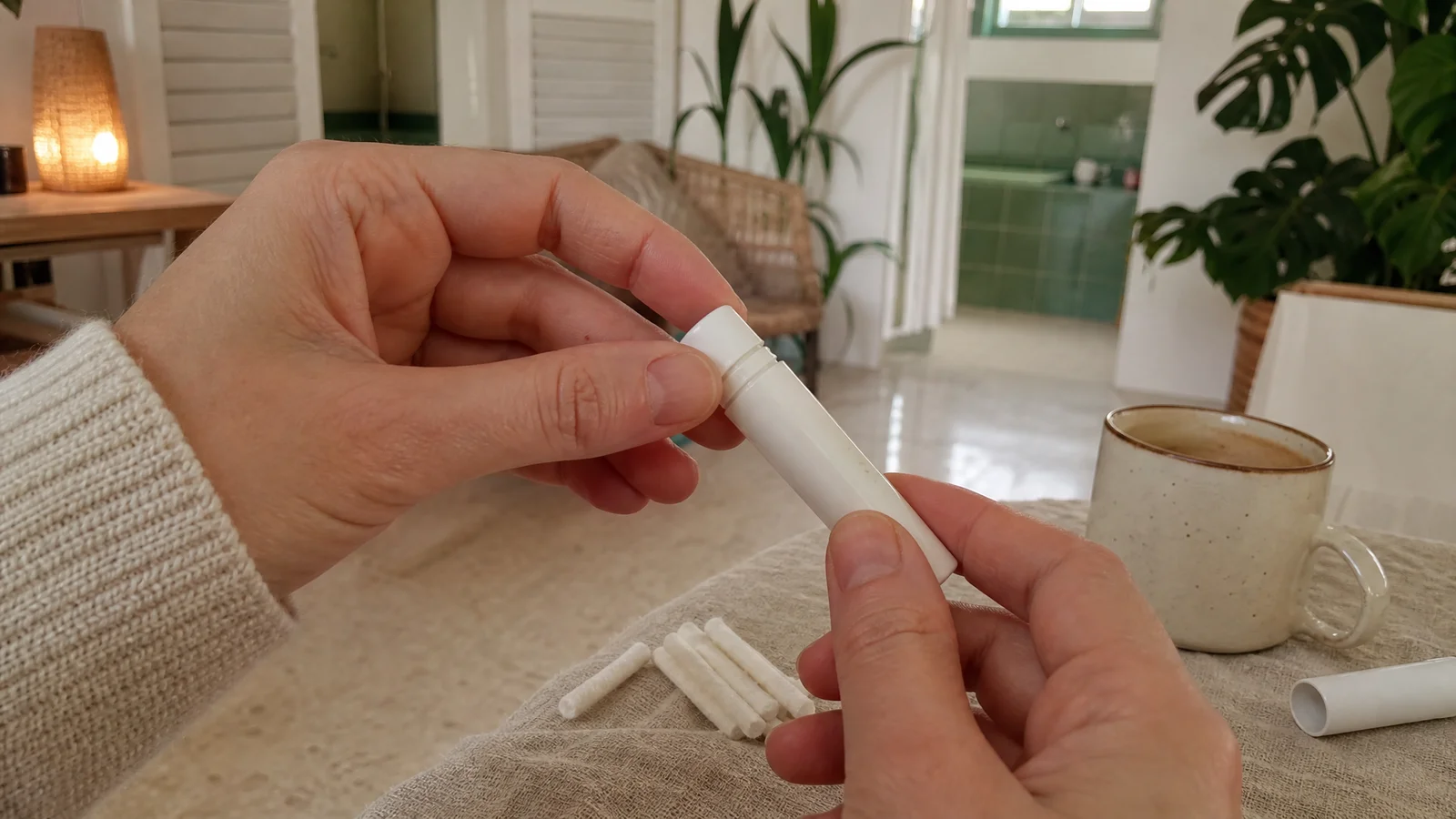
A personal inhaler stick, as the Tisserand Institute describes it in its guide to essential oil inhalation, is a tube with an opening at the top and smaller openings at the bottom for air intake, holding a cotton wick that has been dipped in essential oil, with a cap to protect it. You remove the cap and "actively inhale" from it, so you control how deep a breath you take and how much you inhale. There is no water, no heat and no electricity. Two consequences follow. The oil on the wick is undiluted, so the dilution percentages used for skin products do not apply (see the essential oil dilution chart for those). And the dose is set by how many drops you put on the wick and how often you sniff, which is why a conservative starting amount is the main safety decision you make.
Drop counts: what is sourced and what is reasoning
We did not find a published drop count for inhaler wicks. The Tisserand Institute's inhalation guide gives drop figures for other methods (2 to 5 drops for steam inhalation, and "no more than 2-3 drops" for a clothing patch) but none for inhaler sticks, and a wick's capacity depends on its size, which we cannot know for a blank you bought elsewhere. Reasoning from the clothing-patch figure, which is the nearest cited number for undiluted oil held near the face, our advice is to begin with 3 drops in total, sniff from about an arm's length, and add one drop at a time on later days only if the scent is too faint to notice. If you reach 6 drops on a wick, the likelier fix is a better-fitting or fresher wick, not more oil. That range is a starting formula, not a tested amount, and we have not trialled any of the blends below.
Drops are an imprecise unit. The Tisserand Institute's review of three drop-size studies (1999, 2000 and 2016) found 20 drops of essential oil averaged 0.66 g and the number of drops in a milliliter varied from about 20 to 40. So "3 drops" is somewhere between 0.075 and 0.15 mL, and ratios by drop are approximate when you use two different bottles with differently sized dropper inserts. For three or more inhalers, mix a small stock in a clean glass vial and dispense from that, so every wick gets the same ratio. At the Tisserand Institute's 30 drops per mL assumption, a stock of 20 drops of amyris and 10 drops of sweet orange is about 1 mL in total, and each inhaler then gets 3 drops of that stock (a 2:1 amyris to orange ratio, 2 drops amyris and 1 drop orange).
Three starting formulas, by drop
These are arithmetic starting formulas worked out from the amounts above. They are untried by us and not trialled in any test. Each totals 3 drops. Amyris comes from us; the citrus and any other oils you buy from a supplier of your choice, as we sell only amyris. We also sell no inhaler blanks.
| Blend | Amyris | Sweet orange | Lemon | What you are aiming for |
|---|---|---|---|---|
| Woody and warm | 2 | 1 | 0 | A creamy, woody, balsamic scent lifted slightly by citrus |
| Bright desk blend | 1 | 0 | 2 | Mostly citrus with a woody base so it lingers; amyris is a base note and helps citrus top notes hold |
| Travel | 1 | 1 | 1 | An even three-way split that is easy to count in a hurry |
The aim column describes scent, not a health effect. We make no claim that any of these blends relieves, reduces or improves anything. If you want a blend for concentration or for winding down, the evidence for those uses is covered in essential oils for focus and essential oils for stress, and it is modest.
Build it: a short, careful sequence
- Choose a tube. Glass or aluminum, per the Tisserand Institute's suggestion. If you use plastic, label the date and plan to discard it after 2 to 3 weeks.
- Prepare the blend away from the face. Open the bottle only at arm's length, keep the oil off your skin, and wipe up spills; undiluted oil on skin is exactly what the dilution rules exist to avoid. See patch testing if you ever do put a diluted blend on skin.
- Drop the oil onto the wick, not into the tube. Count drops out loud. Use the number from the table, not a guess.
- Seal and label. Write the blend and the date on the tube or on tape. A cap that is not fully on lets the scent leave, and a loose inhaler in a bag leaks onto everything else.
- Use it deliberately. A few slow breaths, a few times a day, is a pattern that matches how the Tisserand Institute describes active inhalation. It does not give a number of breaths, so none is stated here.
When to refresh, and when to start over
Volatile oils leave a wick over time, so the scent fades. Reasoning from that, re-dose with one drop when you cannot smell it from a few centimeters away, but do not keep topping up the same wick for weeks. The cited limit is on the tube: for plastic, the 2 to 3 week replacement. Treat the wick as disposable at the same point and replace both.
Evidence: what inhalers have been studied for
Inhaler-style delivery has been tried in clinical settings. Cathey et al. (2020) ran a feasibility study of lavender via a nasal inhaler in an awake craniotomy setting: 40 patients were approached and 31 completed the study. Anxiety and pain visual-analogue scores trended lower after inhalation, but the differences were not statistically significant. That is a feasibility result in a very specific setting, not evidence for the blends above. The wider evidence picture is in does aromatherapy work.
Limits: who should not make or use an inhaler
- Children. Keep the tube and the oil out of reach of young children and do not make one for a child; ask a pediatrician first. ANSES, the French health safety agency, reported in 2020 that many of its poison-centre cases involved accidental exposure, often in young children. See oils around children.
- Pregnancy and breastfeeding. ANSES advised against essential-oil use for pregnant or breastfeeding women, so ask an OB-GYN or midwife; the page on pregnancy and essential oils goes further.
- Asthma and breathing conditions. The Tisserand Institute lists asthma among the conditions where advice from a doctor or suitable practitioner should come first, and ANSES advised people with respiratory conditions against use. Reasoning from the design, an inhaler puts the oil directly at your nose, so the air you breathe is likely to be more concentrated than in room diffusion.
- Eyes, skin and swallowing. Keep the wick off skin and out of eyes, and never take the oil internally. Our shop page is explicit that amyris is not for internal use; the page on swallowing essential oils explains why.
- Pets. Ask a veterinarian before using any inhaler near animals.
For the general safety habits behind all of this, the essential oil safety guide is the place to start.
A personal inhaler is a small, low-tech way to carry a scent, and its risks come from the undiluted oil and the plastic around it. Keep the amount small, keep the tube clean, and replace it on schedule.
Amyris Essential Oil
Amyris Essential Oil from our own shop, in sizes from 0.5 oz to bulk.
From $20.99
Shop Now →Sources & Further Reading
- Tisserand Institute, undated page (images dated May 2024), read October 2026. The ultimate guide to essential oil inhalation. tisserandinstitute.org
- Tisserand Institute, undated page, read October 2026. How big is a drop? tisserandinstitute.org
- Tisserand Institute, undated page, read October 2026. Main safety guidelines. tisserandinstitute.org
- Cathey K, Gunyon N, Chung N, et al., 2020. A feasibility study of lavender aromatherapy in an awake craniotomy environment. Journal of Patient-Centered Research and Reviews 7(1):19-30. pubmed.ncbi.nlm.nih.gov
- ANSES, 28 April 2020. ANSES calls for vigilance concerning essential-oil based sprays and diffusers. anses.fr