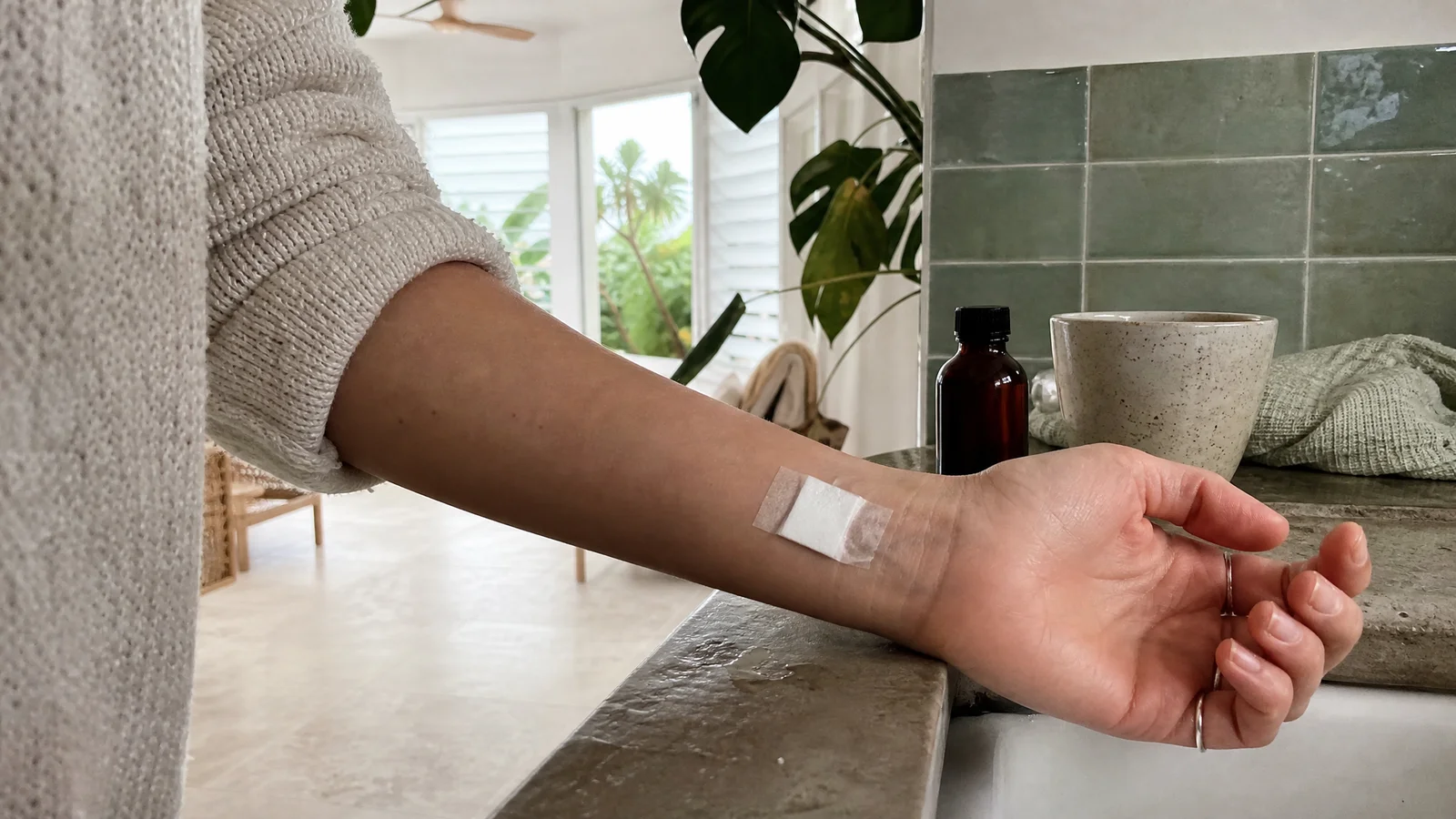
How to Patch Test Essential Oils, and What a Test Can't Show
A home patch test is worth doing and proves less than its reputation says. It can show that a dilution irritates your skin on the day you try it. It cannot clear an oil for the future, because an allergy to an oil only appears after your immune system has been primed by repeated exposure. Our shop guidance says to patch test first, and we stand by that as a cheap screen; the Tisserand Institute's position is more skeptical, and the difference between the two is the useful part of this page.
Amyris Essential Oil
Our own Amyris Essential Oil, in sizes from 0.5 oz to bulk.
From $20.99
Shop Now →What a real patch test is, and what yours is not
The American Academy of Dermatology describes clinical patch testing as small amounts of allergens placed under patches, normally on the back, left in place for 48 hours without being loosened or wetted, with a return visit at 48 hours and a final visit 4 to 7 days later "because it can take time for your skin to develop an allergic reaction." A dermatologist chooses which allergens to test and reads the results. The AAD also says more than 15,000 substances can cause an allergic skin reaction, which is why the panel is chosen by someone who has looked at your history.
What you can do at home is a different thing. The Tisserand Institute's page on skin irritation and allergy (undated page, read October 2026) says "in general we don't recommend" patch testing essential oils at home, for four reasons it gives: it is normally carried out by a dermatologist using specially prepared patches you cannot buy, doing it properly is laborious, it is "not 100% reliable" with occasional false positives and false negatives, and intensive patch testing can itself occasionally produce allergic reactions that would not otherwise have occurred. A drop of diluted oil on the forearm is not those patches, and nobody should read it as an equivalent.
Why a clean result today does not mean much about next month
Irritation and allergy behave differently over time, and the difference decides what a test can see. Tisserand describes irritation as the least troublesome reaction, with inflammation dying down quickly once the oil is removed, and describes sensitization as "the priming of the immune system that subsequently leads to an allergic reaction." DermNet's page on the open application test adds the timing clue: immediate irritation usually points to irritant dermatitis, while allergic reactions often appear several days after application.
Reasoning from those two statements: on a first exposure, a person who has not yet been sensitized has nothing for the test to detect, and a short test reads the irritation question only. That is not hypothetical. A 2020 case report from Singapore (Kwong and Lim, JAAD Case Reports) describes a 57-year-old man whose armpit rash appeared 1 to 2 days after using a roll-on antiperspirant that he had used for about 30 years, and patch testing gave a positive reaction to hydroperoxides of limonene. It is one case, so it shows that allergy can start late, not how often.
How often does it happen with essential oils? In the German IVDK network's 2010 to 2019 data (IVDK network, Contact Dermatitis, 2022), twelve oils were patch tested in 10,930 dermatitis patients and 908 (8.3%) reacted to at least one. Only six oils exceeded 1%: ylang ylang (3.9%), lemongrass (2.6%), jasmine absolute (1.8%), sandalwood oil (1.8%), clove (1.6%) and neroli (1.1%). The authors concluded sensitization occurs, "albeit infrequently in most cases." Two cautions: these were people already attending skin clinics, so the numbers do not describe the general public, and amyris is not among the six named, though the abstract does not say whether it was one of the twelve tested.
The oil in the bottle changes the answer
Oxidized oils are a separate allergy risk. A 2005 study in six European centers (Matura and colleagues, Contact Dermatitis) patch tested 1,511 dermatitis patients and found 1.3% reacted to oxidized linalool, noting that terpenes "are not allergenic themselves but readily form allergenic products on air-exposure." In a 2021 to 2022 audit of 17,359 patients (Uter and colleagues, Contact Dermatitis, 2026), the terpene hydroperoxides produced the most positive reactions of 19 audit allergens: 7.65% for linalool hydroperoxide and 6.78% for limonene hydroperoxide. For a home test the practical consequence is to test the same bottle, at the same dilution, that you will use, and to put the date you opened it on the label. We make no claim about how much of either terpene our oil contains, because we do not publish a composition report.
The method, in order
- Dilute to the strength you intend to use, no stronger. Our shop guidance for amyris is 0.5% to 2% in a carrier oil; for the test, use the lower number. The Tisserand Institute's advice for people with a past allergic reaction to a topical product is to start at about 1% and rise in 0.5% steps, which is a gradual escalation and not a one-off test. For arithmetic see our dilution chart.
- Pick the site. DermNet suggests hairless skin without dermatitis that has not been in the sun recently, such as the forearm, inner elbow, behind an ear or the side of the neck, in an area of about 5 cm by 5 cm.
- Keep it going for a week, not a day. DermNet's open application test is applying the product to the same patch twice a day for one week, because allergic reactions often show up several days in. A 24 to 48 hour test covers only the early part of what a clinical patch test does, since the clinical patch is read at 48 hours and again at 4 to 7 days.
- Hold off if you are taking oral antihistamines, oral steroids or other immune-modulating medicines, or using topical steroids on the site, since DermNet lists them as interfering. A pharmacist can tell you whether your medicines are affected.
- Read it honestly. Redness, dryness, itching or frank dermatitis at the site, at any point in the week, is a result. DermNet calls a normal-looking site at the end of a week evidence that a significant allergy to that product is unlikely, which is narrower than "safe."
If the skin reacts
The Tisserand Institute's adverse-reaction page (undated, read October 2026) says to stop using the oil, remove contaminated clothing, wash with soap and water, preferably unperfumed, for at least 10 minutes, and keep the area out of direct sunlight while remaining oil evaporates. It says to see a doctor if irritation persists, that oral antihistamines can help with itching, and that a barrier cream or mild corticosteroid cream is the usual medical approach: which of those fits you is a clinician's call. Reapplying the same oil can trigger the reaction again. Swelling of the lips, tongue or throat, or difficulty breathing, needs emergency services at once.
Who should see a dermatologist first
If you have had a reaction to a fragrance, a perfume or a cosmetic, have eczema or very reactive skin, or a positive home test, a dermatologist can order formal patch testing and an allergist can look at hives or breathing symptoms. Tisserand names people with one or more past topical allergic reactions as higher-risk. A positive home test is the case where DermNet says formal patch tests may be needed to find the specific allergen. Reasoning from how the test works: the cause may be the carrier oil or another ingredient in the mix rather than the essential oil, so a dermatologist will want to know everything that was on the skin.
What our guidance says, and where it sits against the sources
Our shop copy for amyris says to patch test first, dilute to 0.5% to 2%, and keep it away from eyes, children and pets. The Tisserand Institute's view that home patch testing is not generally recommended is a real disagreement with that wording, and our reading is this: a week-long test costs nothing and screens out an obvious irritant, so we still suggest it, but you should treat the result as narrow and rely more on staying low in strength. For sensitive skin we would stay at the 0.5% end of our range and avoid the top of it. We have no reaction data of our own for amyris, and we did not find published patch-test data for it. See amyris oil safety basics, amyris in lotions and body oils and the general safety guide.
Whatever the result, a skin test is a starting point and not a certificate: keep the strength modest, keep notes on what you used, and stop at the first sign of a reaction.
Amyris Essential Oil
Amyris Essential Oil from our own shop, in sizes from 0.5 oz to bulk.
From $20.99
Shop Now →Sources & Further Reading
- American Academy of Dermatology, undated page, read October 2026. Patch testing for a rash. aad.org
- Tisserand Institute, undated page, read October 2026. Irritation and allergic reactions. tisserandinstitute.org
- Tisserand Institute, undated page, read October 2026. What to do when experiencing an adverse reaction. tisserandinstitute.org
- DermNet, undated page, read October 2026. Open application test. dermnetnz.org
- IVDK network, 2022. Contact sensitization to essential oils: IVDK data of the years 2010-2019. Contact Dermatitis. doi.org (abstract read via Europe PMC record 35417610)
- Matura M and colleagues, 2005. Selected oxidized fragrance terpenes are common contact allergens. Contact Dermatitis. doi.org (abstract read via Europe PMC record 15932583)
- Uter W and colleagues, 2026. Patch test results with additions to the European Baseline Series, 2021/22. Contact Dermatitis. doi.org (abstract read via Europe PMC record 42135251)
- Kwong HL, Lim SPR, 2020. Pigmented contact dermatitis in the axillae caused by hydroperoxides of limonene. JAAD Case Reports 6(6):476-478. pmc.ncbi.nlm.nih.gov