Choosing Essential Oils: What to Check and What Proves Nothing
No label, certificate or single test proves that an essential oil is what the bottle says. What you can build is a chain: a botanical name, a country, an extraction method, a lot number, and an analysis tied to that lot, each of which a seller either supplies or does not. This guide orders the checks the way a buyer can run them, says what each one can and cannot show, and applies them to our own oil, because we sell one (Amyris balsamifera) and you should read everything here knowing that.
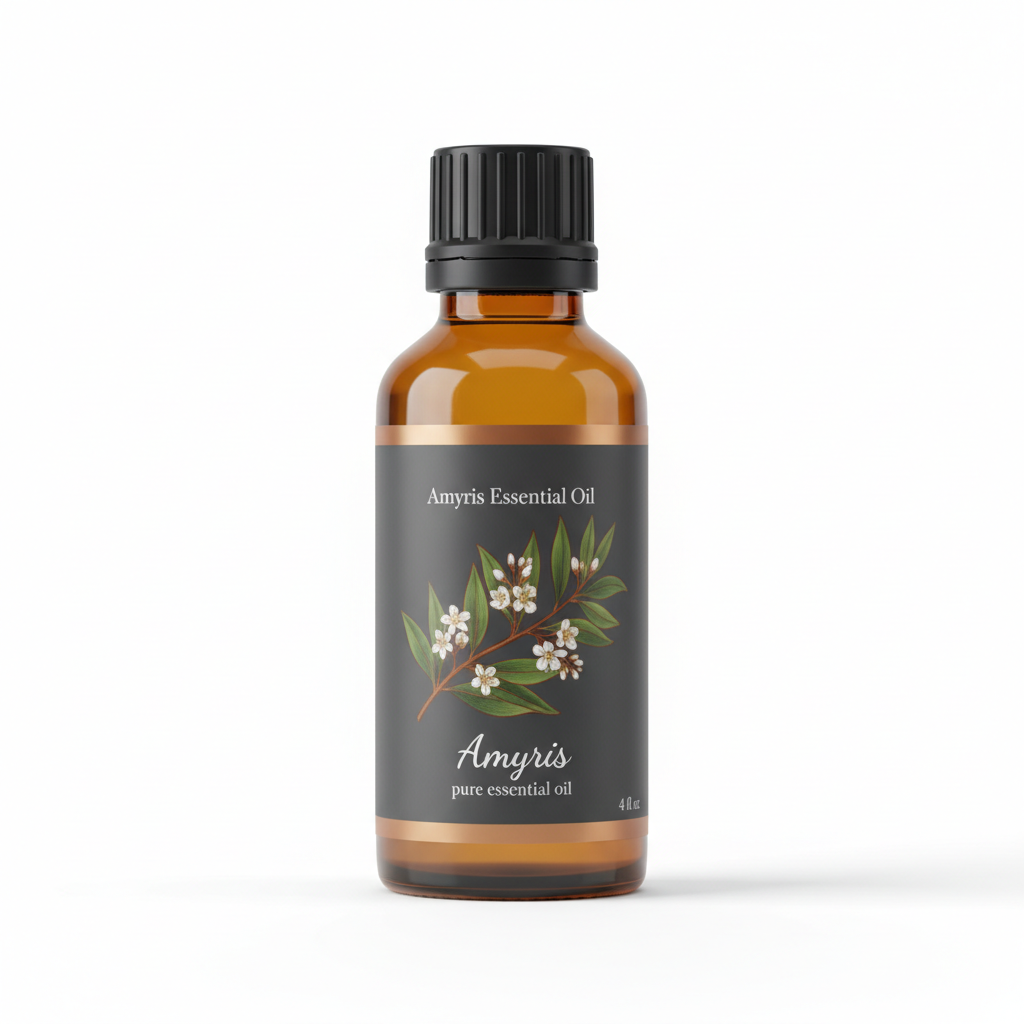
Amyris Essential Oil
Our own Amyris Essential Oil, in sizes from 0.5 oz to bulk.
From $20.99
Shop Now →Where the evidence actually sits
Most buying advice treats purity as a property of the oil. The adulteration literature treats it as a property of a batch, verified by methods that each miss something. A 2021 paper by Capetti and colleagues on lavender, lemon and tea tree adulteration found that the routine screen, GC-MS with normalized peak areas, catches cheaper oils and synthetic additions when marker compounds fall outside reference ranges, but that dilution with vegetable oil leaves the profile and the normalized percentages unchanged. In their lavender sample, spotting the dilution took absolute quantitation, which the authors call difficult and time-consuming, and which they estimated at roughly 40-50% vegetable oil (Capetti et al., 2021). In the tea tree case, a 50:50 mix of Australian and Chinese oil barely moved the normalized 4-terpineol figure; only the enantiomeric ratio gave a clear signal.
The practical consequence is that a document is evidence of a specific kind, and "has a report" is not the same as "is verified." Reasoning from that paper, the useful buying question is not "is it tested?" but "what was measured, on which lot, by whom, and would that method have caught the adulteration that matters for this oil?"
The checks, in the order you can run them
1. Botanical name and plant part
The common name alone is not enough. ISO 4720:2018, the essential oils nomenclature standard, exists to list the botanical names of the plants used to produce essential oils alongside their common names (AFNOR listing for ISO 4720:2018). A Latin binomial is the first green flag on the Tisserand Institute's supplier checklist, and a missing or plainly wrong botanical name is the first red one (Hana Tisserand, Tisserand Institute, undated page, read October 2026). Ask for the plant part too: wood, bark, leaf and flower of one species can give different oils.
A disclosure on our own paperwork: the ingredient line on our published Certificate of Analysis reads "Amyris balsamifera (Amyris) bark oil, CAS 8015-65-4," while we describe what we distil as aged heartwood. The two wordings do not match, and this check is the one that catches that sort of gap. If the difference matters to your use, ask us through the contact page before you order.
2. Country of origin and who gathered the raw material
The same checklist counts "country of origin noted, or disclosed readily upon request" as green and "no country of origin" as red. Origin is not a quality guarantee in itself, but it lets you compare a profile against literature for that origin, and a seller who will not say where the plant grew has told you something. Our amyris comes from Haiti; the wood is naturally fallen branches and trunks and pruning by-product from farms where the tree grows as a boundary or shade tree, which is described on the sourcing page.
3. Extraction method
The Tisserand Institute checklist wants the extraction type noted on the bottle or the website, and flags "essential oils" sold from materials that do not yield one, such as certain fruits or flowers. A "fragrance oil" labelled as an essential oil fails this check outright (a distinction explained in our essential oil versus fragrance oil comparison). Ours is steam distilled; how that distillation runs is written out separately.
4. Lot number and dates
A lot number is what makes every other check possible, because a report can only be tied to a bottle through it. Dates matter because oils change with air: linalool and linalyl acetate in lavender oil oxidize on contact with air into sensitizing hydroperoxides, and in a Gothenburg patch-test series, 2.8% of patients with suspected contact allergy reacted to oxidized lavender oil (Hagvall & Bråred Christensson, Acta Dermato-Venereologica, 2016). That is one oil and one mechanism, not a statement about amyris. Reasoning from it, a bottle with no dates gives you no way to judge age or storage, which is why we put a lot number plus two dates (still date and fill date) on ours; see shelf life and storage for what to do after it arrives.
5. Analysis tied to the lot
The Tisserand Institute treats "analysis available for the product, ideally batch-specific GC/MS conducted by a 3rd party lab" as green, and "no analysis available, even upon request" and "trust us" as red. That is the right test of a seller, and it is why we send each lot to an independent laboratory and make reports available on request, using the lot number on the bottle.
Two limits belong next to that. First, a GC-MS report is not a purity stamp. Alex St-Gelais of Laboratoire PhytoChemia writes that "GC-MS cannot tell you if a given compound is natural or synthetic," that pesticides at ppm or ppb levels sit below standard GC-MS sensitivity, and that a GC-MS test cannot distinguish organic from non-organic oil (St-Gelais, Tisserand Institute, undated page, read October 2026). Second, library matches are hypotheses. Sadgrove and colleagues stress that mass spectra alone can suggest "several very convincing matches" and that retention index is the second check (Sadgrove et al., 2022). How to read the report line by line is the subject of our GC-MS reading guide.
What we publish is narrower than a GC-MS report: one batch's Certificate of Analysis showing physical constants. Those are appearance (yellow liquid), relative density at 20 C of 0.952 against a standard of 0.946-0.978, refractive index at 20 C of 1.505 against 1.504-1.512, and optical rotation at 20 C of +21.32 degrees against +20.00 to +45.00 (published COA, batch AMYQGAABHTC003A). They are a plausibility screen. They do not give a composition, and we do not publish a GC-MS report on the site. Ask for the lot's lab report by contact page or the number on the bottle.
6. Packaging and storage condition
Our oil ships in amber glass, in retail and bulk sizes. Reasoning from the oxidation finding above, dark glass and a tight closure address the two things that drive oxidation, light and air; that is an inference, and we have not measured it. Check that any oil you buy states a still or distillation date, not only a best-by.
7. Price plausibility
Prices should differ between oils. The Tisserand Institute's checklist flags "all oils cost the same, or prices are too low to be real" as red, though Robert Tisserand has also written that price is only a rough guide to quality (Robert Tisserand, 2010 post with comments to 2014). So price is a flag, never a verdict. Why prices vary covers the economics; we do not state our own price in articles.
8. Claims on the label and the page
"Exaggerated medical claims" is a red flag on the same checklist. The FDA says it does not have regulations defining "natural" or "organic" for cosmetics and does not require cosmetics to be approved before they go on the market (FDA, Aromatherapy, read October 2026). Grade labels are a related trap, covered in what grade terms do and do not mean. For organic, certification is the only meaningful evidence, and the lab report cannot supply it; see organic versus conventional. We do not claim organic or any sustainability certification for our oil.
A case worth knowing: oils sold under the wrong name
Kucharska and colleagues bought six oils sold as sandalwood and analysed them by GC-MS. None met the ISO 3518:2002 range for Santalum album (the paper's introduction gives alpha-santalol 41-54% and beta-santalol 16-24%). Three were amyris-type oils, with valerianol, eudesmol isomers, elemol and caryophyllene dominating. One of those, labelled Santalum album, contained no santalols. Two others were judged synthetic mixtures, one of them mainly benzyl benzoate at 74.6% (Kucharska et al., 2021). The lesson for buying is the order of the checks: the botanical name on the label, then a lot-specific analysis, caught every one of these. It is also the reason we do not describe amyris as sandalwood. For the broader adulteration picture see adulterated essential oils.
What we can and cannot show you
Using only what we can document: Latin name, the part distilled, origin in Haiti, steam distillation in our own still, a lot number and two dates on the bottle, amber glass, an independent laboratory report for each lot available on request, and a published COA with physical constants. We do not publish a GC-MS report, we hold no organic or sustainability certificate, and we have no pesticide or heavy-metal data to show. The Origin page also says the laboratory confirms the valerianol, elemol and eudesmol profile and that the oil is not a sandalwood substitution, and that "no medicinal claim is made for amyris." If you need organic certification, pesticide testing, an oil we do not sell, or help with a medical question, we are not the right supplier; see a physician or pharmacist for the last of those.
Putting it into a decision
For a first purchase from any seller, run the checks as a gate in this order. If the botanical name, origin or extraction method is missing, stop. If there is no lot number, stop. If the seller will not send an analysis for the lot, buy the smallest size or nothing. If the report arrives, check that the name and lot match the bottle, that the oil's main constituents sit in the range the literature gives for that species, and that the report says what method and laboratory produced it. Then smell it and judge it against what the species should smell like. A good sniff is the cheapest filter you own, and it is also the least reliable on its own, since adulterators work to match it.
If you are comparing amyris specifically, the overview of the oil describes what the species is and is not. Whoever you buy from, tie each bottle to a lot, each lot to a document, and each document to a method that could have caught the problem you care about.
Amyris Essential Oil
Amyris Essential Oil from our own shop, in sizes from 0.5 oz to bulk.
From $20.99
Shop Now →Sources & Further Reading
- Capetti F. et al., 2021. Adulteration of Essential Oils: A Multitask Issue for Quality Control. Three Case Studies. pmc.ncbi.nlm.nih.gov
- AFNOR, 2018. ISO 4720:2018 Essential oils: Nomenclature (listing). boutique.afnor.org
- Hana Tisserand, Tisserand Institute, undated page, read October 2026. Eight green and red flags when looking for your ideal essential oil supplier. tisserandinstitute.org
- Hagvall L. and Bråred Christensson J., 2016. Patch testing with oxidized lavender oil. Acta Dermato-Venereologica 96(5). medicaljournals.se
- St-Gelais A., Tisserand Institute, undated page, read October 2026. The Highs and Lows of GC-MS in Essential Oil Analysis. tisserandinstitute.org
- Sadgrove N.J. et al., 2022. Fundamental Chemistry of Essential Oils and Volatile Organic Compounds, Methods of Analysis and Authentication. Plants 11(6):789. pmc.ncbi.nlm.nih.gov
- Robert Tisserand, 2010 (comments to 2014). Therapeutic grade oils: read all about it. roberttisserand.com
- FDA, read October 2026. Aromatherapy. fda.gov
- Kucharska M. et al., 2021. A Comparison of the Composition of Selected Commercial Sandalwood Oils with the International Standard. Molecules 26(8):2249. pmc.ncbi.nlm.nih.gov