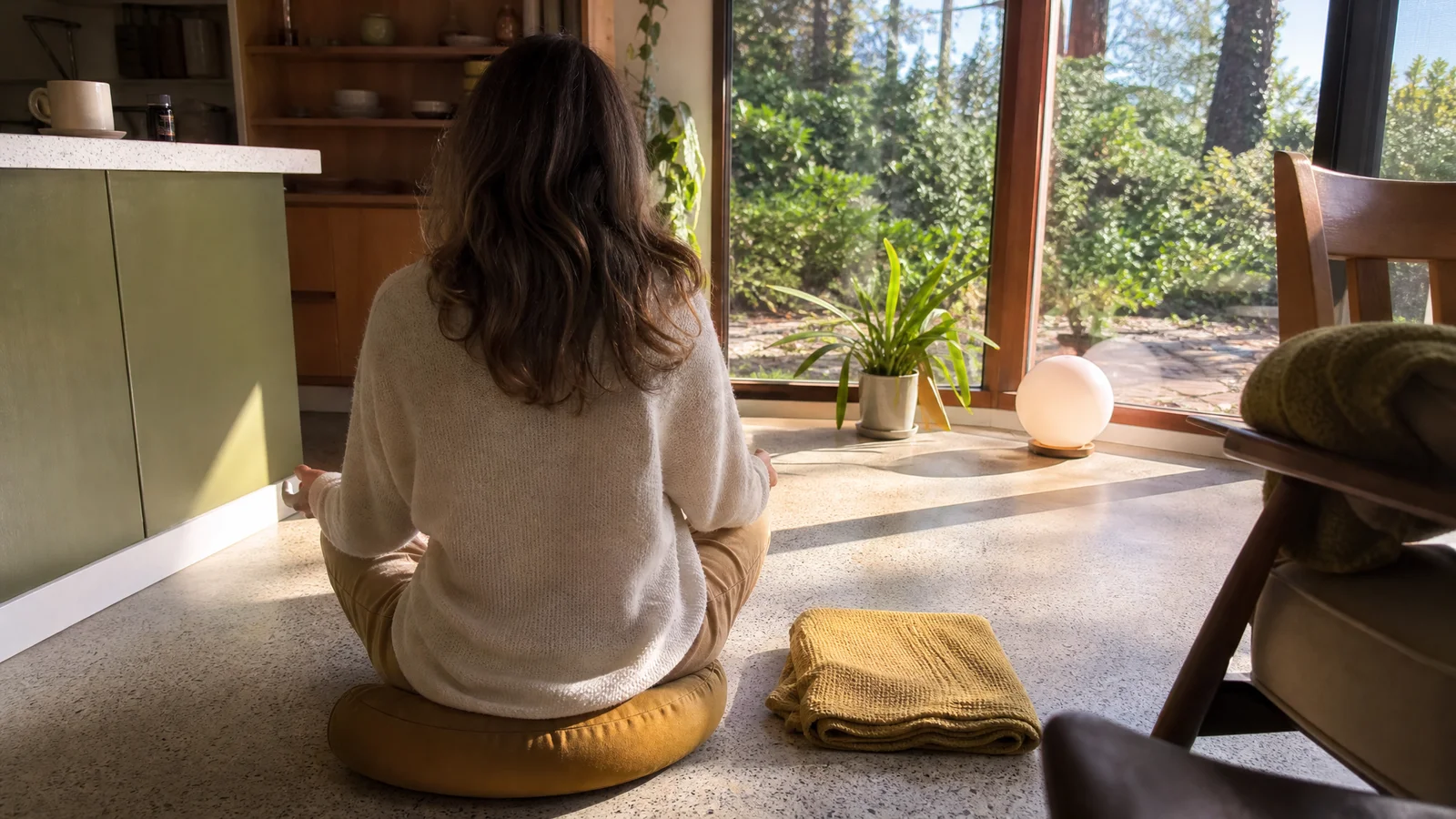
Essential Oils for Meditation: Scent as a Cue, Not a Shortcut
A scent will not put you into a meditative state, and no trial we found shows that any essential oil deepens meditation. What a scent can do is act as a cue: the same smell, used only at the start of your practice, becomes a marker that tells you it is time to sit. That is a habit design argument, and the reasoning behind it is worth separating from the health claims that usually travel with it.
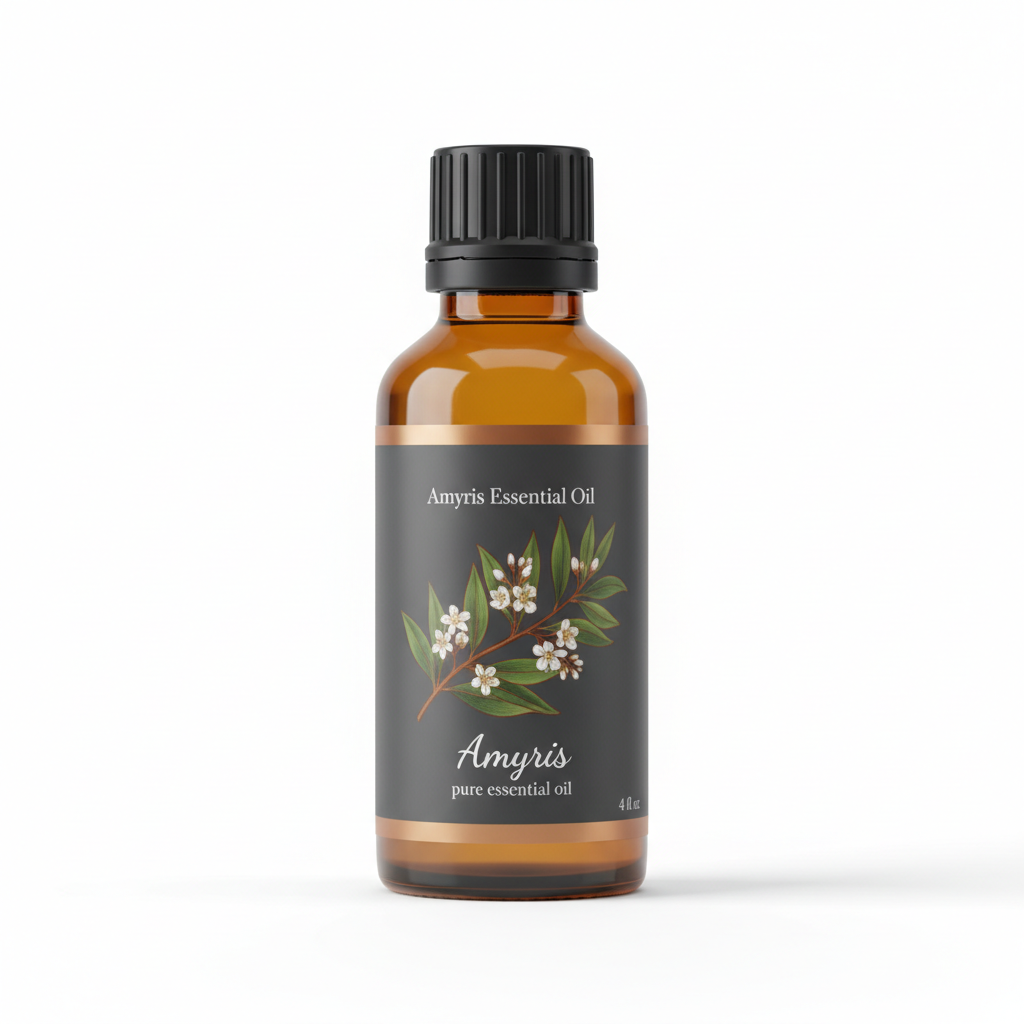
Amyris Essential Oil
Our own Amyris Essential Oil, in sizes from 0.5 oz to bulk.
From $20.99
Shop Now →What the research on scent and practice does and does not say
Three studies are worth reading closely, because each one limits a common claim.
The cue idea has a laboratory basis in memory research. In a 2007 study in Science, Rasch, Büchel, Gais and Born had participants learn material while an odour was present, then re-exposed them to the same odour during sleep. Re-exposure during slow-wave sleep improved retention of declarative memories. It had no effect during REM sleep or wakefulness, or when the odour had not been present during learning, and brain imaging showed hippocampal activation during odour re-exposure. That shows an odour can function as a context cue in a lab. It says nothing about meditation, and the effect required the odour to have been paired with a specific task first.
A 2026 trial in Psychological Medicine by Ngandeu Schepanski and colleagues randomized 504 participants to a four-week self-guided online program of hypnotherapy plus aromatherapy, hypnotherapy alone, aromatherapy alone, or a control pause, with subjective calmness as the primary outcome. Both hypnotherapy groups reported more calmness than the control group (for the combined group, beta = 2.08, 95% CI 0.50 to 3.65), and a week-5 aromatherapy-only conditioning test showed no significant differences. The abstract reports gains for the two guided-practice arms and does not report a benefit specific to the scent.
A 2025 pilot in Scientific Reports by Eliasson and colleagues added odours to mindfulness sessions for 98 women with social anxiety. The odours were human body odours, not essential oils, so it is only loosely relevant here. Its primary hypothesis, a greater fall in state anxiety in the odour groups, was not supported, yet the odour groups rated the practice as significantly more helpful than controls (p = 0.002). The lesson that carries over is cautionary: a practice can feel more helpful with a scent in the room without the measured outcome changing.
Choosing a scent by three tests, not by a list of "grounding oils"
Lists of grounding oils usually sort woods and resins into one bucket and attach a mood to each. We could not source an effect on meditation for any oil, so we do not rank them. Reasoning from the cue argument above, three practical tests matter more than the oil's reputation.
- Do you like it after ten breaths, not just on the first sniff? A scent you tolerate becomes a mild irritation by minute fifteen.
- Is it neutral in your memory? If a smell already belongs to a bad week, a former partner's perfume or a hospital, it will carry that with it. Reasoning from the odour-memory study, a cue brings back what it was paired with.
- Will you use it for nothing else? The pairing only works if the scent is reserved. A blend you also diffuse while cooking is a weak marker.
Where our oil fits: amyris has a creamy, woody, balsamic scent with a soft vanilla undertone, and the published Certificate of Analysis for one batch describes the smell as woody, earthy and smoky. Whether that profile suits quiet sitting is a matter of taste. We make no medicinal claim for it, and we do not call it sandalwood. Frankincense, vetiver and cedarwood are also often named for this purpose; we do not sell them and have not ranked them here. If you want to compare woods, see choosing your first woody oil and what amyris smells like.
A practice you can build, labelled as reasoning
This is a sequence worked out from the cue argument. It is not an instructor's method, and we have no teacher or practitioner behind it.
- Pick one scent and one delivery method. Diffuser, personal inhaler or a drop on a tissue held near, but not touching, your face. For a diffuser, how to use an essential oil diffuser gives the cited run times (30 to 60 minutes on, then off); a short session needs far less. For an inhaler, see making a personal inhaler.
- Start the scent before you sit, and keep it faint. The Tisserand Institute says very low, barely noticeable levels are fine for any length of time; a strong smell competes with your attention.
- Sit, and do the practice you already do. In the Ngandeu trial the reported gains were in the arms that included guided practice.
- End the scent when you end the session. Open a window or let the tissue go. The aim is a clean start and finish.
- Keep a plain note for two weeks. Write down whether you actually sat on the days you used the scent. If it does not help you start, drop it. To make the note a fairer test, sit without any scent for the first week and add it in the second, then compare how often you actually sat. That is a simple test of the cue idea, and it is only your own record, not a trial.
If you prefer skin application at a pulse point, dilute first. Our shop guidance is 0.5% to 2% in a carrier oil with a patch test, kept away from eyes. At the Tisserand Institute's assumption of 30 drops per mL, 1% in 10 mL of carrier oil is 3 drops (10 mL x 30 drops x 0.01). Keep skin application away from the face and hands you will touch your face with; the patch test guide covers the check, and the dilution chart covers the arithmetic.
Limits and people who should ask first
The evidence above supports a cue, not a cure for anything; if you are meditating for persistent anxiety, low mood or sleep trouble, a physician or licensed mental health professional comes first. Fragrance can trigger headaches or breathing symptoms, and ANSES, the French health safety agency, reported in 2020 that essential-oil sprays and diffusers were linked to irritation and respiratory effects even under normal use, advising against use by people with respiratory conditions such as asthma and by pregnant or breastfeeding women. Ask a physician or an OB-GYN or midwife in those cases, and read the essential oil safety guide. A shared yoga or meditation room is a different matter from your own: others may react to a scent you like, so ask the teacher or space before bringing anything. Keep oils away from children and pets, and ask a veterinarian before diffusing near animals.
The most reliable starting point is the simplest one: pick a scent you like, reserve it for sitting, keep it faint, and judge it by whether it gets you to the cushion. For the wider picture on what aromatherapy can and cannot do, see the aromatherapy beginner guide and essential oils for stress.
Amyris Essential Oil
Amyris Essential Oil from our own shop, in sizes from 0.5 oz to bulk.
From $20.99
Shop Now →Sources & Further Reading
- Rasch B, Büchel C, Gais S, Born J, 2007. Odor cues during slow-wave sleep prompt declarative memory consolidation. Science 315(5817):1426-1429. doi.org
- Ngandeu Schepanski S, Bogdanski M, Siegfried KK, et al., 2026. Promoting relaxation through essential oil-enhanced digital hypnotherapy: a randomized controlled trial. Psychological Medicine 56:e80. pubmed.ncbi.nlm.nih.gov
- Eliasson ET, Vigna E, Dal Bò E, et al., 2025. A quasi-randomised pilot study on the efficacy and perceived usefulness of adding chemosignals to mindfulness practice for women with social anxiety. Scientific Reports 15. pubmed.ncbi.nlm.nih.gov
- Tisserand Institute, undated page, read October 2026. Safety guidelines for diffusion. tisserandinstitute.org
- Tisserand Institute, undated page, read October 2026. How big is a drop? tisserandinstitute.org
- ANSES, 28 April 2020. ANSES calls for vigilance concerning essential-oil based sprays and diffusers. anses.fr