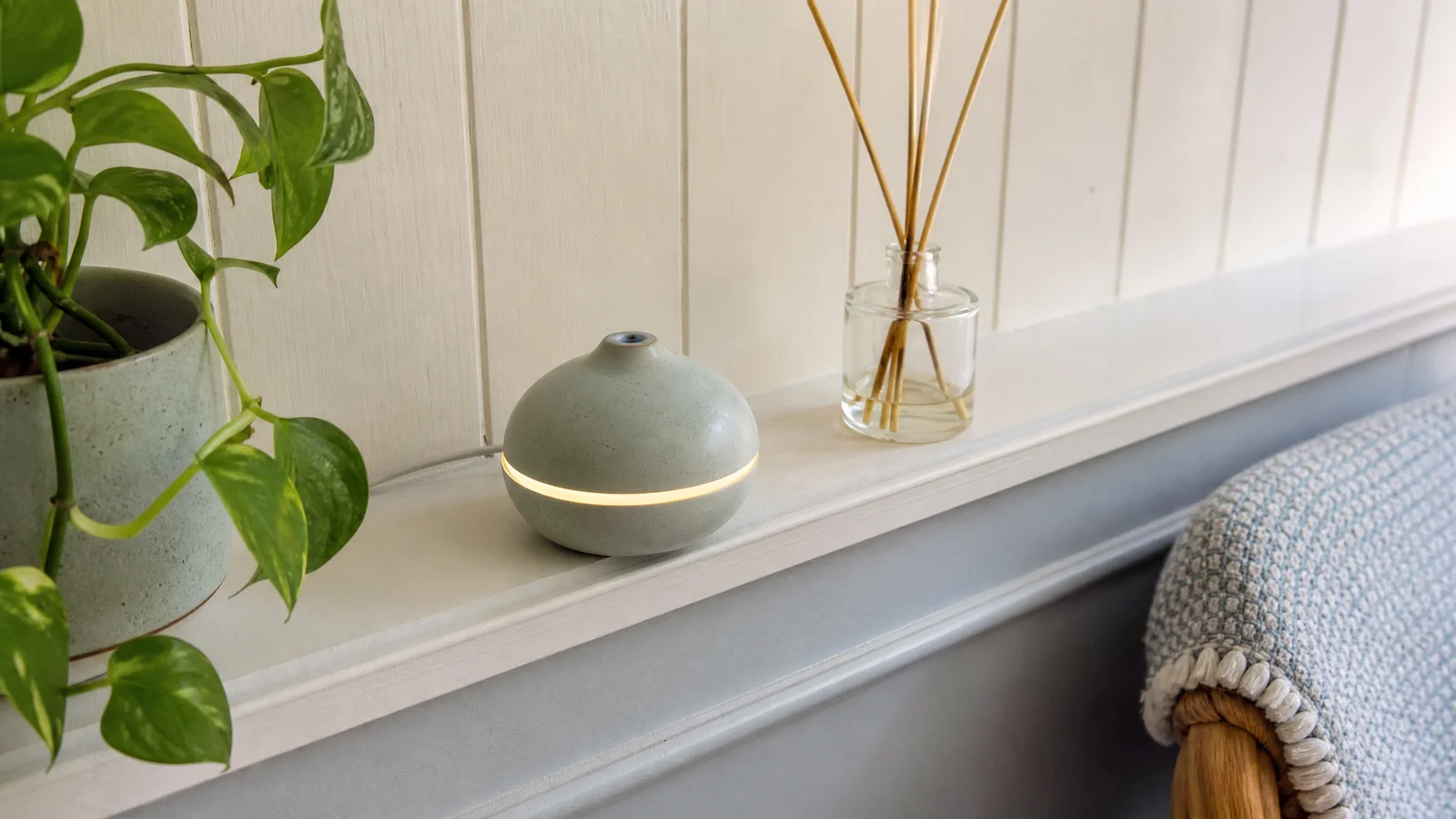
Essential Oil Diffuser Types: What Each Mechanism Does
Choose a diffuser by what leaves the device and what you have to maintain, not by marketing words like "pure" or "waterless." The four common types (ultrasonic, nebulizing, heated or evaporative, and passive such as reed) differ in whether water is involved, whether the oil is heated, and how much of the output is vapour versus fine particles. Only one type, the ultrasonic, has published emission measurements that we could read, so this page says plainly where the evidence stops.
Amyris Essential Oil
Our own Amyris Essential Oil, in sizes from 0.5 oz to bulk.
From $20.99
Shop Now →We sell no diffusers and have no affiliate links or commission arrangements with any diffuser brand. Nothing below ranks products. It compares mechanisms, and where a claim comes from a manual or a study, the source is named.
What the sources actually let us say, type by type
| Type | How the oil leaves the device | What we could verify | What we could not |
|---|---|---|---|
| Ultrasonic | A few drops of oil go into a tank of water; a vibrating ceramic disc turns the water and oil into mist. Manuals describe an "ultrasonic disc" and water reservoir, with a Primavera unit quoting 160 kHz. | A chamber study measured both vapour and particles from one ultrasonic unit. Two manuals give dosing and cleaning rules. | Results for other brands or oils beyond the four tested. |
| Nebulizing | Generally described as atomizing undiluted oil with air pressure, with no water. | A 2022 application note from an instrument maker compared one ultrasonic and two nebulizing diffusers running lemon oil, but the part we could read gives no emission values. | A manufacturer manual or measured numbers for nebulizers. |
| Heated or evaporative | Oil is warmed on a plate or pad, or air is blown across a wick or pad. | The same application note says heat can "potentially cause chemical changes to the essential oil," and says it did not test heated units. | Any measured data on heated units. |
| Passive (reed, stone, clay) | Oil evaporates from a wick, reed or porous surface with no power. | The application note states passive diffusers are "often subject to uneven evaporation of components," and did not test them. | Measured output rates. |
The mechanism descriptions for the nebulizing, heated and passive rows are the general ones, not drawn from a manual we opened; the only manufacturer documents we could read were ultrasonic manuals. The CDS Analytical application note was published in The Analytical Scientist in March 2022; it is produced by a company that sells air-sampling equipment, and we read it as a statement of what the instrument can do, not as an independent comparison.
What an ultrasonic diffuser really emits
The ultrasonic diffuser is the one type with an academic chamber study. Schwartz-Narbonne, Du and Siegel (Indoor Air, 2021) ran an ultrasonic unit with lemon, lavender, eucalyptus and grapeseed oils. Over 15 minutes the most abundant vapours were 2.6 mg of d-limonene from lemon oil and 3.5 mg of eucalyptol from eucalyptus oil. Each oil also produced its own fine-particle profile: PM1 (particles under one micrometre) emission rates were about 2 mg per hour for lemon, 0.1 mg per hour for lavender and eucalyptus, and 3 mg per hour for grapeseed oil. Filling the eucalyptus unit with tap water instead of deionized water raised PM1 emissions fivefold. The authors' modelling concluded that reasonable use can contribute substantially to indoor fine particles, depending on the oil and the water.
Three practical points follow, and they are reasoning from that abstract, not further findings. Grapeseed oil, a carrier oil, gave the highest particle emission of the four, so a carrier oil is not a harmless thing to add to an ultrasonic tank. The oil you pick changes the particle output by a factor of about thirty (0.1 versus 3 mg per hour), so no single "ultrasonic emits X" figure is safe to quote. And the water you pour in is itself an input, which is why a distilled-water habit is cheap insurance. The step-by-step version of this is in how to use an essential oil diffuser.
Water or no water: the question that decides most of the others
Whether the type uses water is the fork that matters. A water-based unit dilutes the oil to a few drops per 100 mL (Tisserand Institute's rule of thumb is 3 to 5), needs a clean tank and a descaled disc, and shuts off when the water runs out. The Kmart ultrasonic manual we read has an auto-off when the reservoir is dry or the timer ends. A unit that atomizes neat oil skips the water but puts the full-strength oil through the machine. Reasoning from the Primavera manual's warning that viscous or strongly colouring oils may damage an ultrasonic unit, the practical question for any non-ultrasonic device is whether the maker names restrictions on oil thickness, and you can ask before buying. A spec sheet worth trusting gives an oil consumption rate, as the Primavera "Petit" sheet does for its small unit (a misting rate of about 8 mL per hour of water with 1-2 drops of oil per fill).
Heat, passive evaporation and what changes in the oil
The one cited concern about heat is a general statement: warming can alter an oil's chemistry. The application note offers no measurements behind it, so treat it as a reason to prefer a cool method if you care about a blend smelling the same at the end as at the start, not as a proven loss. For passive types, the same note's remark about uneven evaporation of components fits a basic point about mixtures: lighter, more volatile components leave a wick or reed faster than heavier ones, so a blend's scent shifts over days. Where that matters, a single oil is more predictable than a blend. That is reasoning about evaporation, not a test; we have not measured any reed or heated device. Our page on making a reed diffuser takes up the passive option.
Picking a type: four questions in order
- Who is in the room? ANSES, the French health safety agency, reported in 2020 that essential-oil sprays and diffusers were linked to irritation and respiratory effects even in normal use and advised against use by people with respiratory conditions, particularly asthma, and by pregnant or breastfeeding women. If that describes your household, ask a physician before choosing any type.
- Do you want to manage water? If not, a passive unit avoids tanks and descaling, at the cost of control over strength and timing.
- Do you want an off switch? Powered types offer timers; Tisserand Institute guidance is intermittent use, 30 to 60 minutes on and 30 to 60 minutes off, which a timer makes easy. A reed cannot be turned off, only removed or capped.
- What oil will go in? Read the manual's list of restricted oils first. Acidic oils, viscous oils and strongly coloured oils are the categories manuals name.
Where amyris fits, and where it does not
Amyris is a base note with a creamy, woody, balsamic scent, which suits a slow-evaporating setting. We have no measurement of how it behaves in any specific diffuser type, and our published Certificate of Analysis describes the appearance as a yellow liquid, so check a unit's restrictions on coloured oils with the maker if you are unsure. For ideas on what to blend it with, see amyris diffuser blends; for the shared habits that apply to any type, see the aromatherapy beginner guide.
Limits of this comparison
This is a comparison of published manuals and one chamber study, not a bench test: we have not run, smelled or measured any diffuser. The Toronto study covers one ultrasonic device and four oils. The nebulizer, heated and passive entries rest on a vendor application note and manufacturer descriptions. If you need emission figures for a specific device, ask its maker for them, and treat the absence of an answer as information.
Whichever type you choose, buy on the manual's instructions and your own tolerance for upkeep, not on a claim of purity, and run any of them in short cycles with fresh air in the room.
Amyris Essential Oil
Amyris Essential Oil from our own shop, in sizes from 0.5 oz to bulk.
From $20.99
Shop Now →Sources & Further Reading
- Schwartz-Narbonne H, Du B, Siegel JA, 2021. Volatile organic compound and particulate matter emissions from an ultrasonic essential oil diffuser. Indoor Air 31(6):1982-1992. doi.org
- CDS Analytical, March 2022. Thermal desorption analysis of essential oil emissions from common in-home diffusers (application note). theanalyticalscientist.com
- Kmart Australia, undated. White Ceramic Aroma Diffuser instruction manual, model B-0353-1. kmart.com.au
- Primavera Life GmbH, June 2025. Aroma Diffuser Petit instructions. primaveralife.com
- Tisserand Institute, undated page, read October 2026. Essential oil applications. tisserandinstitute.org
- Tisserand Institute, undated page, read October 2026. Safety guidelines for diffusion. tisserandinstitute.org
- ANSES, 28 April 2020. ANSES calls for vigilance concerning essential-oil based sprays and diffusers. anses.fr