Amyris Oil Chemistry: Valerianol, Elemol and Eudesmols
Open a lab report for amyris oil and you will not find the sweet, citrusy names you see on lemon or lavender. You will find valerianol, elemol and a handful of eudesmols, a family of heavy, woody alcohols that make amyris a very different animal from a top-note oil. Knowing those three names is enough to read most amyris reports with confidence.

Amyris Essential Oil
Our own Amyris Essential Oil, in sizes from 0.5 oz to bulk.
From $23.99
Shop Now →A team of woody alcohols
Amyris is built mostly from sesquiterpene alcohols, large slow-moving molecules that suit a base note. In a 2021 study that analyzed six commercial "sandalwood" oils, the two that were truly amyris ran at roughly 14.5% valerianol, about 9% elemol and around 26% eudesmol isomers combined, with sesquiterpene alcohols making up some 54 to 55% of the whole. A supplier's own published sheet for a Haitian batch told the same story with different numbers: valerianol near 19.5%, elemol close to 8.7%, and three eudesmols at roughly 8% each.
Notice what the two sources do and do not agree on. The cast is the same. The percentages are not, and they should not be: different labs, different columns, different years, different lots. The takeaway is that a typical amyris oil leads with valerianol, elemol and eudesmols, and the exact shares move from lot to lot. Valencene turns up in a lot of amyris write-ups, but it is not among the leaders in either data set, so we do not treat it as a defining ingredient.
Do not let the names put you off
Long chemical names can make a friendly wood oil look intimidating. You do not need to memorize anything. If you remember that amyris is a heavy, woody oil and that a report for it should list valerianol, elemol and eudesmols near the top, you are most of the way there. The rest is just looking carefully, one line at a time.
What the chemistry is good for
The most practical use is identity. Sandalwood is judged by its santalols, which the international standard sets at around 41 to 54% for alpha-santalol and 16 to 24% for beta-santalol. Amyris does not lead with those. In that 2021 study, one oil sold as sandalwood carried valerianol and eudesmols and almost no santalol, and the authors judged it mislabelled. So when a chromatogram shows valerianol and eudesmols where santalols should be, you are looking at amyris, whatever the label says. We unpack that naming story in is amyris really sandalwood.
The second use is planning. If shares shift between lots, so can the way an oil sits in a blend. That is simple reasoning from the spread above, and it suggests a habit worth having: buy enough from one lot for a project and note the lot number on your notes.
What chemistry does not do is explain scent. Smell depends on how a molecule fits a receptor, not on how much of it there is. One study of alpha-santalol found that flipping the geometry of a single double bond turned a woody molecule odorless or fatty. Nobody has published which amyris molecule carries which part of its aroma, so any claim that elemol makes it creamy or valerianol makes it smoky is a guess. We would rather you smell it than take the guess on trust.
Reading our paperwork, and asking for more
The Certificate of Analysis we publish for one batch of our amyris (batch AMYQGAABHTC003A, steam distilled) lists relative density of 0.952 at 20 C, refractive index of 1.505 and optical rotation of +21.32 degrees, each inside the printed standard range. Those are whole-oil measurements, great for screening and quick checks that a batch behaves like amyris. They do not break the oil into its compounds. If you want a GC-MS profile with valerianol, elemol and eudesmol percentages for the lot you are buying, ask us in writing through our contact page before you order, and we will tell you what is available.
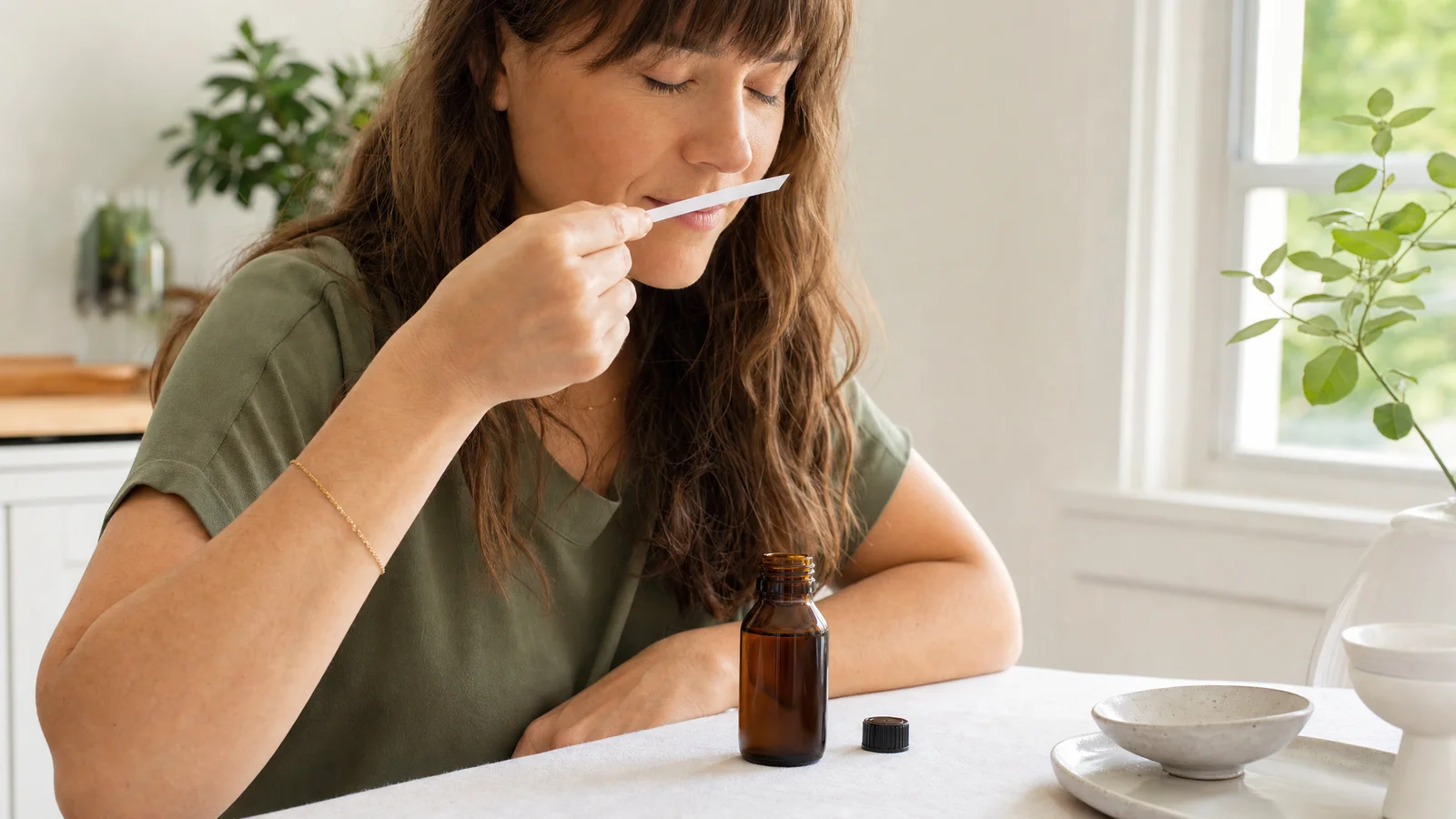
It is worth keeping every report you collect in one folder, filed next to the lot number it belongs to. When a new lot arrives, put a drop of the old and the new on separate paper strips and smell them side by side. Your nose is a good partner for the paperwork, because it picks up differences a table of percentages can hide.
How to read a chromatogram without getting lost
- Check the lead peaks first. Valerianol, elemol and eudesmols should be in front.
- Look for santalols. Meaningful alpha- or beta-santalol in an oil sold as amyris suggests a blend.
- Find the method. A good report names the column, the reference library and the date.
- Match the lot. A report is only about the batch it names.
- Treat percentages as shares of what was detected, not absolute amounts, so one compound can look bigger simply because another shrank.
Even a perfect-looking report is a strong clue and not the final word, because GC-MS alone can miss some adulteration and labs often add other tests alongside it. Our walk-through of how to read a GC-MS report goes deeper, adulterated essential oils covers what tests find and miss, and how to buy amyris oil turns it into a shopping routine. This page is about composition, not outcomes. For skin use our guidance is 0.5% to 2% in a carrier oil with a patch test first, and our amyris safety basics post covers the rest.
Chemistry is a good map, but it is not the territory. The territory is the oil on the strip in your hand, and we would always rather you spend a few minutes with that than an hour with a spreadsheet.
Amyris Essential Oil
Amyris Essential Oil from our own shop, in sizes from 0.5 oz to bulk.
From $23.99
Shop Now →Sources & Further Reading
- Kucharska M et al., 2021. A Comparison of the Composition of Selected Commercial Sandalwood Oils with the International Standard. Molecules 26(8):2249. pmc.ncbi.nlm.nih.gov
- Aliksir, product sheet for amyris essential oil, batch AMBAHTI05V. aliksir.com
- Hasegawa T et al., 2012. Structure-Odor Relationships of alpha-Santalol Derivatives with Modified Side Chains. Molecules 17(2):2259. pmc.ncbi.nlm.nih.gov
- St-Gelais A, Tisserand Institute. The Highs and Lows of GC-MS in Essential Oil Analysis. tisserandinstitute.org