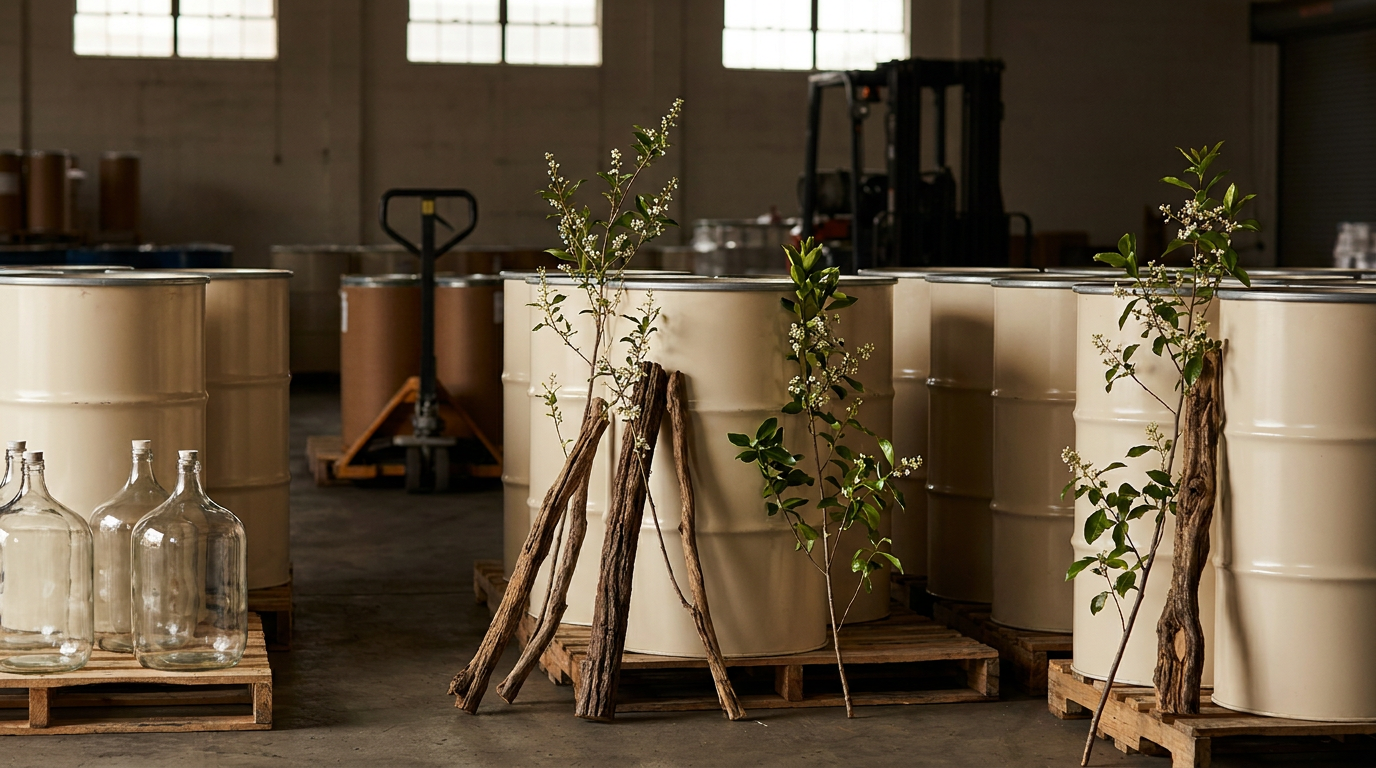
Amyris essential oil has become the industry's default budget base note, the oil formulators reach for when a brief calls for sandalwood character without the sandalwood price. This guide covers how the trade actually buys it: what grades and naming claims to watch for, who the real bulk customers are, and how our nine sizes map onto a working formulator's order cycle.
Start with a sample size and the published Certificate of Analysis before scaling to pound or drum quantities.
Amyris balsamifera grows across Haiti and the wider Caribbean, where it has long carried working names like candlewood and torchwood, a history covered in A Short History of Amyris. The tree's dense, resin-rich heartwood is what distillers want, and the tree itself only yields that character once the wood has aged.
Production runs through steam distillation of the aged heartwood, a slow process detailed in how the oil is distilled, and it is that aging step, not the species alone, that separates a flat, thin-smelling batch from one with real depth. Buyers sourcing at volume are effectively buying a supplier's patience with their wood stock as much as their still.
The creamy, powdery edge that makes amyris valuable as a base note traces to specific constituents: elemol carries much of the soft, waxy character, while the wider profile is mapped in the chemistry of amyris oil. None of that shows up on a label, which is exactly why grading by nose and by paperwork both matter at wholesale volume.
| Sold as | What it actually is | How to recognize it |
|---|---|---|
| West Indian Sandalwood | A trade nickname for Amyris balsamifera, not Santalum album or spicatum | Check the botanical name on the label or COA; true sandalwood costs markedly more per pound |
| Amyris oil, unspecified grade | Distilled from heartwood that may or may not have been properly aged before distillation | A thin, flat scent with little of the creamy vanilla drydown; see the checks in how to spot low quality amyris oil |
| Pure amyris essential oil | Wholly Amyris balsamifera, bottled pure and undiluted with no carrier or synthetic extender | A published Certificate of Analysis for the specific batch, not a generic spec sheet |
| Diluted amyris blend | Amyris cut with a carrier oil or another woody note and sold at a lower per-bottle price | Label wording that avoids the word pure, and pricing that looks too low for the size |
The naming confusion above is common enough that we address it directly in Is Amyris Really Sandalwood?, and the purity question in Pure Amyris Oil vs Diluted Blends. Both are worth reading before a first bulk order, because label language in this category is looser than in most.
The sourcing trap in this category is not fraud so much as vagueness: a supplier who calls their product West Indian sandalwood without naming Amyris balsamifera anywhere, or who cannot produce a batch-specific COA on request, is telling a buyer everything needed to walk away. Ask for the botanical name in writing and the certificate before the wire transfer, not after.
Wholesale demand for amyris comes overwhelmingly from three groups: independent perfumers and fragrance houses using it as an affordable fixative base, soap and candle makers who need a woody note that survives their process, and body-care brands formulating beard oils, body oils, and solid perfumes. The buying guide at Wholesale Amyris Oil covers this ground in more detail.
What these buyers share is a low tolerance for surprise: a candle maker qualifying a fragrance oil for cold throw, or a perfumer building a formula around a specific fixative ratio, cannot absorb batch-to-batch drift once the recipe is locked. That is the case made in How to Buy Amyris Essential Oil, and it is why repeat buyers tend to stay with one supplier once the batch testing checks out.
Before placing a bulk order, a formulator should confirm the following about any amyris supplier.
Every batch we ship traces to a published Certificate of Analysis, and any formulator qualifying us as a supplier should ask for it before the first sample order goes out, not after the first production run.
Our size ladder runs from a half-ounce sample bottle through one, two, four, eight, and sixteen-ounce bottles, then steps up to 5 lbs, 25 lbs, and 400 lbs for production-scale buyers. The reasoning behind that spread, and which size suits a first order, is laid out in Amyris Essential Oil Bottle Sizes.
Full pricing and drum-level ordering live on the bulk page; most formulators qualify a supplier at 16 oz before committing to a pound-tier order.
Order a half-ounce or one-ounce bottle and run it against your working formula before committing to anything larger.
Check cold throw, blend stability, or skin feel against the batch Certificate of Analysis, not against memory of a previous supplier's oil.
Move to 5 lbs or 25 lbs once the batch is qualified, using the bulk page for current pricing.
Request the COA for each new lot before it ships, since aged-heartwood batches can vary in depth from one harvest to the next.
The categories below cover the applications where amyris actually earns its place in a formula, drawn from how our own customers use it.
The affordable base note fragrance houses reach for to anchor citrus and floral formulas without the sandalwood price tag.
Read the sourcing guide →A woody note soap makers add for scent, tested against the discoloration and trace questions that come with any cold process batch.
Read the sourcing guide →A woody base for candle blends, chosen for how it performs at fragrance load in soy wax, not just how it smells from the bottle.
Read the sourcing guide →A smooth woody drydown grooming brands use as the base note in beard oils and other leave-on blends.
Read the sourcing guide →A woody-floral base note body-care brands use in lotions and body oils where a soft, lasting scent matters more than sharp top notes.
Read the sourcing guide →A compact, long-wearing base note crafters use in solid perfumes and other travel-format personal care products.
Read the sourcing guide →A restful, low-key woody note home fragrance makers use in room and linen sprays where the scent needs to be subtle, not sharp.
Read the sourcing guide →Fragrance formulators substituting a costlier sandalwood line item with amyris as a comparable woody base note.
Read the sourcing guide →Reach out for drum-level pricing or lead times ahead of a production run.