Sustainable Essential Oils: What IUCN and CITES Say
"Sustainable" is a claim about one species, one harvest method and one year, and the public conservation lists can test the first part of it. For the aromatic woods and resins below, the status runs from Least Concern to Critically Endangered, and the two lists people treat as interchangeable, the IUCN Red List and CITES, often disagree. Our amyris is listed as Least Concern, and we have no third-party sustainability certification.

Amyris Essential Oil
Our own Amyris Essential Oil, in sizes from 0.5 oz to bulk.
From $20.99
Shop Now →The status of the main aromatics, side by side
We read each IUCN record through the Global Biodiversity Information Facility (GBIF), which republishes the Red List with the assessor and year, and each CITES entry from the Species+ database run by UNEP-WCMC and the CITES Secretariat. Both were read in October 2026.
| Aromatic (species) | IUCN Red List (assessor, year) | CITES |
|---|---|---|
| East Indian sandalwood (Santalum album) | Vulnerable (Arunkumar, Dhyani and Joshi, 2019) | Not listed |
| Rosewood (Aniba rosaeodora, filed by IUCN as Aniba rosodora) | Endangered (Barstow, 2021) | Appendix II since 2013; annotation covers extracts |
| Agarwood (Aquilaria malaccensis) | Critically Endangered (Harvey-Brown, 2018) | Appendix II, genus listing effective 2023 |
| Palo santo, Peru and Ecuador (Bursera graveolens) | Least Concern (Samain, Fuentes and Martinez Salas, 2019) | No Species+ record found |
| Palo santo, Paraguay and Argentina (Bulnesia sarmientoi) | No entry found in the Red List data we searched | Appendix II since 2017; annotation covers extracts |
| Frankincense (Boswellia sacra) | Near Threatened (Thulin, assessment dated 1998) | Not listed |
| Frankincense (Boswellia serrata) | Least Concern (Nandikar and Hingorani, 2025) | Not listed |
| Amyris (Amyris balsamifera) | Least Concern (IUCN SSC Global Tree Specialist Group and BGCI, 2020) | No Species+ record found |
The IUCN records are at GBIF for Santalum album, Aniba, Aquilaria malaccensis, Bursera graveolens, Boswellia sacra, Boswellia serrata and Amyris balsamifera. The CITES entries are in Species+ for Santalum album, Aniba rosaeodora, Aquilaria malaccensis, Bulnesia sarmientoi, Boswellia sacra and Boswellia serrata. Statuses change, so check the live records before you rely on a row.
Three ways this table gets misread
The two lists answer different questions. Reasoning from the table: the Red List records an assessor's judgement of extinction risk, while a CITES appendix is a trade rule. Sandalwood shows the gap. East Indian sandalwood is rated Vulnerable but carries no CITES listing, whereas agarwood is both Critically Endangered and in Appendix II. Celedon and colleagues (2016, The Plant Journal) describe natural populations of the slow-growing sandalwood tree as threatened by over-exploitation in places such as southern India. A buyer who checks only CITES would see no flag.
An old assessment is still the current record until someone replaces it. The Boswellia sacra record carries a 1998 assessor citation, while the Boswellia serrata record was assessed in 2025. We report what each record said on the day we read it; we are not claiming the 1998 figure describes frankincense trees today.
One common name can cover two trees. "Palo santo" is Bursera graveolens in Peru and Ecuador, with a Least Concern record. In the Species+ record for Bulnesia sarmientoi, "Palo Santo" is also given as a Spanish common name, and that species sits in CITES Appendix II. "Frankincense" likewise spans several Boswellia species with different statuses. A bottle that says "palo santo" or "frankincense" without a Latin name has not told you which row of the table applies.
One more detail worth knowing: the annotations for rosewood and for Bulnesia cover "extracts," while stating that "finished products containing such extracts as ingredients, including fragrances, are not considered to be covered." Reasoning from that wording, the pure oil itself is the item that needs trade paperwork, and a perfume made with it does not.
What the table means for a buyer
This is our reasoning from the rows, not a published rule. For a Critically Endangered or Endangered species such as agarwood or rosewood, the first question is whether the seller can show the oil comes from a documented source, and the CITES paperwork is part of that answer. For a Vulnerable species with no trade rule, such as East Indian sandalwood, the table gives no paperwork to ask for, which leaves the buyer relying on the seller's account of where the wood came from. For Least Concern species, the species-level worry is smaller, and the method of harvest becomes the main thing to ask about. In every case the Latin name has to be on the bottle or in the batch document before the table can be used at all.
What "Least Concern" does and does not tell you about amyris
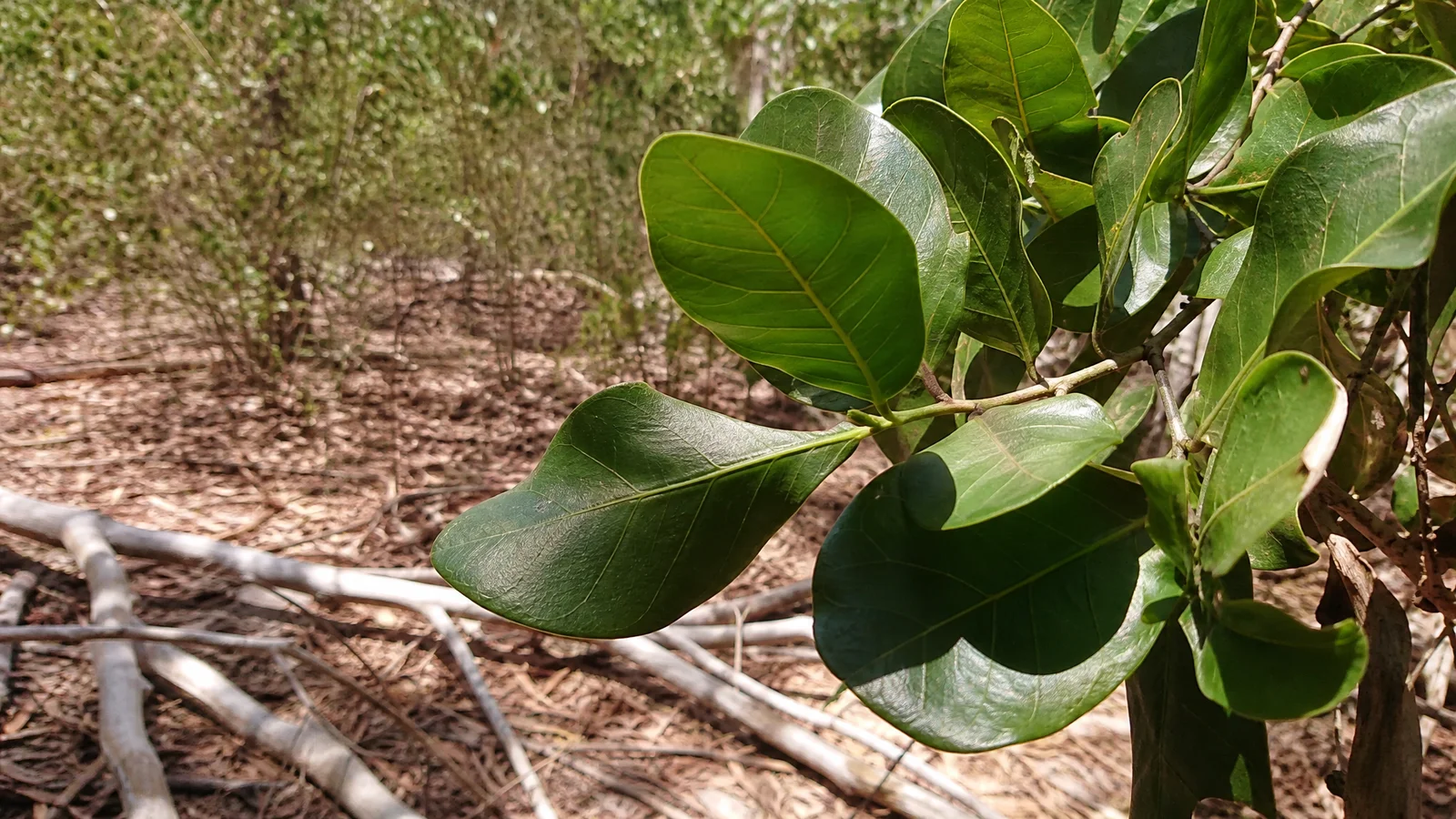
The IUCN SSC Global Tree Specialist Group and Botanic Gardens Conservation International assessed Amyris balsamifera as Least Concern in 2020. The Cuban Redlisted Plant Species list (2023), as republished in GBIF, adds a national remark that the species is widely represented in Cuba with abundant populations. We have read no assessment specific to Haiti, where our wood comes from. Reasoning: a global category is built from the whole range of a species, so it cannot tell you how many trees stand on one hillside, or whether demand from one trade is changing that. It is an argument against alarm, not a certificate for any particular lot of oil.
For the sandalwood comparison, amyris is sometimes bought in place of it. That substitution is covered in amyris vs sandalwood and in our comparison of sandalwood alternatives. Neither a Least Concern rating nor a lower price makes amyris a sandalwood, and we do not describe it as one.
Our practice, and what we cannot prove
Our amyris wood is gathered as naturally fallen branches and trunks, and as pruning by-product, from farms in Haiti where amyris grows as a boundary or shade tree. No living tree is felled for our oil. The wood is aged in the sun and only the heartwood is distilled; when gathered wood of the grade cannot be had, we wait and sell nothing meanwhile. The distillation itself is described in how amyris oil is distilled from aged heartwood, and more on sourcing is on our sourcing page.
That is our practice, stated by us. Here is what stands behind it and what does not:
- We hold no third-party sustainability certification, and no audit of how the wood is gathered.
- We publish no volume data: no tonnage gathered, no count of trees or farms.
- We hold no ecological data on what removing deadwood does to a site. Reasoning, not a finding: fallen wood is not automatically free of impact, so "fallen" describes a method, not an outcome.
- We are not certified under FairWild or any comparable standard, so no one outside the business has verified our collection.
For comparison, the FairWild Foundation (undated site, read October 2026) describes a standard for wild-harvested plants that addresses biodiversity, collector welfare and traceability, with approved control bodies. That is the kind of independent check a sustainability claim can be held to. A claim without one is a statement of intent and should be read as one, ours included.
Questions to put to any seller
- What is the Latin name, and which plant part is distilled?
- Is the plant wild or cultivated, and was any living tree cut?
- If the species appears on a CITES appendix, where is the permit paperwork for this lot?
- Is there a named third-party standard, with a certificate number you can look up, or only an adjective on the label?
- Is there any volume or sourcing data the seller will put in writing?
The broader checklist for judging a bottle is in our guide to choosing essential oils, and the link between rarity and price is in why essential oil prices vary.
Conservation status lets a buyer rule species in or out and spot a missing Latin name. It cannot certify a harvest, and we would rather say plainly what we cannot prove than lend an adjective to an unaudited practice.
Amyris Essential Oil
Amyris Essential Oil from our own shop, in sizes from 0.5 oz to bulk.
From $20.99
Shop Now →Sources & Further Reading
- IUCN Red List records (Arunkumar et al., 2019; Barstow, 2021; Harvey-Brown, 2018; Samain et al., 2019; Thulin, 1998; Nandikar and Hingorani, 2025; IUCN SSC Global Tree Specialist Group and BGCI, 2020), read October 2026 through GBIF. api.gbif.org
- Cuban Redlisted Plant Species, 2023, via GBIF. Amyris balsamifera record. api.gbif.org
- Species+ (UNEP-WCMC and CITES Secretariat), read October 2026. CITES listing records for the species in the table. speciesplus.net
- Celedon et al., 2016. Heartwood-specific transcriptome and metabolite signatures of tropical sandalwood (Santalum album) reveal the final step of (Z)-santalol fragrance biosynthesis. The Plant Journal. europepmc.org
- FairWild Foundation, undated page, read October 2026. About FairWild. fairwild.org