Adulterated Essential Oils: What Tests Find, Checks Miss
In a 2021 Polish study, six oils sold as sandalwood were analysed by gas chromatography with mass spectrometry, and none met the international standard for sandalwood oil. Only one contained the santalols of real East Indian sandalwood; three were Amyris balsamifera oil; two were synthetic mixtures. That single case holds most of what a buyer needs to know about adulterated essential oils: what the substitutions are, what finds them, and what a home check cannot see.
Amyris Essential Oil
Our own Amyris Essential Oil, in sizes from 0.5 oz to bulk.
From $20.99
Shop Now →What was in the six bottles
Kucharska and colleagues (2021, Molecules) bought six oils sold as sandalwood in stationary and online stores and compared them with ISO 3518:2002. Their findings, in the order that matters to a buyer:
- One oil was Santalum album, and it still fell short. The full text reports 37.1 percent alpha-santalol against a lower limit of 41 percent that the authors cite. A genuine oil outside a standard's window is not the same thing as a fake, and a buyer who treats every miss as fraud will misjudge natural variation.
- Three oils had the valerianol, elemol and eudesmol profile of Amyris balsamifera. The label was correct for two of them. The third was sold as "Santalum album 100% bio-natural oil" and contained none of the components characteristic of that oil.
- Two oils were synthetic mixtures. One was predominantly benzyl benzoate; the other contained synthetic alcohols (javanol, polysantol and ebanol) and was labelled as a natural essential oil. The authors call such products "particularly dangerous and misleading to the consumer" and note that the toxicological properties of javanol, polysantol and ebanol, for example, are unknown.
Two limits on what this shows. Six bottles from shops is not a market survey, and none of the sources we read gives a rate for how common adulteration is. Capetti and colleagues (2021) say only that it is "not uncommon along supply chains," with no figure. And an amyris oil sold honestly as amyris is not adulterated; the problem in this study is the label, not the oil.
The routes adulteration takes
Capetti and colleagues (2021, Molecules), working on lavender, lemon and tea tree oils, describe three routes: adding cheaper essential oils (lavandin to lavender is their example), adding synthetic materials (synthetic linalool and linalyl acetate in bergamot), and diluting with vegetable oil, which they call "quite devious" because it leaves the qualitative composition and the normalised marker percentages unchanged. Sadgrove, Padilla-Gonzalez and Phumthum (2022, Plants) add scenting a fixed oil and selling it as an essential oil, and note that adulterators have learned to defeat basic chemical checks.
For sandalwood specifically, Robert Tisserand (Tisserand Institute, undated page, read October 2026) writes that Indian sandalwood oil "may be adulterated by the addition of sandalwood terpenes and fragrance chemicals," and his list of possible adulterants includes amyris oil.
What actually detects it
- GC-MS or GC-FID with normalised percentages compared with the standard ranges for the oil. Capetti and colleagues use it to catch added cheaper oils and synthetic compounds.
- Chiral GC, which separates mirror-image forms of molecules. Their ratios can expose synthetic additions and geographic origin.
- Absolute quantitation, needed for vegetable-oil dilution; the same authors call it difficult and time-consuming.
- Isotope ratio analysis, which Sadgrove and colleagues say can reveal mixtures of oils from different photosynthetic types but needs well-developed technical expertise.
- Near-infrared spectroscopy, which Kuriakose and colleagues (2010, Analyst) reported could detect adulterants "even 1% of the low-grade oils" in high-quality sandalwood oil, in a calibrated laboratory model.
None is a guarantee. Alexis St-Gelais of Laboratoire PhytoChemia (Tisserand Institute, undated page, read October 2026) writes that "not all adulterants can be spotted using markers," that a mass spectral search "produces a list of hits, some of which are incorrect," that the tests require "quite extensive knowledge of what is usual and what is not," and that the method "tells a lot, but not everything." Standard GC-MS also lacks the sensitivity for pesticides and heavy metals. Our guide to reading a GC-MS report goes through what the peaks mean.
What home checks can and cannot show
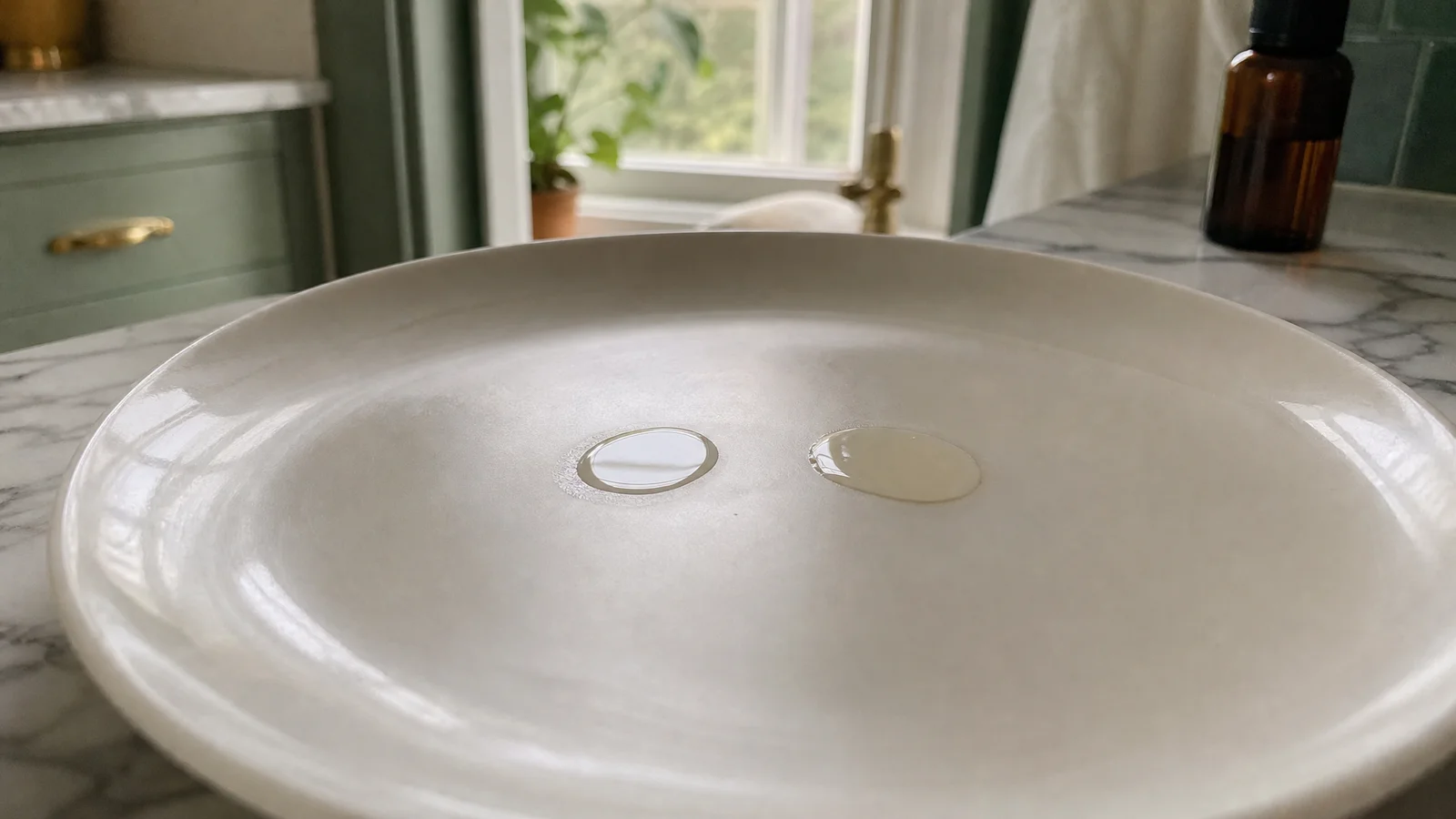
The paper spot test, where a drop on paper should evaporate without a ring, is the usual home check. Sadgrove and colleagues list evaporation tests among simple methods that can reveal dilution or non-volatile additives. Reasoning from that description: a greasy residue tells you something non-volatile is in the bottle, but not what it is, and a clean evaporation says nothing about a cheaper oil or a synthetic that evaporates just as the real one does. A clean result is therefore weak evidence, and a ring is a prompt for a question.
Smell is weaker still for woods. Kucharska and colleagues introduce amyris as an oil "with a similar smell" to sandalwood and less expensive, and their six oils included three that matched amyris in composition. Price is no better: the same authors report that the oils varied in price and conclude that price "is not a suitable criterion, either." We make the same point in why essential oil prices vary. Our older guide to at-home checks for amyris oil is best read in this light: the checks are screens that can raise a question, not proofs of purity.
Amyris in the sandalwood story
Amyris appears on both sides of this subject, and the difference is the label. Sold as amyris, it is what it says. Sold as sandalwood, it is a substitution. We sell amyris only, and we do not call it sandalwood; the scent, price and use differences are set out in amyris vs sandalwood.
For orientation, the two amyris-labelled oils in the Kucharska study were nearly identical: valerianol was the main peak at about 14.5 percent, with eudesmol isomers near 26 percent and elemol near 9 percent. That is what one laboratory found in two bottles, not a range for the species and not our oil's analysis, but it shows why the lab's job is to confirm a profile and not merely a name.
Buying by documents, and where our documents stop
Ask any seller for the report for the lot you will receive, with the laboratory, the method, the date and a lot number that matches your bottle. Here is what we have, and what we do not.
- Our bottle carries a lot number and two dates (still date and fill date), in amber glass.
- Each lot goes to an independent third-party laboratory. Reports are available on request through our contact page or the number on the bottle. According to our sourcing page, the laboratory confirms the valerianol, elemol and eudesmol profile and checks that the oil is not a sandalwood substitution.
- We publish a Certificate of Analysis for one batch. It lists appearance and smell as complying, a relative density of 0.952 at 20 C (standard 0.946 to 0.978), a refractive index of 1.505 (standard 1.504 to 1.512) and an optical rotation of +21.32 degrees (standard +20.00 to +45.00).
- We do not publish a GC-MS report, a chiral analysis, or any pesticide or heavy-metal data.
Those three physical constants are a plausibility screen, not an identity test. Reasoning from the Capetti findings: a gross dilution would tend to move a density or a refractive index, but a mixture built to sit inside all three windows would not be caught, and normalised composition percentages cannot see vegetable-oil dilution at all. The lot report is where the composition evidence is, and you should read it as the primary document and the COA as the summary.
Adulteration is real, but the available evidence on how common it is comes from small samples, and no home check settles it. The defensible habit is to buy by the lot document, to treat price and smell as weak clues, and to be wary of any bottle whose name and contents you cannot match.
Amyris Essential Oil
Amyris Essential Oil from our own shop, in sizes from 0.5 oz to bulk.
From $20.99
Shop Now →Sources & Further Reading
- Kucharska et al., 2021. A comparison of the composition of selected commercial sandalwood oils with the international standard. Molecules. pmc.ncbi.nlm.nih.gov
- Capetti et al., 2021. Adulteration of essential oils: a multitask issue for quality control. Three case studies: Lavandula angustifolia, Citrus limon and Melaleuca alternifolia. Molecules. pmc.ncbi.nlm.nih.gov
- Sadgrove, Padilla-Gonzalez and Phumthum, 2022. Fundamental chemistry of essential oils and volatile organic compounds, methods of analysis and authentication. Plants. pmc.ncbi.nlm.nih.gov
- Kuriakose, Thankappan, Joe and Venkataraman, 2010. Detection and quantification of adulteration in sandalwood oil through near infrared spectroscopy. Analyst. pubmed.ncbi.nlm.nih.gov
- St-Gelais, undated page, read October 2026. The highs and lows of GC-MS in essential oil analysis. Tisserand Institute. tisserandinstitute.org
- Robert Tisserand, undated page, read October 2026. Santalum album oil rejuvenated. Tisserand Institute. tisserandinstitute.org