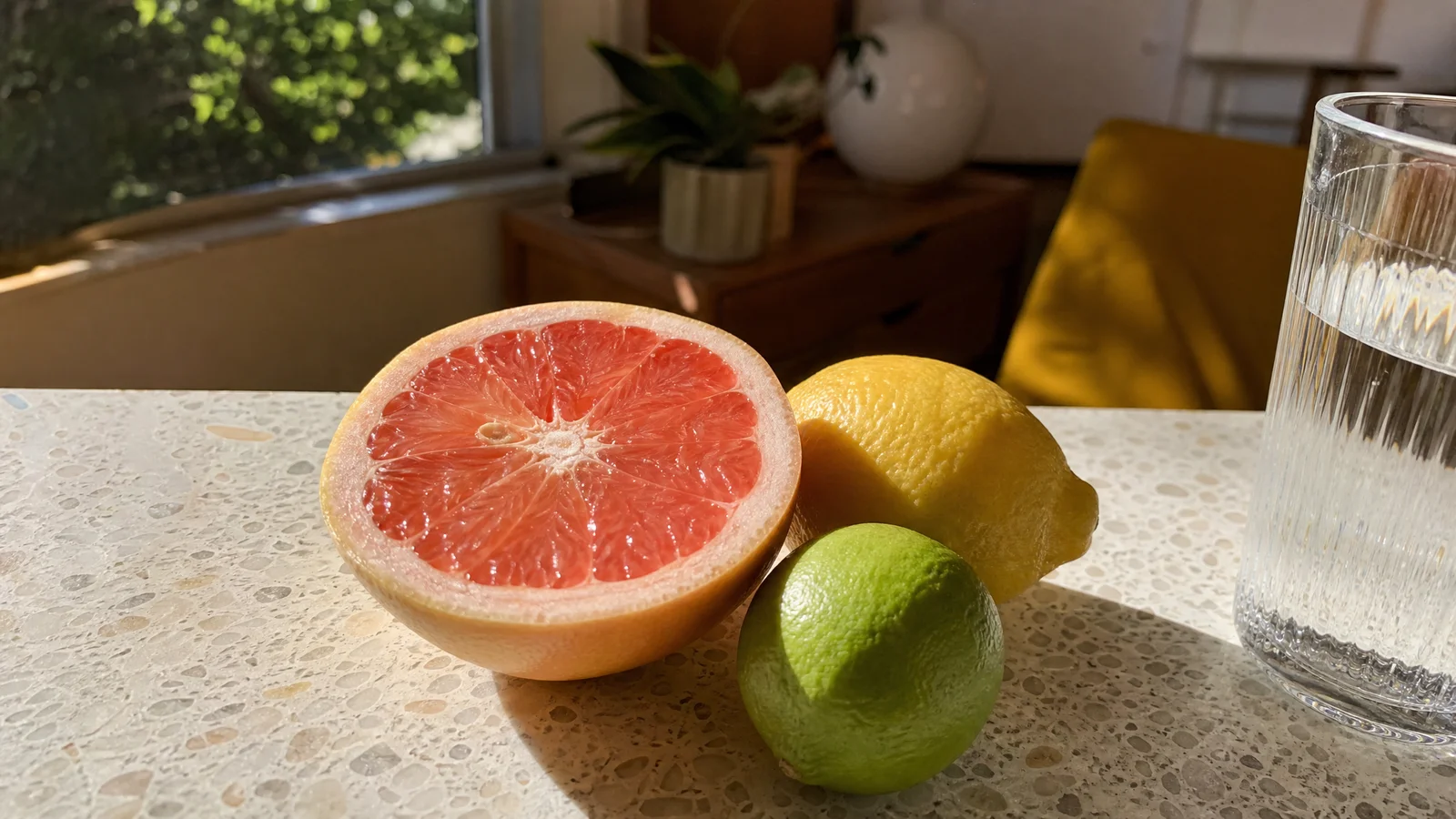
Phototoxic Essential Oils: IFRA Limits and Where Amyris Fits
"Phototoxic" is not a synonym for "citrus." It describes oils that carry furocoumarins, chemicals that react with ultraviolet light on the skin, and the safe level for each oil is a published number that is far lower than the 0.5% to 2% dilutions used for ordinary oils. Bergamot oil, pressed from the peel, is capped at 0.40% in a finished product by the fragrance industry's own standard, which is a fifth of the top of our amyris range. A dilution chart cannot tell you that, because the oil decides the number.
Amyris Essential Oil
Our own Amyris Essential Oil, in sizes from 0.5 oz to bulk.
From $20.99
Shop Now →What actually happens on the skin
The Tisserand Institute (undated page, read October 2026) explains that almost all phototoxic plant chemicals are furanocoumarins. They enter skin cells, and under UVA light they bind DNA, which leads to cell death, inflammation and often pigmentation. Without UV light the molecule leaves the cell and nothing happens, which is why the same oil can be harmless on a cloudy evening and a problem the next afternoon.
The delay is what catches people. The same page says there is no pain at first, and burns develop hours later and worsen for one to three days. It cites a 1977 study by Zaynoun and colleagues finding that UVA exposure within roughly the next 12 hours, possibly longer, can trigger a reaction, and mentions a case of a burn 30 hours after bergamot oil was applied. Its practical advice is to keep the area covered or out of the sun for at least 12 hours, and it says sunscreen helps only partially.
The published limits, side by side
The numbers below come from the International Fragrance Association's individual standards (Amendment 49, 2020). Each gives a maximum concentration of the oil in a finished product, and the figure is the same across the skin-contact categories, with "No Restriction" listed for a few categories such as rinse-off and non-skin products. IFRA publishes later amendments, so check the current text before you formulate for sale.
| Oil | Maximum | Compared with a 2% blend |
|---|---|---|
| Lime oil, expressed | 0.70% | 2% is about 3 times the cap |
| Bergamot oil, expressed | 0.40% | 2% is 5 times the cap |
| Bitter orange peel oil, expressed | 1.25% | 2% is 1.6 times the cap |
| Lemon oil, cold pressed | 2.0% | 2% is exactly the cap |
| Grapefruit oil, expressed | 4.0% | 2% is half the cap |
| Angelica root oil | 0.80% | 2% is 2.5 times the cap |
| Cumin oil | 0.40% | 2% is 5 times the cap |
| Rue oil | 0.15% | 2% is about 13 times the cap |
The two sources agree on bergamot: the Tisserand Institute's page gives the same 0.4% for sun-exposed leave-on products, excluding wash-off products. The standards add that where the furocoumarin level of an oil is unknown, the oil's own limit applies, so the cap is the default, not an optional extra.
Three rules that change how you blend
Limits add up. IFRA's umbrella standard on citrus oils and other furocoumarin-containing essential oils says that when several are used together, each concentration, expressed as a percentage of its own cap, must sum to no more than 100. A worked example: 0.2% bergamot is 50% of its 0.40% cap, and 1% lemon is 50% of its 2.0% cap, so that blend sits exactly at the limit and a further drop of either takes it over.
Bergapten can replace the oil-by-oil limit. The same standard allows, for skin exposed to UV light and excluding rinse-off products, a cap of 0.0015% (15 ppm) of bergapten in the finished product when the oil's bergapten content has been measured. The Tisserand Institute gives bergamot as typically containing 0.11 to 0.33% bergapten, and calculates that an oil at 0.33% would be capped at about 0.45%. A supplier's analysis is what makes this route usable; without it, you apply the oil's own limit.
Expressed and distilled are different oils. According to the Tisserand Institute, distilled citrus oils contain far fewer furocoumarins than expressed ones, and bergapten-free (FCF) bergamot is made by fractional distillation to remove virtually all of it; it lists bergapten contents of 0.0003% for distilled lime and 0.005% for expressed tangerine as examples. IFRA's standard lists petitgrain mandarin and tangerine (50 ppm each) and parsley leaf (20 ppm) as containing small amounts, not high enough to need their own restriction alone but counted toward the 15 ppm bergapten total in a blend. We do not sell any citrus oil, FCF or otherwise, so a supplier who does is the one to ask which version you are buying and what its analysis says.
What the limits mean at the bench
Arithmetic makes the caps concrete. At 30 drops to the milliliter (an assumption, since drop size varies by bottle), a 10 mL roller holds 300 drops of blend, and 0.40% of that is 1.2 drops of expressed bergamot. One drop is about 0.33% and two drops is about 0.67%, which is over the cap. In a 30 mL body oil, the 2.0% lemon cap works out to 0.6 mL, or about 18 drops. Anyone writing a recipe that lists "6 drops lime" in a small bottle without a stated volume has not told you whether the blend is within its limit. Because the cap is a share of the finished product, a rinse-off product is treated differently from a leave-on one, and the bergapten route above excludes rinse-off products altogether.
Where amyris stands, and what we cannot tell you
Amyris is not on any of the lists above. It is not one of the eight oils IFRA's umbrella standard names as restricted, nor one of the three minor-furocoumarin oils, and the Tisserand Institute's phototoxicity page does not mention it. That is all we can verify. We could not find an analysis of furocoumarins in Amyris balsamifera oil, and we do not publish a GC-MS report for ours, so the honest summary is "not listed", not "tested and clear." Reasoning from that: use amyris at the dilutions in our shop guidance, and if you blend it with any oil in the table, work out the sum with the oil in the table counted at its own cap. If a reaction appears on skin that has been in the sun, stop using the blend and ask a dermatologist; do not assume the amyris was or was not the cause.
The oil that counts is usually the other one. A roll-on with a lemon top note, a body oil with grapefruit, a citrus-and-woods diffuser blend that ends up in a massage oil: the amyris at 1% is not what the table is about. If you are choosing citrus to pair with amyris, our blending guide covers the scent side, and the roll-on perfume recipe is where this arithmetic gets applied. The dilution chart shows how to turn a percentage into drops, and our patch test page explains the limits of a skin test; reasoning from the mechanism above, a test on a patch of skin that stays covered would not reveal this particular hazard, because the reaction needs UV light.
Who to ask
A dermatologist is the right person for any burn, blistering or lasting dark patch that appears after sun exposure on skin that had oil on it, and for a question about photopatch testing. A pharmacist can say whether a medicine you take affects sun sensitivity. For the wider safety context see the essential oil safety guide and the skincare guide.
The rule that survives all of this is short: for a citrus oil, look up its own limit, check whether it is expressed or distilled, and add it to anything else in the bottle.
Amyris Essential Oil
Amyris Essential Oil from our own shop, in sizes from 0.5 oz to bulk.
From $20.99
Shop Now →Sources & Further Reading
- Tisserand Institute, undated page, read October 2026. Phototoxicity: essential oils, sun and safety. tisserandinstitute.org
- IFRA, 2020 (Amendment 49). IFRA Standard: Citrus oils and other furocoumarins containing essential oils. ifrafragrance.org
- IFRA, 2020 (Amendment 49). IFRA Standards for bergamot oil expressed, bitter orange peel oil expressed, lime oil expressed, lemon oil cold pressed, grapefruit oil expressed, angelica root oil, cumin oil and rue oil. ifrafragrance.org (standards 086 to 096, one PDF each)