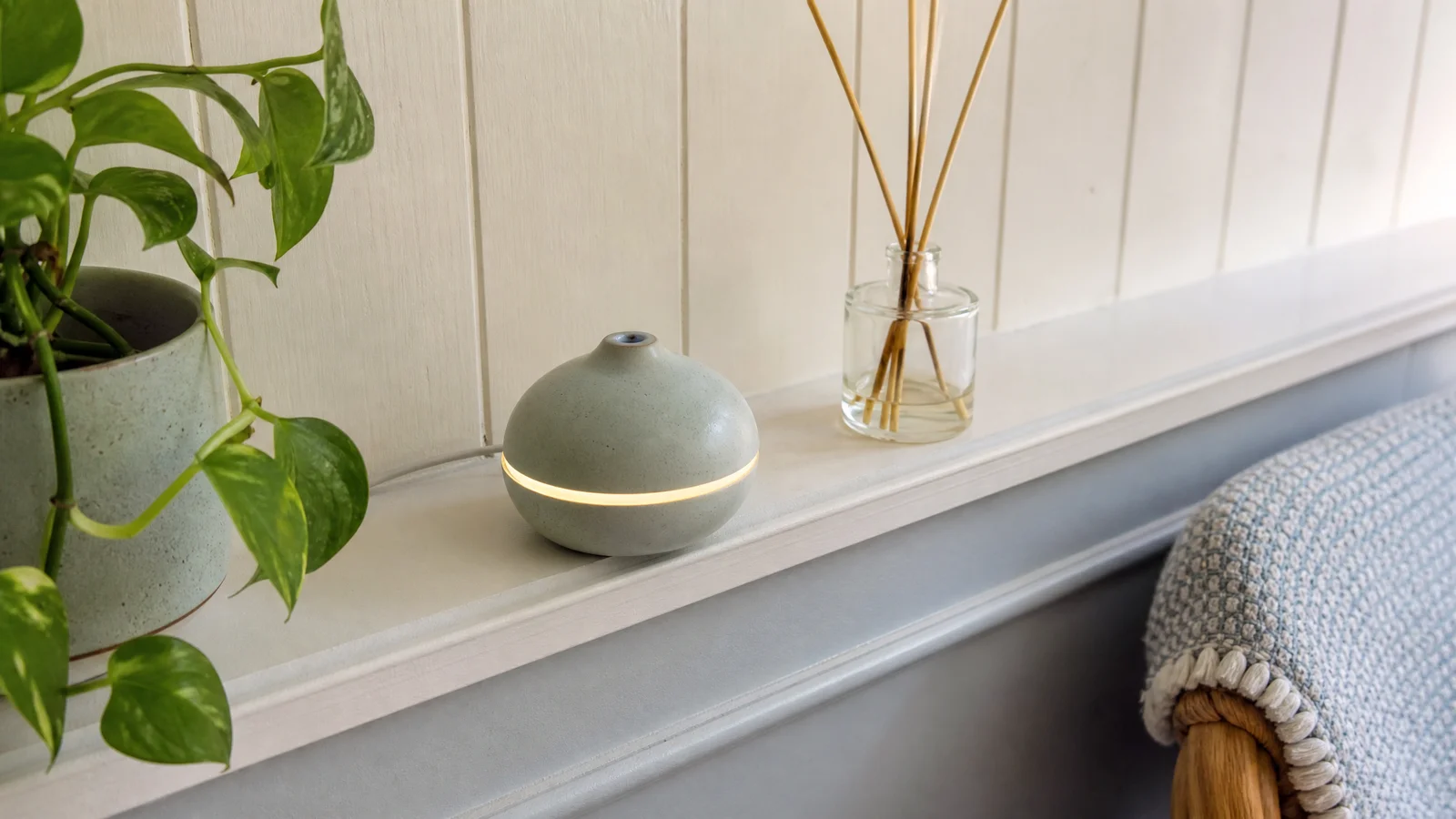
Types of Diffusers: Which One Suits Your Space?
Walk down a diffuser aisle and you will see a dozen shapes and a handful of promises. Underneath the styling, there are really only four ways to get an aroma into a room: mist it with water, spray it as a fine cloud of neat oil, warm it, or let it evaporate on its own. Once you know which one a device uses, choosing gets much easier.

Amyris Essential Oil
Our own Amyris Essential Oil, in sizes from 0.5 oz to bulk.
From $23.99
Shop Now →Ultrasonic: a few drops in water
This is the one most people own. A small ceramic disc vibrates in a tank of water and turns the water, with a few drops of oil floating on it, into a cool mist. It is quiet, it usually has a timer, and it shuts itself off when the tank runs dry. The upkeep is the price: the tank needs rinsing and the disc needs the occasional descale. A little goes a long way, and the Tisserand Institute's rule of thumb for a small room is only a few drops, not a generous pour (R. Tisserand, Tisserand Institute).
Nebulizing: neat oil, no water
A nebulizer pushes air across a glass reservoir of undiluted oil and sends out a fine vapour. With no water in the picture, the aroma is stronger and truer to the bottle, and nothing needs descaling. It also uses oil faster than other types, so it suits someone who wants a short, clear burst of scent rather than a room that hums all evening.
Heated and evaporative: warm or fan-assisted
Here the oil sits on a warm plate or a pad with a small fan behind it. These are simple and inexpensive. A gentle warmth lifts light, citrusy top notes quickly, so a blend can smell different an hour in than it did at the start. That is a feature if you like scent that evolves, and something to know if you want a particular blend to hold steady.
Passive: reeds, stones and clay
No power, no noise, no switch. Oil climbs a reed or sits in a porous stone and drifts off slowly. Lighter components leave first, so the scent shifts over days. It is the least controllable option and the most peaceful one, and it works nicely in a hallway or a bathroom. We cover the reed version in making a reed diffuser.
Four questions that pick the type for you
- Do you want to manage water? If the answer is no, go nebulizing or passive.
- Do you want a timer? The Tisserand Institute suggests diffusing in intervals of 30 to 60 minutes on and 30 to 60 minutes off, with fresh air coming in (Tisserand Institute, safety guidelines). A powered unit with a timer makes that effortless, whereas a reed can only be removed.
- Who shares the space? ANSES, the French health safety agency, reported in 2020 that poison-centre cases linked to sprays and diffusers included eye, nose and throat irritation and breathing effects even under normal use, and it called for particular care around people with asthma or other chronic respiratory conditions (ANSES, 2020). If that describes your household, ask a physician before choosing any type.
- What oil will go in? Read the manual's list of oils the maker advises against. Thick or strongly coloured oils are the usual ones, and the answer can matter more than the diffuser brand.
Where each one lives best
- A desk or reading nook: a small ultrasonic or a nebulizer with a timer, set across the room, not under your nose.
- A hallway or bathroom: reeds, stones or clay, which need nothing from you.
- A large open living room: a bigger powered unit, because a tiny personal diffuser gets lost in it.
- A small room: go gently, since a strong nebulizer can overwhelm a space the size of a closet.
Listen to the machine, too. Some fans hum and some tanks gurgle, and a sound you notice in the first five minutes will bother you by the fifth day.
A word about upkeep
Whatever you pick, think about the chore you will really do. An ultrasonic tank that needs rinsing every few uses is wonderful if you like a small ritual, and a nuisance if you do not. A passive reed asks for almost nothing, apart from the odd flip. Choosing the one whose upkeep you will actually keep up with is more useful than choosing the one with the best reviews on the box.
Where amyris fits
Amyris is a base note, creamy and woody with a balsamic edge, which means it unfolds slowly rather than announcing itself. That makes it a good partner for the slower diffusers, and a natural anchor in a blend with brighter oils on top. Because it is a deep, rounded scent, a couple of drops goes a long way in a small room. Our Certificate of Analysis describes the batch it covers as a yellow liquid, and if your unit's manual mentions coloured oils, a quick check with its maker is all you need.
For blending ideas, see amyris diffuser blends, and for habits that apply to any device, how to use an essential oil diffuser and the aromatherapy beginner guide. We sell an essential oil and not diffusers, so you will find those at a home or craft store.
Whichever type you choose, short cycles, a fresh breeze and a scent you actually enjoy matter more than any feature on the box.
Amyris Essential Oil
Amyris Essential Oil from our own shop, in sizes from 0.5 oz to bulk.
From $23.99
Shop Now →Sources & Further Reading
- ANSES, 28 April 2020. ANSES calls for vigilance concerning essential-oil based sprays and diffusers. anses.fr
- Tisserand Institute. Safety guidelines. tisserandinstitute.org
- Tisserand R., Tisserand Institute. Essential oil inhalation and children (diffusion guidance). tisserandinstitute.org