Amyris vs Cedarwood: Chemistry, Scent and How to Choose
Amyris and cedarwood are not two versions of the same woody oil, and the usual advice to swap one for the other skips the chemistry. Cedarwood oil on the market is mostly made from junipers and is built on hydrocarbons such as cedrene and thujopsene, while amyris oil is built on sesquiterpene alcohols such as valerianol, elemol and the eudesmols. Below is what the published sources say about each, where they disagree, and how to choose. We sell only the amyris oil; cedarwood comes from any reputable supplier, and we do not sell it.
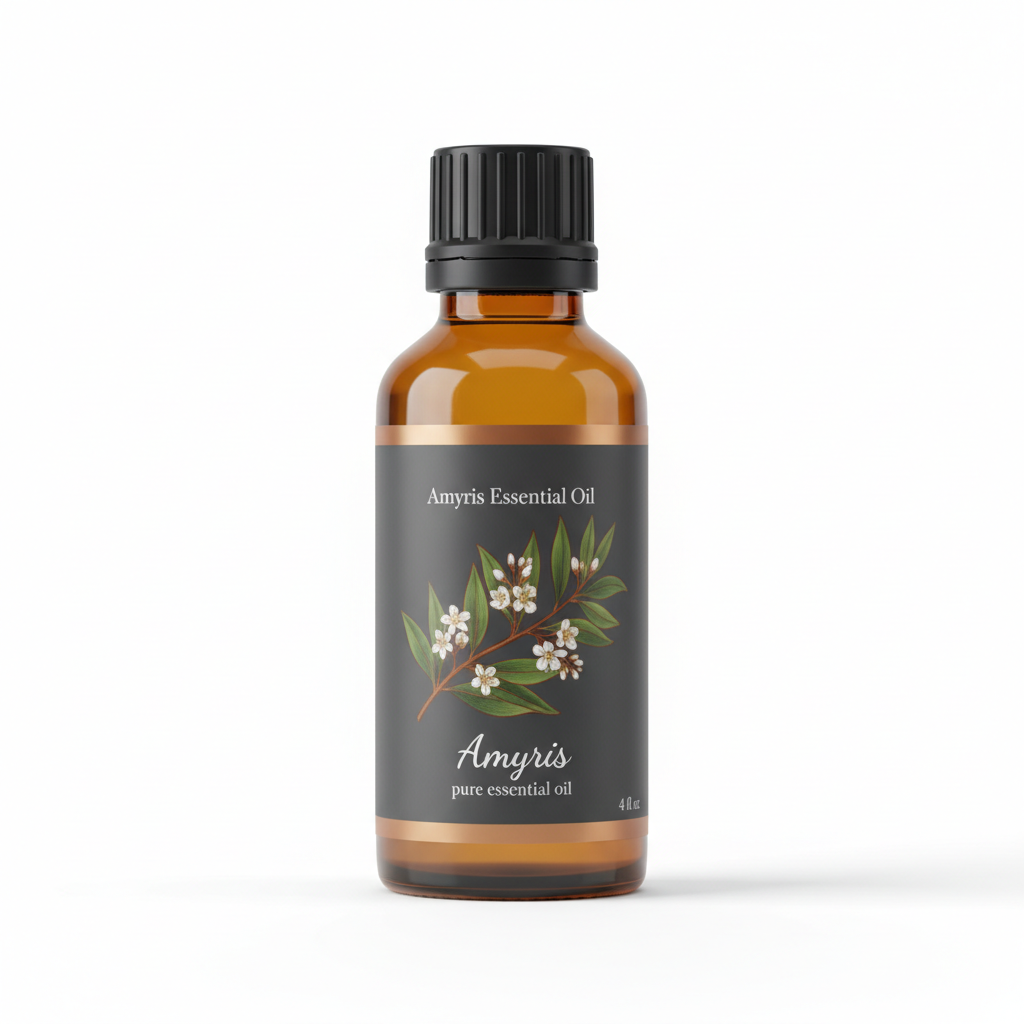
Amyris Essential Oil
Our own Amyris Essential Oil, in sizes from 0.5 oz to bulk.
From $20.99
Shop Now →"Cedarwood" is usually a juniper
The name misleads before any smelling starts. R. P. Adams, in a 1987 Economic Botany paper on new sources of cedarwood oil, identifies the two commercial United States oils as "Texas cedarwood oil" from Juniperus ashei and "Virginia cedarwood oil" from Juniperus virginiana. Both are junipers, called redcedars. A bottle labelled "Atlas cedarwood" comes from yet another source: Atlas cedar belongs to the genus Cedrus, not Juniperus. No composition source for Atlas cedar is cited here, so the comparison below covers the juniper oils (Texas and Virginia) and leaves Atlas out.
Amyris is Amyris balsamifera, a Caribbean tree in the family Rutaceae; the Atlas of Florida Plants lists it as native there under the common name balsam torchwood. The two oils share nothing botanically. When a recipe says "cedarwood" you need to know which oil it means before you substitute anything.
What is in each bottle
Adams reports the major components of the two juniper oils. Texas oil is dominated by thujopsene (about 60%), with cedrol near 19%. Virginia oil has alpha-cedrene (about 27%) and thujopsene (about 28%), with cedrol near 16%. These figures come from the oils Adams examined in 1987, and commercial lots vary, so read them as a profile and not a specification.
For amyris, the measured profile in the open literature is thinner. Kucharska et al. (2021, Molecules) analysed six oils sold as sandalwood by GC-MS. Two were correctly labelled amyris, and they showed valerianol at about 14.5% and 14.4%, elemol at about 9.2% and 9.4%, and eudesmol isomers. A third amyris-type oil, mislabelled as sandalwood, had valerianol near 8%, elemol near 6% and caryophyllene at 11.7%. So even two correctly labelled lots differ from a third, and the profile is a range, not one number.
| Oil | Reported main constituents | Source |
|---|---|---|
| Texas cedarwood (J. ashei) | Thujopsene about 60%, cedrol about 19% | Adams, 1987 |
| Virginia cedarwood (J. virginiana) | Thujopsene about 28%, alpha-cedrene about 27%, cedrol about 16% | Adams, 1987 |
| Amyris (two correctly labelled lots) | Valerianol about 14.4-14.5%, elemol about 9.2-9.4%, eudesmol isomers | Kucharska et al., 2021 |
Reasoning from the compound classes: cedrene and thujopsene are sesquiterpene hydrocarbons, while cedrol, valerianol, elemol and the eudesmols are sesquiterpene alcohols. That points to cedarwood being drier and more hydrocarbon-heavy, and amyris leaning on alcohols. We have no chromatogram of our own to put beside these figures: the lab confirms the valerianol, elemol and eudesmol profile of each lot, we do not publish a GC-MS report, and our published Certificate of Analysis gives only physical constants (relative density 0.952, refractive index 1.505 and optical rotation +21.32 degrees for one batch). Those constants cannot tell you the composition.
How the scents are described
Scent description is where sources are weakest, because no study defines it. The Good Scents Company, a fragrance-materials database, describes amyris bark oil (CAS 8015-65-4) as "woody sweet creamy sandalwood blackcurrant smoky" and Virginia cedarwood oil as "cedar woody oily balsam." Our own shop description of our oil is "creamy, woody, balsamic with a soft vanilla undertone," and the published Certificate of Analysis records its smell as woody, earthy and smoky. Put side by side, the common ground is wood and balsam, and the difference is the sweet, creamy side of amyris against the pencil-shaving, dry-cedar side of cedarwood. We have not smelled the two in a side-by-side test and make no claim about one lasting longer.
The same database lists a substantivity of 388 hours on a smelling strip for Virginia cedarwood and none for amyris. Treat that figure with care: the page does not state the method, and a smelling strip says little about skin. We have no longevity test for amyris, so we do not rank the two on tenacity.
Safety: what the sources say and do not say
A one-line verdict on pregnancy is tempting, and the sources do not support one. Robert Tisserand wrote on his blog in August 2011 that "There is no known reason to avoid any type of cedarwood oil in pregnancy," while noting that Texas cedarwood and its main constituents had not been tested on pregnant rodents. That is a 2011 blog answer, not a trial, and it rests on the absence of known harm and on constituents that had not been tested, so read it as a statement of what was unknown. For amyris, the sources cited on this page contain no pregnancy data at all. Our position, reasoned from that gap: anyone pregnant or nursing should ask an OB-GYN or midwife about either oil and not rely on us or on a recipe.
For skin, a 2020 review by Sindle and Martin in the International Journal of Women's Dermatology says approximately 80 essential oils have been shown to cause contact allergy. Its patch-test table lists cedar oil (10% in petrolatum) and sandalwood oil, and does not mention amyris. Absence from a table is not evidence of safety; it means no one has published the case in those sources. Both oils follow the same rules for skin: dilute, patch test, and keep away from eyes, children and pets, and see a dermatologist for any reaction. Our wider guidance is in amyris oil safety basics.
One regulatory difference matters if you make perfume. The IFRA 51st Amendment index of Standards (30 June 2023) lists cedrene (CAS 469-61-4 and 546-28-1 among its numbers) as a restriction dating from 2020. It does not list amyris oil (CAS 8015-65-4) or cedarwood oil by name. Reasoning from Adams, a Virginia oil with alpha-cedrene near 27% brings that constituent standard into play, so a fragrance maker should ask the supplier for the composition and check the category limits. The category limits for the cedrene Standard are not quoted here, so check them in the Standards themselves. For amyris, no standard under the oil's own name appears in that index, but constituent standards (the index also lists eugenol, for example) apply to any oil that contains those materials, and we do not publish composition data to check against.
How to choose
- You want a creamy, sweeter wood base in a blend. The descriptions above point to amyris. See our comparison of woody essential oils and base-note oils for where it sits among others.
- You want a dry, pencil-shaving wood. The descriptions point to cedarwood. We do not sell it, so buy it from a supplier who gives the species and the lot's composition.
- You need a sandalwood stand-in. Neither oil is sandalwood. We do not call amyris sandalwood. Kucharska et al. found amyris-type oil among the oils sold as sandalwood in their sample, and the comparison is in amyris vs sandalwood and sandalwood alternatives compared.
- You are scaling a perfume formula. Do not substitute one for the other by weight without re-smelling. They are different materials, and any ratio you pick is a starting point we have not trialled.
- You need a diffuser, pets or children in the house. The chemistry above does not change the rules; start with is diffusing essential oils safe.
Cedarwood is a family of oils from different trees, and amyris is one oil from one tree, so the honest answer to "which is better" is which job the base note has. If it is the creamy, balsamic side, our amyris is the one we make; if it is dry cedar, look elsewhere and read the species on the label. For the oil itself, see what is amyris essential oil.
Amyris Essential Oil
Amyris Essential Oil from our own shop, in sizes from 0.5 oz to bulk.
From $20.99
Shop Now →Sources & Further Reading
- Adams, R. P., 1987. Investigation of Juniperus species of the United States for new sources of cedarwood oil, Economic Botany 41(1): 48-54 (Oregon State University juniper site summary). juniper.oregonstate.edu
- Kucharska, M., Frydrych, B., Wesolowski, W., Szymanska, J. A., Kilanowicz, A., 2021. A Comparison of the Composition of Selected Commercial Sandalwood Oils with the International Standard. Molecules 26(8): 2249. pmc.ncbi.nlm.nih.gov
- Sindle, A., Martin, K., 2020. Art of Prevention: Essential oils, natural products not necessarily safe. International Journal of Women's Dermatology 7(3): 304-308. pmc.ncbi.nlm.nih.gov
- Tisserand, R., 2011. Reply on cedarwood oil in pregnancy (blog). roberttisserand.com
- IFRA, 2023. Index of IFRA Standards, 51st Amendment. ifrafragrance.org
- The Good Scents Company, undated pages, read October 2026. Amyris bark oil and cedarwood oil Virginia entries. thegoodscentscompany.com (amyris)
- The Good Scents Company, undated page, read October 2026. Cedarwood oil Virginia. thegoodscentscompany.com (cedarwood)
- Atlas of Florida Plants, undated page, read October 2026. Amyris balsamifera. florida.plantatlas.usf.edu