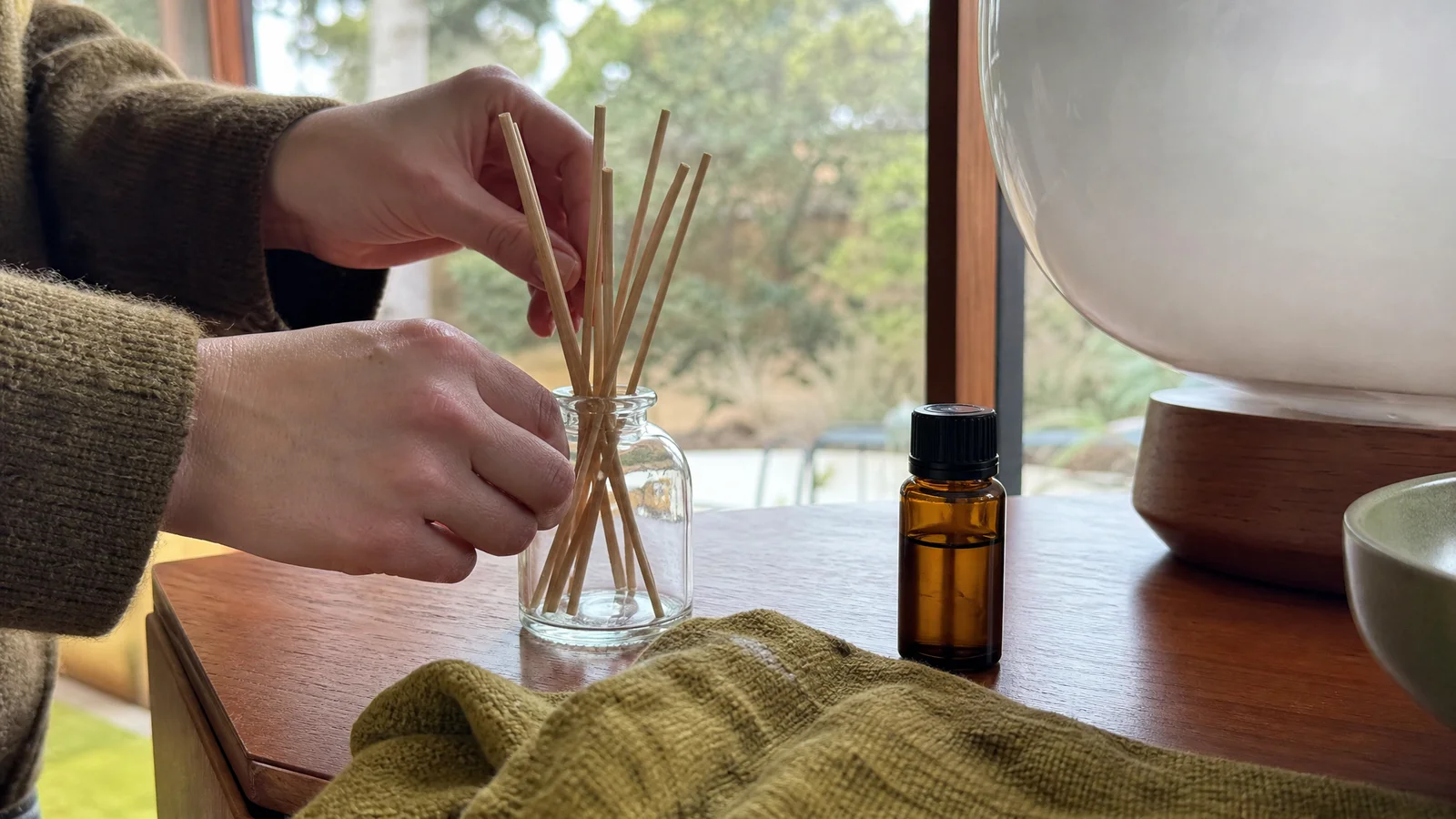
DIY Reed Diffuser: Base Liquids, Fragrance Load and Safety
In a reed diffuser the reeds are only a wick, and the liquid in the bottle decides almost everything: how far it climbs, how fast it evaporates, whether it is a fire hazard, and what happens if a toddler gets hold of it. Reed diffusers are also the home fragrance format with the most useful published poisoning data: a United Kingdom National Poisons Information Service review of 754 exposures over five years found 712 of the patients were under five. A homemade one needs the same care, and the formulas below are arithmetic starting points that we have not trialled.
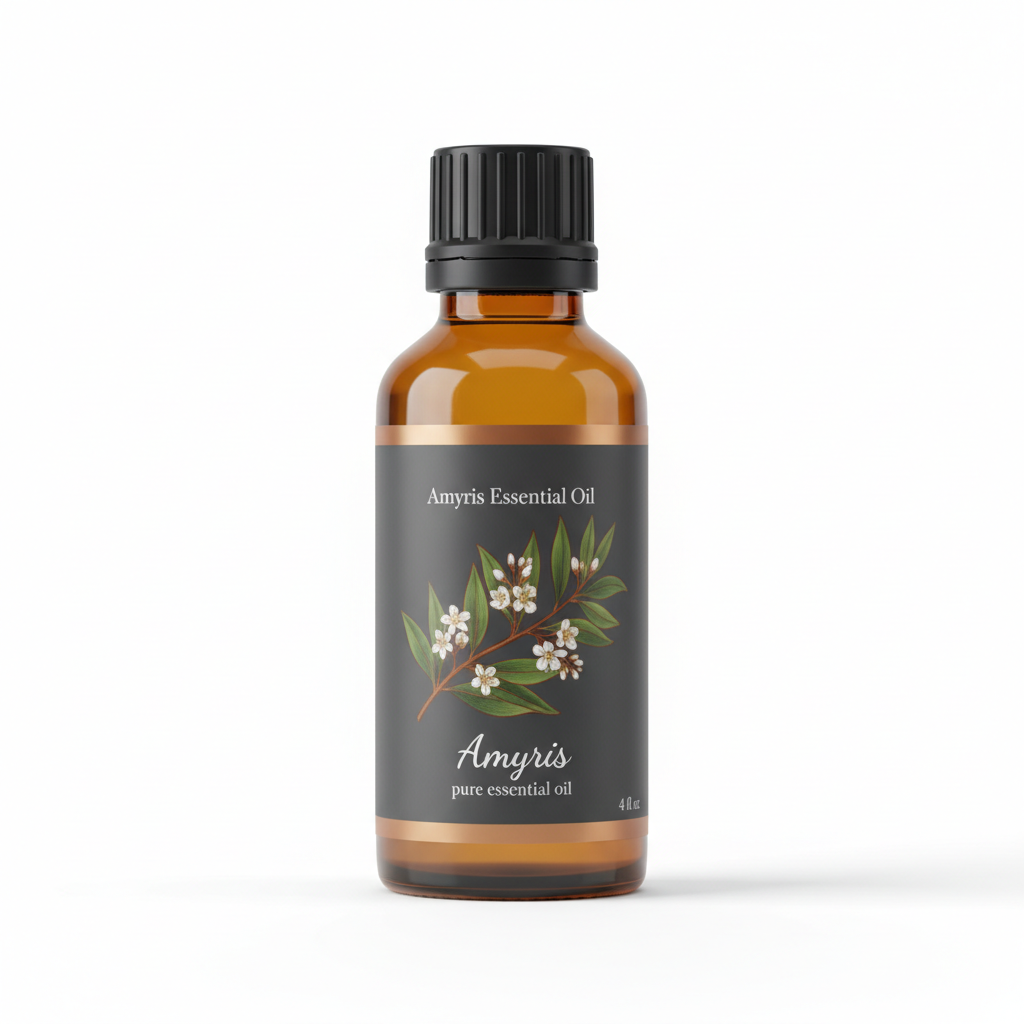
Amyris Essential Oil
Our own Amyris Essential Oil, in sizes from 0.5 oz to bulk.
From $20.99
Shop Now →What the reeds do
A patent for a reed-diffuser device describes the principle plainly: the rods, which "may be made of a natural material, for example, reed or also made of, for example, polyester fiber", are traversed by a system of adjacent capillaries that draw the fragrance oil up to the free end, where it evaporates into the air (Vieira, patent WO2011020519, 2011). Two consequences follow, and both are reasoning from that mechanism rather than anything we have measured. Liquid reaches the tip only as fast as it can climb the capillaries, so a thin liquid wicks readily and a thick one lags. And evaporation happens at the tips, so the number of reeds and the width of the opening change how fast the bottle empties.
What commercial products put in the bottle
The 2016 study by Panchal and colleagues in Clinical Toxicology is the closest thing to a public inventory. It names the ingredients recorded in the enquiries: glycol ethers (including propylene glycol monobutyl ether, dipropylene glycol monomethyl ether and dipropylene glycol n-butyl ether), 3-methoxy-3-methyl-1-butanol, petroleum distillates, ethanol, isopropanol and essential oils (Panchal et al., 2016, Europe PMC record). So commercial bases are mostly synthetic solvents chosen because they are thin and carry fragrance well, not carrier oils. It is a list of what was in reported products, not a statement of what is typical across the market.
The same review matters for safety. Of the 706 patients who swallowed something, the authors tabulate 574 (81.3%) had no symptoms, 117 (16.6%) minor toxicity, 11 (1.6%) moderate toxicity and none severe; the most common symptoms were nausea and vomiting (53 patients), coughing (17) and central nervous system depression (9). The authors also found that products containing 3-methoxy-3-methyl-1-butanol were more likely to cause symptoms than those containing propylene glycol monobutyl ether (p = 0.008). Reading that as a reassurance would be a mistake: the study covers commercial liquids, the 16.6% and 1.6% still describe sick children, and it tells us nothing about a homemade mixture. What it does say is that the solvent matters, and the right place to find out which solvent is in your bottle is its supplier's safety data sheet.
Choosing a base for a homemade diffuser
We do not sell carrier oils, solvents, reeds, bottles or diffusers; they come from any reputable supplier. The only solubility fact we can cite for our oil is from The Good Scents Company's entry for amyris wood oil, which lists it as soluble in alcohol, dipropylene glycol (DPG), isopropyl myristate and benzyl benzoate and insoluble in water (The Good Scents Company, amyris wood oil).
| Base | Why people use it | What to check |
|---|---|---|
| Carrier oil (jojoba, fractionated coconut) | Familiar and easy to buy | Thicker than solvents, so we would expect slow climb and few reeds delivering anything; this is reasoning from viscosity, and we have no wicking data |
| Dipropylene glycol (DPG) | Dissolves amyris per the database; thin enough to wick | Read the supplier's safety data sheet; it is a different substance from the glycol ethers named in the poisoning review |
| Isopropyl myristate | Dissolves amyris per the database | Same: read the supplier's safety data sheet |
| Ethanol or isopropanol | Thin, evaporates quickly | Flammable: the NIOSH Pocket Guide gives ethyl alcohol a flash point of 55 F and flammable limits of 3.3% to 19% |
The flash-point figure is from the CDC's NIOSH Pocket Guide (NIOSH, ethyl alcohol). The Tisserand Institute adds that essential oils are flammable and should not be used in close proximity to a naked flame, and that they should be kept where young children cannot reach them (Tisserand Institute, safety guidelines, read October 2026). Our advice is to keep any diffuser away from candles, hobs, heaters and electric sockets, and to choose a base that is not alcohol.
Fragrance load: the number nobody can source
We looked for a standards body, regulator or peer-reviewed source giving a recommended fragrance percentage for reed diffusers and did not find one we could open and verify. Supplier pages disagree with one another and we are not quoting any of them as authority. So the load below is a dial, with arithmetic, and a way of watching what it does.
| Load by volume | Amyris oil | Base liquid |
|---|---|---|
| 10% | 5 mL | 45 mL |
| 15% | 7.5 mL | 42.5 mL |
| 20% | 10 mL | 40 mL |
Our oil's published relative density is 0.952 at 20 C (Certificate of Analysis, batch AMYQGAABHTC003A), so 5 mL weighs about 4.8 g; if you mix by weight, use that conversion. Start at 10%, with 3 or 4 reeds, and change only one variable at a time: load, then reed count. Keep notes: date, load, reed count, and the level of liquid after a week, because the level is the only reliable measure of how fast the bottle is evaporating. We do not publish a longevity figure because we have no test data.
A reminder about strength: we found no published safe percentage for an airborne reed diffuser equivalent to the Tisserand dilution ranges for skin, and an inhaled scent is a different exposure from a skin one. Fewer reeds, a smaller bottle opening and a small room are all ways to lower the dose without touching the formula.
Why an amyris-based blend keeps its shape
In an open bottle the fastest-evaporating materials leave first, so the scent drifts toward the slowest. The Good Scents Company lists a substantivity of 400 hours for amyris wood oil, 388 for Virginian cedarwood and just 12 for lavender, without stating how the figures were measured (cedarwood Virginia, lavender France). A 2013 analysis by Manuel Zarzo found a strong negative correlation (r = -0.85) between perceived freshness and substantivity (Zarzo, 2013). Reasoning from these, a diffuser that is mostly woody base materials should change less over its life than one that is mostly citrus, which will lose its brightness first. This is the extent of the claim: we do not state how many weeks any blend lasts. Our shop copy describes amyris as a base note that helps citrus and floral top notes hold, which is the basis for using it as the anchor of a blend; for ideas, see amyris diffuser blends.
Spills, children, pets, and where it should not go
Put the diffuser on a tray and well out of children's reach, because the liquid is the hazard and the reeds can be sucked: in the Panchal review, 31 patients sucked on reeds. For a swallowed or splashed liquid, call your local poison control center or doctor with the product's ingredient list. Solvent spills can mark varnished wood and plastic; we do not know how your finish will react, so use a tray and wipe spills at once. Pets are not small people; ask your veterinarian before putting any essential oil diffuser in a room they use, and see essential oils and pet safety. Skip it in rooms where someone with asthma sleeps unless their doctor agrees: the Tisserand Institute's page reports anecdotal accounts that certain oils trigger attacks.
Not a fit: nurseries, homes with crawling children and low shelves, and anyone looking for a product that "purifies" the air; we make no such claim. For the other formats of home scenting, natural home fragrance compares them, essential oil diffuser types covers electric ones, and the water-based room and linen spray has its own limits.
Amyris Essential Oil
Amyris Essential Oil from our own shop, in sizes from 0.5 oz to bulk.
From $20.99
Shop Now →Sources & Further Reading
- Panchal, B., Eddleston, M., Thomas, S.H., Thompson, J.P., Vale, J.A., 2016. 754 exposures to reed diffusers reported to the United Kingdom National Poisons Information Service 2010-2014. Clinical Toxicology 54(4). europepmc.org
- Vieira, P.Q., 2011. Device for dispensing volatile substances according to the reed diffuser principle. Patent WO2011020519. patents.google.com
- The Good Scents Company, read October 2026. Amyris wood oil; cedarwood oil Virginia; lavender oil France. thegoodscentscompany.com
- CDC NIOSH, undated page, read October 2026. Pocket guide to chemical hazards: ethyl alcohol. cdc.gov
- Tisserand Institute, undated page, read October 2026. Safety guidelines. tisserandinstitute.org
- Zarzo, M., 2013. What is a fresh scent in perfumery? Perceptual freshness is correlated with substantivity. Sensors 13(1). riunet.upv.es