How to Blend Essential Oils: One Change at a Time
Here is something that surprises most beginners: the top, middle and base labels on an oil do not tell you how many drops to use. They describe how quickly a scent leaves a blotter or your skin. Use the pyramid as vocabulary, and build blends the way a cook develops a sauce, changing one thing at a time and tasting between.
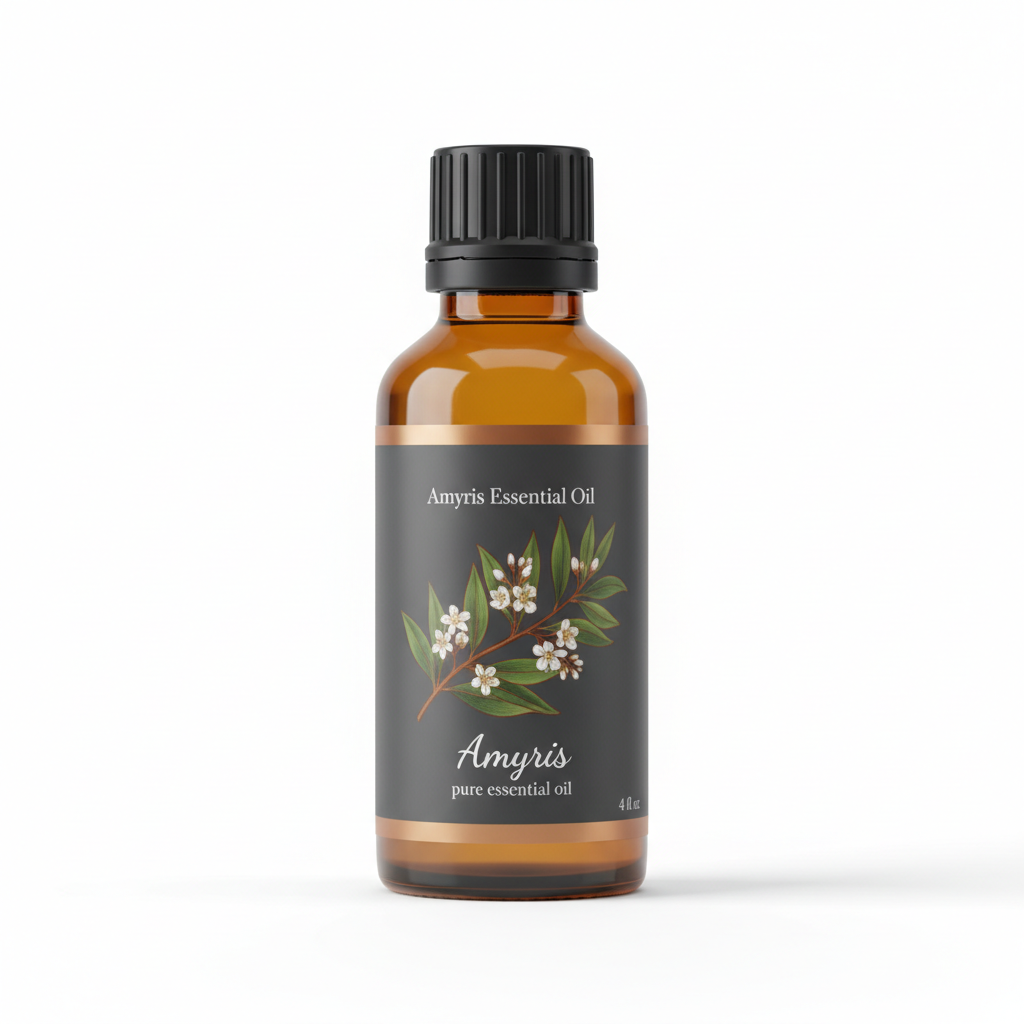
Amyris Essential Oil
Our own Amyris Essential Oil, in sizes from 0.5 oz to bulk.
From $23.99
Shop Now →What the pyramid actually says
A 2021 review of perfume chemistry in Molecules, by Rodrigues and colleagues, attaches rough skin durations to Jean Carles' pyramid: top notes, typically citrus, about 15 to 30 minutes; middle notes such as spice and florals, three to four hours; base notes, more than four hours. Those are teaching numbers, not promises, but they make the point. The labels sort materials by fade rate and say nothing about strength.
Steffen Arctander, the perfumery writer, described three stages when you judge an oil on a blotter. The topnote is the first impression, the body-note is the main character with a longer life, and the dry-out is what remains hours later and shows the oil's tenacity. His example is lemon oil: a fresh topnote of very short duration, a body that lasts an hour or two on a blotter, and no tenacity at all. Sage clary, in contrast, slides into a rich body of long duration. Pleasantness and lasting power are two separate things.
Why a fixed ratio rarely works
You will see 30/50/20 (top/middle/base) passed around as a rule. We would treat it as a convention at best. A strongly scented base oil at 20% can swamp everything above it, and a quiet one at 40% can barely register. And Arctander notes that some materials, vetiver and patchouli among them, show no typical dry-out within the same day and need at least 24 hours of study, so a sniff after ten minutes tells you nothing about the base. Pick a ratio as a first draft and expect to move it.
A method that keeps you in control
- Decide the job. A diffuser blend, a body oil and a perfume do not evaporate under the same conditions, so what works on paper has not yet proven itself on skin.
- Choose the base first. It is the slowest to judge and sets the foundation.
- Add the middle, then the top, smelling after each addition.
- Change one thing per draft: a material or its share, never both. If draft four is worse than draft three, you know why.
- Keep a log. Draft number, formula in parts, the single change, and your impressions at first sniff, 30 minutes, three hours and the next day.
- Keep conditions steady. Same room, away from cooking smells, on the same blotter paper.
Fix the total essential oil percentage before you balance the parts, since that is the safety decision. Our dilution chart and safety guide cover it.
A worked example with amyris as the base
Suppose you want a woody-citrus body oil in a 10 mL bottle at 2% total essential oil. That is 0.2 mL of oil and 9.8 mL of carrier. Draft one uses equal roles, 1:1:1, so about 0.067 mL each of base, middle and top. For draft two, change only the base share to 2:1:1: 0.10 mL base, 0.05 mL middle, 0.05 mL top. The carrier is something you buy at a craft shop or pharmacy, and 2% is the top of the range we give for amyris on skin, so it makes a reasonable ceiling while you learn.
What does amyris bring as a base? We describe it as creamy, woody and balsamic. Arctander described the oil as faintly woody, not dry, with a very tenacious body that eventually fades to a weak woody-balsamic note, and called it a mild blender. So amyris is a gentle supporting base that rounds a blend, and it is a good one for that role. For a base with a more commanding dry-out you would reach for another material. Our posts on blending amyris with citrus, spice and florals and amyris in perfumery show which pairings suit it.
Keep the drafts tiny
Make your drafts small: a few drops on a blotter, or a 5 mL bottle at most. If a draft goes wrong you have lost a few drops and nothing else, and you will be far more willing to try something odd. Big batches make people cautious, and cautious blends tend to be dull.
Give your nose a rest between drafts. Step outside for a breath of fresh air or take a few minutes with something else, because after several sniffs everything begins to smell the same. Come back to the strips later and you'll notice which ones still hold your interest.
And keep the boring draft. The one you almost threw away is sometimes the one that smells best the next morning.
Reading a blotter honestly
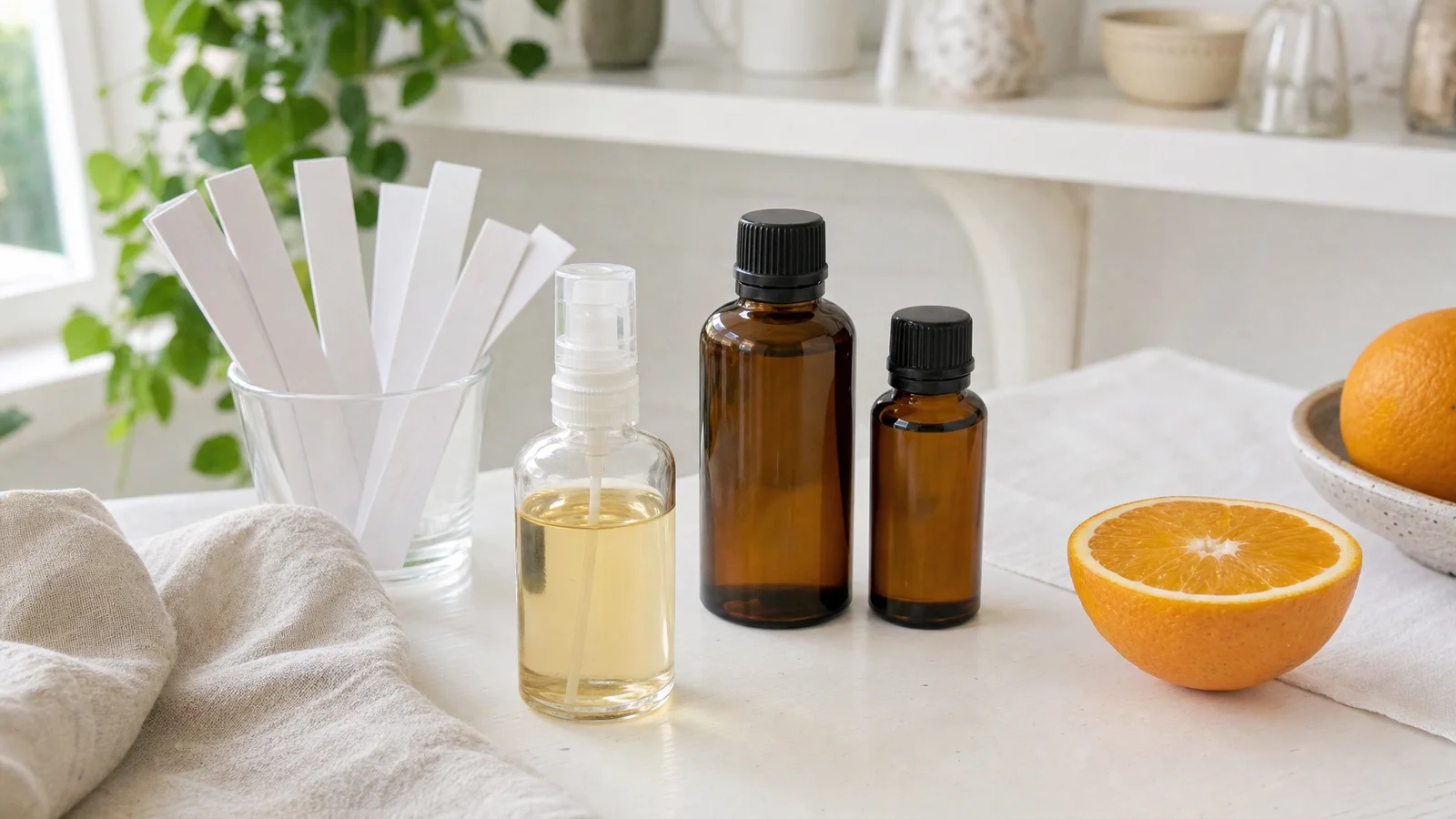
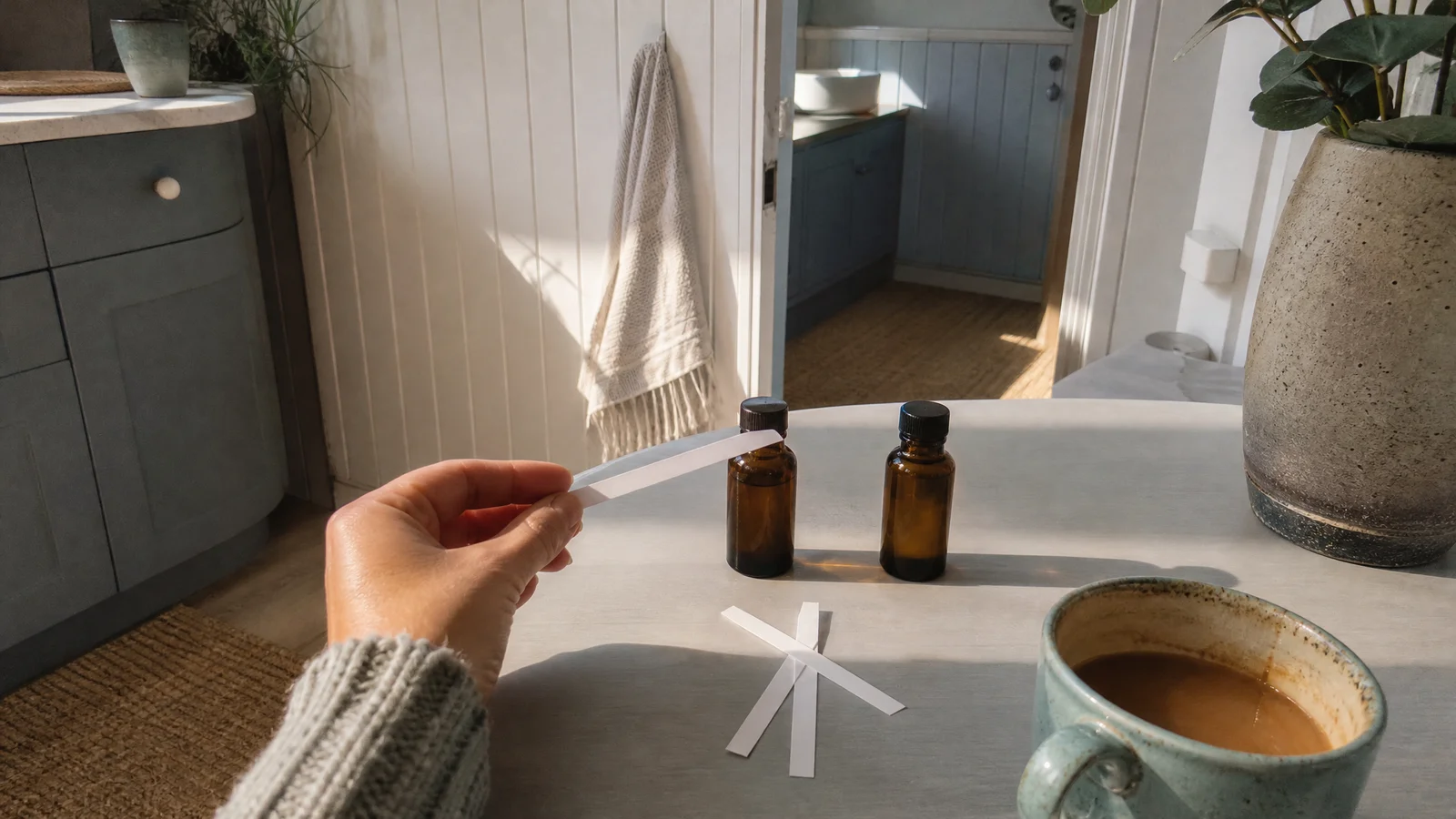
Dip a strip in each draft, label it, and come back at your log intervals. Note what you smell first, what you smell when the top has gone, and what remains the next day. A blotter is only a guide: the perfumery chemist J. Stephan Jellinek cautioned in 1960 that something that slows evaporation on paper is not necessarily doing so on skin, since conditions differ. Once a draft looks promising, try it in its final form.
The simplest blends often win. Two or three oils, a clear job and a log will teach you more than a drawer full of half-used bottles.
Amyris Essential Oil
Amyris Essential Oil from our own shop, in sizes from 0.5 oz to bulk.
From $23.99
Shop Now →Sources & Further Reading
- Rodrigues et al. Molecules 2021. pmc.ncbi.nlm.nih.gov/articles/PMC8196857
- Arctander S. Perfume and Flavor Materials of Natural Origin, 1960. archive.org/details/ArctanderPerfumeryBook
- Jellinek JS. Evaporation and the odor quality of perfumes. J Cosmet Sci 1960;12(3). library.scconline.org/v012n03/42