Essential Oils on Skin: Dilution and Safety Basics
Most lists of "the best essential oils for skin" skip the three things that matter most: how much oil is in the bottle, what it is dissolved in, and whether your skin has already learned to react to fragrance. Get those right and almost any blend is a gentler experience. Get them wrong and the fanciest oil will not rescue it.
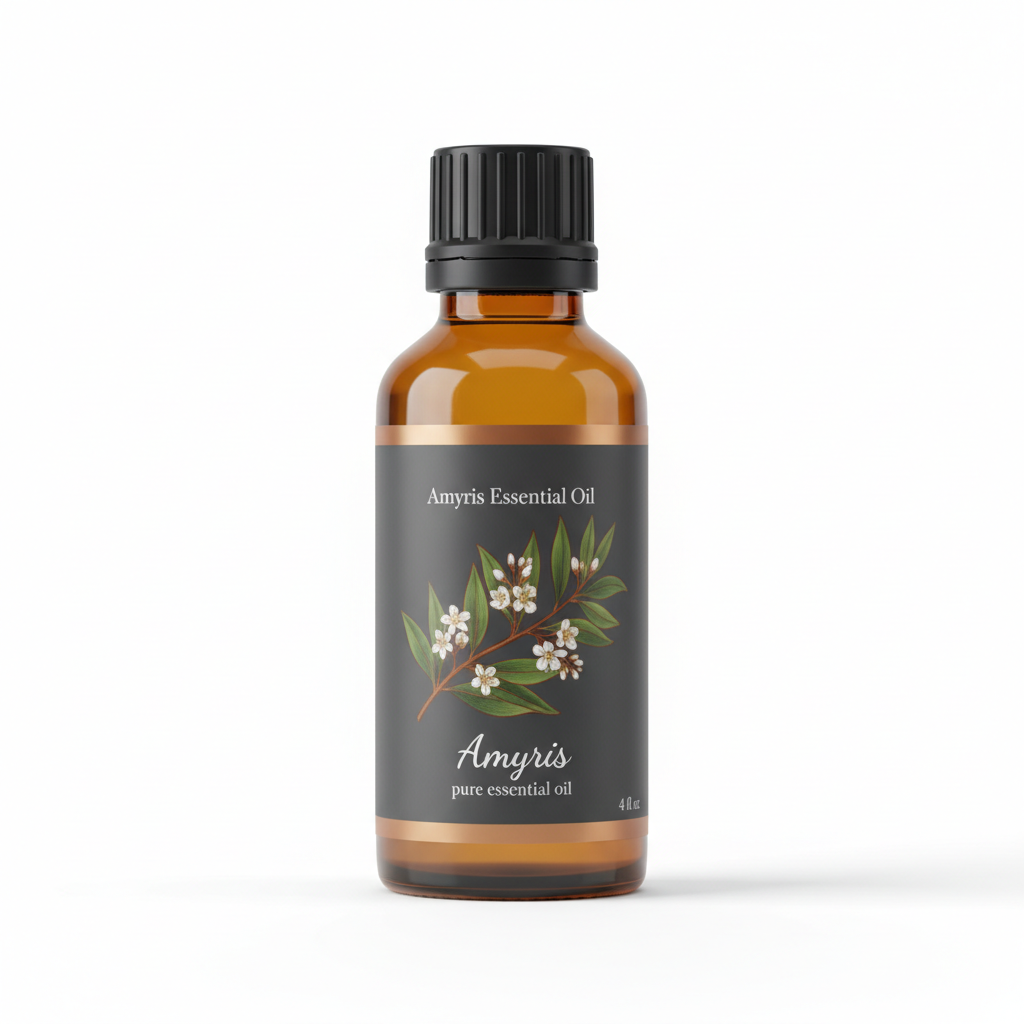
Amyris Essential Oil
Our own Amyris Essential Oil, in sizes from 0.5 oz to bulk.
From $23.99
Shop Now →Start with the percentage
Robert Tisserand's published ranges are the numbers most blenders work from, and the Tisserand Institute presents them as guidelines, not laws. For reaction-prone or impaired skin the range is 0.2% to 1%. For the face it is 0.5% to 1.2%. For body oils and lotions it is 1% to 3% (Tisserand Institute).
Our own guidance for amyris is to dilute to 0.5% to 2% in a carrier oil and patch test first. Putting the two together, here is what we would do: take the bottom of whichever band applies. For anything on the face, stay at 0.5% to 1%. For a first body oil, 1% is plenty. A scent you can only just notice on your skin is usually the right strength, because essential oil is a fragrance first and a skin ingredient never. The arithmetic for drops, millilitres and percent lives in our dilution chart.
It is easy to get carried away in the first few days of a new hobby, when every oil seems interesting. A good habit is to keep things deliberately plain. Choose one carrier, one oil and one percentage, make a small amount, and use it for a while. Boring is a good sign. A routine that you can describe in one sentence is a routine you can keep an eye on.
Fragrance allergy is the real risk
Contact allergy to fragrance ingredients is one of the best documented skin problems in cosmetics. A 2025 update from Sukakul and Svedman describes fragrances as still the most prevalent cosmetic allergens (Current Allergy and Asthma Reports, 2025). Natural does not mean exempt: many essential oils contain compounds, linalool and limonene among them, that are on the EU's list of fragrance allergens.
The practical lesson is to change one thing at a time. Add one new oil, wait, and only then add another. If a blend ever causes redness, itching or swelling, stop using it, and see a dermatologist if it does not settle within a day or two.
The patch test is a screen, not a clearance
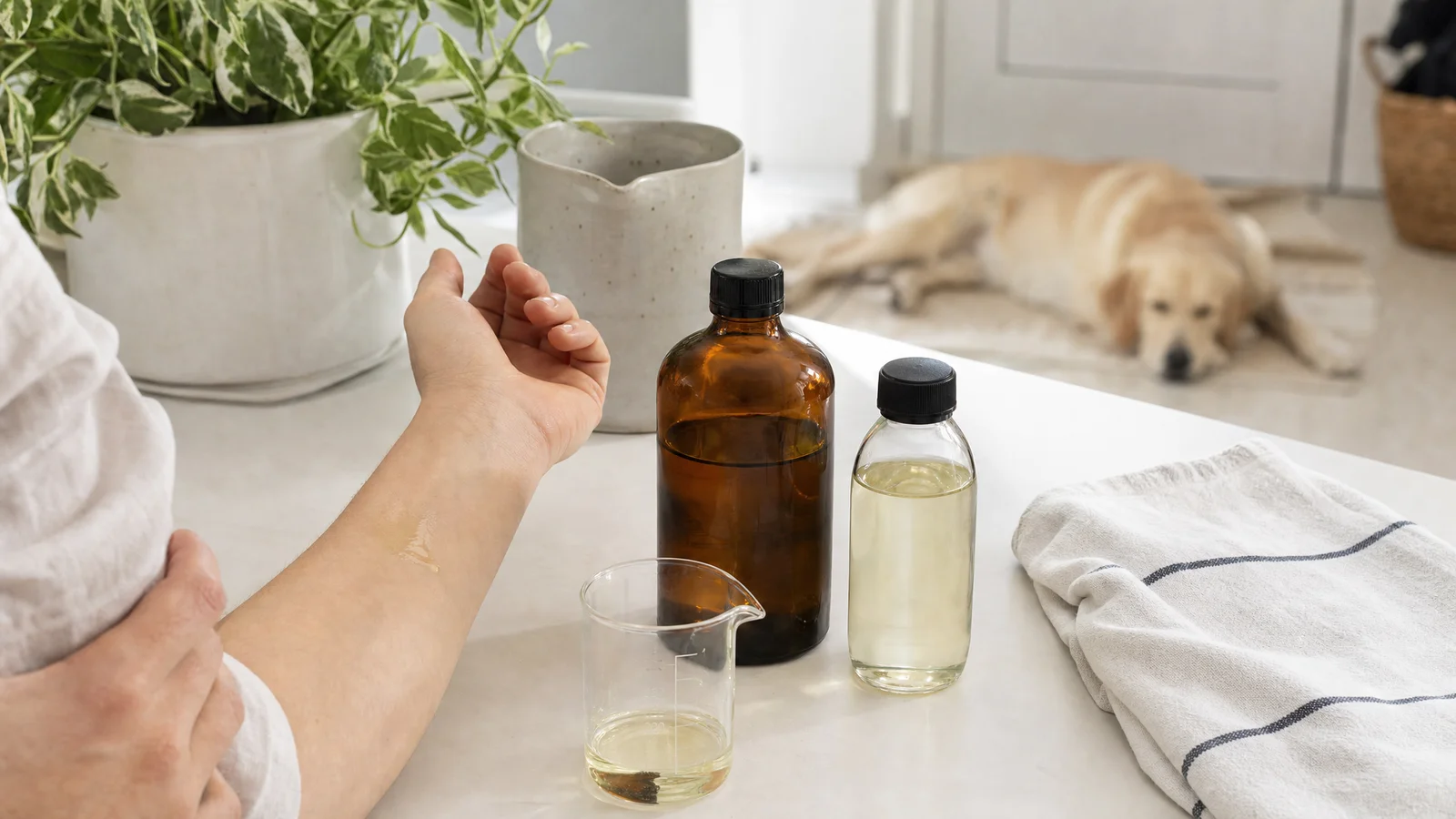
We do ask you to patch test, and we also want you to know what it can and cannot do. The Tisserand Institute says a patch test is not 100% reliable and that irritation usually fades within hours while an allergic reaction can last days or weeks (irritation and allergic reactions). So a clean forearm an hour later is encouraging, not final. Give it a full day, and keep using the blend lightly at first. Our guide to patch testing covers the method.
The carrier is nearly the whole bottle
At 1%, the carrier is 99% of what touches your skin, so choose it as carefully as the oil. A 2017 review by Lin and colleagues reports one study in which olive oil, rich in oleic acid, harmed the skin barrier in adult volunteers while sunflower seed oil, rich in linoleic acid, did not, though a small infant pilot saw no difference (Lin et al., 2017). That is a reason not to treat olive oil as the automatic default. We do not sell carrier oils; any reputable supplier will do, and our carrier oils guide compares them. If you have a tree nut or peanut allergy, skip those oils altogether.
Pay attention to how the blend feels as well as how it smells. A good diluted oil should sit lightly on your skin and soak in without a greasy film. If it feels heavy, you may have used too much carrier on a small area. If your skin feels tight or prickly, wash it off and start again with less. You will quickly learn what feels right for your own skin on your own forearm, and that knowledge is better than any chart.
Mind the sun
Pressed citrus oils such as bergamot can make skin react to sunlight. The Tisserand Institute cites an IFRA maximum of 0.4% bergamot oil in a leave-on product for sun-exposed skin and advises keeping treated skin out of UV for at least 12 hours (phototoxicity). If you blend with citrus, check our phototoxic oils guide first.
Where amyris fits
If you like a quiet woody scent, a good way to enjoy amyris is in a small bottle of body oil, mixed at the gentle end of the range. Open the bottle, smell it on its own, then smell it again once it is mixed into the carrier. You will notice that the aroma becomes softer and rounder once it is diluted, which is exactly why a low percentage still smells like something.
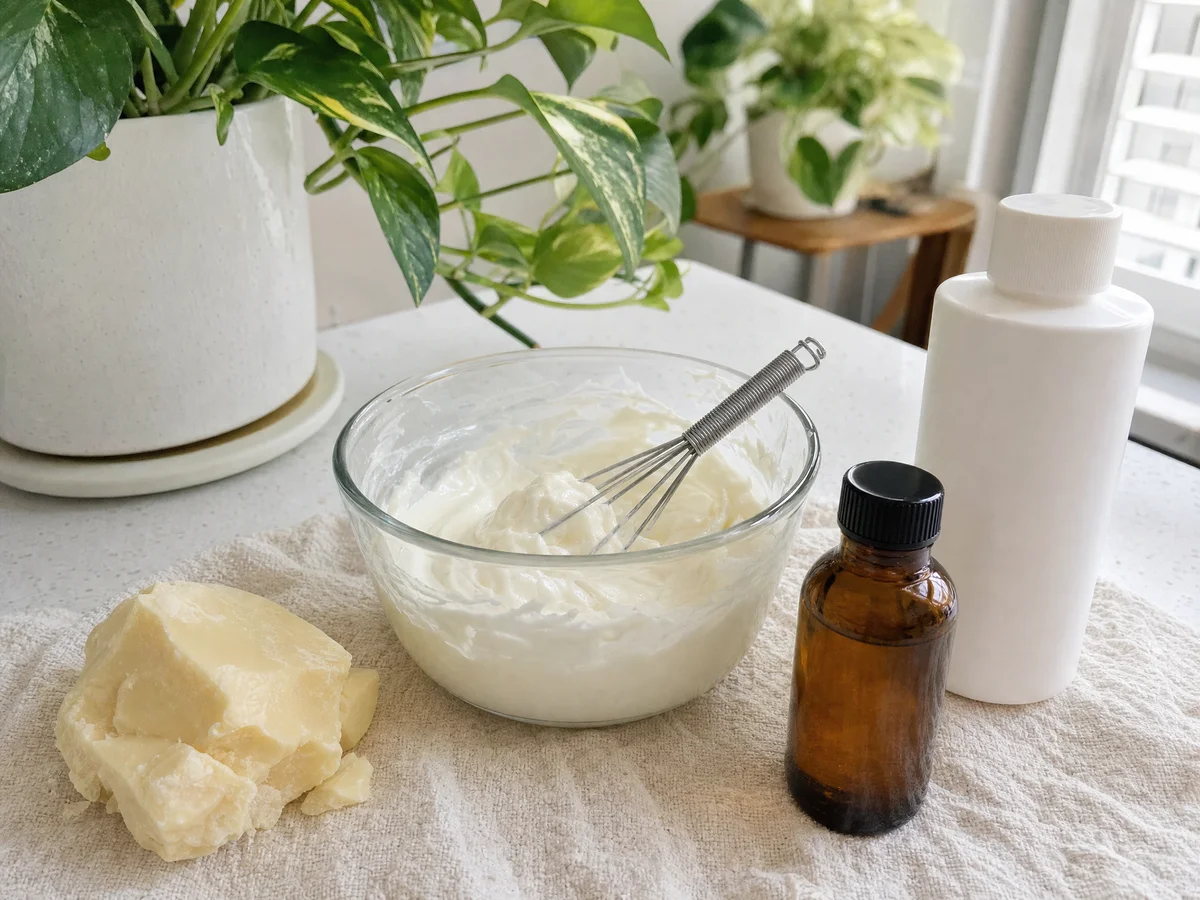
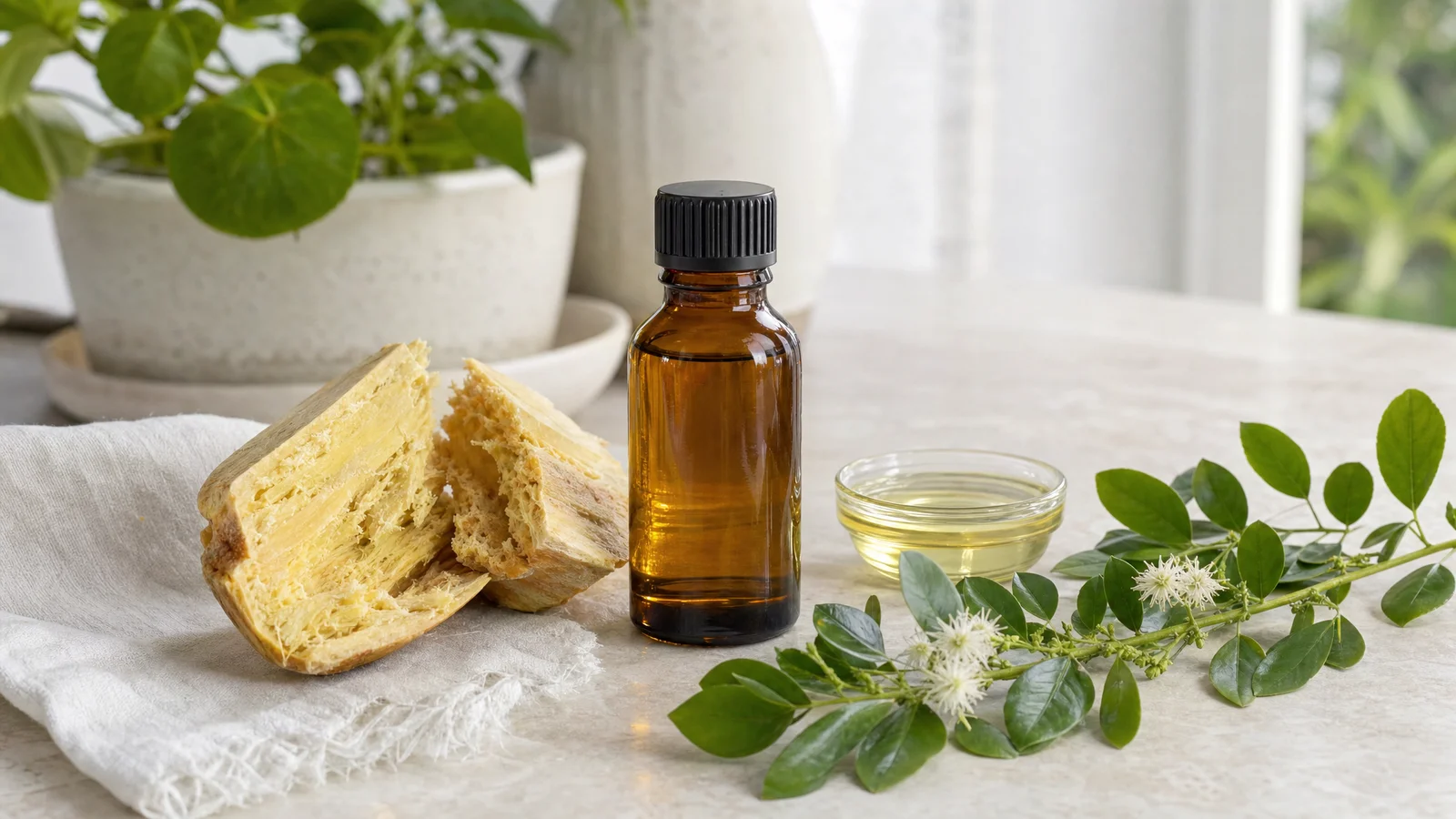
We sell one oil, amyris, steam distilled from wood and sold undiluted. Its scent is creamy, woody and balsamic, and it is a base note, so on skin it does one narrow job: a quiet woody fragrance in a blend you dilute yourself. We make no claim that it changes any skin condition. For broken, inflamed or easily irritated skin, a dermatologist should choose what goes on it, and for babies, children and pregnancy a pediatrician, OB-GYN or midwife is the right person to ask.
Whatever you make, low, slow and one change at a time is the habit that keeps skin happy.
Amyris Essential Oil
Amyris Essential Oil from our own shop, in sizes from 0.5 oz to bulk.
From $23.99
Shop Now →Sources & Further Reading
- Tisserand Institute. Essential oil dilution. tisserandinstitute.org/safety/dilution
- Tisserand Institute. Irritation and allergic reactions. tisserandinstitute.org
- Tisserand Institute. Phototoxicity. tisserandinstitute.org
- Sukakul T, Svedman C, 2025. What is new in contact allergy to cosmetics. pmc.ncbi.nlm.nih.gov
- Lin TK, Zhong L, Santiago JL, 2017. Anti-inflammatory and skin barrier repair effects of topical application of some plant oils. pmc.ncbi.nlm.nih.gov