Essential Oil Shelf Life and Storage: When Oxidation Matters
An essential oil does not expire on a date the way milk does; it drifts, and the part of the drift that matters most for skin is not the smell. Oxygen, light and heat convert some of an oil's own terpenes into oxidation products, and several of those products are contact allergens. So the useful question is not "has it gone off?" but "has it sat open, warm or in the light long enough that I should not put it on my skin?", and no nose can answer that reliably.
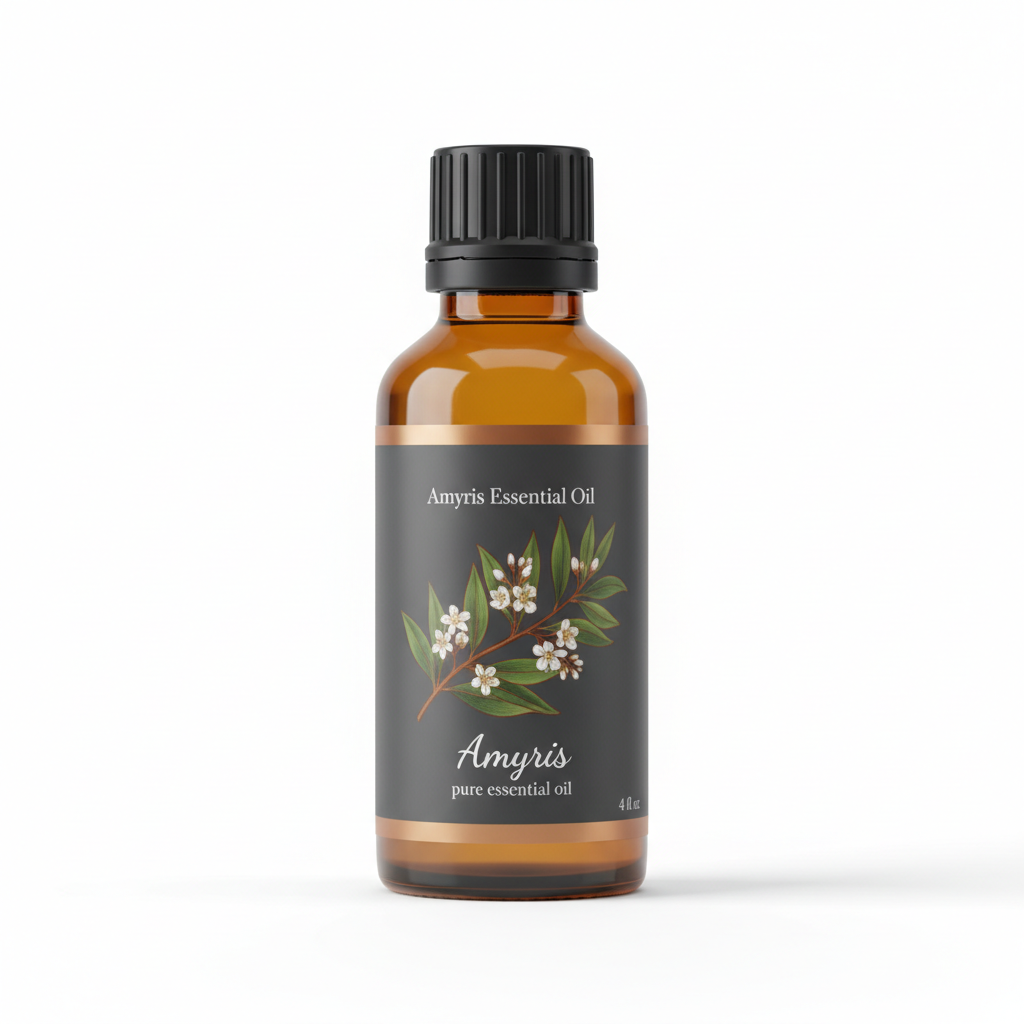
Amyris Essential Oil
Our own Amyris Essential Oil, in sizes from 0.5 oz to bulk.
From $20.99
Shop Now →What changes in the bottle
The standard review is Turek and Stintzing, 2013, "Stability of essential oils: a review" in Comprehensive Reviews in Food Science and Food Safety. Its abstract describes essential oils as made of lipophilic, highly volatile components that are "susceptible to conversion and degradation reactions," says oxidation and polymerization can reduce quality and pharmacological properties, and names temperature, light and oxygen availability as the key factors. The Tisserand Institute's course page on oxidation and shelf life (updated March 2022) lists the same three causes, oxygen, light and heat, and its outline covers glass color, sediment and interaction with plastic over time.
There is a limit to what we can tell you beyond that. The Institute's course includes a shelf-life chart for 96 oils, but the chart is a handout and we could not read it, and we could not open a primary study that measures how long a given oil takes to reach a stated level of oxidation. Shelf-life years circulate widely online. We are not repeating any of them as fact, since none of the pages we could open ties a number to a measurement. The planning figure that applies to our own oil is given further down, labelled as a listing.
Why oxidation is a skin question
The clearest numbers in the literature are about allergy. A 2005 study across six European dermatology centers (Matura and colleagues, Contact Dermatitis) patch tested 1,511 consecutive dermatitis patients with oxidized fragrance terpenes. It found 1.3% reacted to oxidized linalool and about 0.5% to oxidized caryophyllene, and it noted that limonene, linalool and caryophyllene are "not allergenic themselves but readily form allergenic products on air-exposure." A pooled audit of 17,359 patients tested in 2021 and 2022 (Uter and colleagues, Contact Dermatitis, 2026) found the terpene hydroperoxides produced the highest number of positive patch-test reactions among 19 audit allergens: 7.65% for linalool hydroperoxide at 1% in petrolatum and 6.78% for limonene hydroperoxide at 0.3% in petrolatum. The authors report that the terpene hydroperoxide reactions were considered clinically relevant in more than two thirds of cases.
Two cautions keep those numbers in proportion. They describe people who were already being patch tested for suspected contact dermatitis, not the general public, and the test materials were made in a lab at fixed strengths, so they cannot tell you how oxidized a particular bottle at home is. Reasoning from them: the preparations that provoke reactions are small percentages of oxidation product, so an old, air-exposed oil should not be assumed safe for skin simply because you dilute it. We publish no composition percentages for our oil, and we make no claim about how much limonene or linalool it holds. That is also a reason not to guess.
A 2020 case report (Kwong and Lim, JAAD Case Reports) adds a caution about trusting your eyes. A man's older roll-on antiperspirant had darkened to a deeper pink, which the authors linked to air oxidation of limonene, yet he did not react more strongly to the older product than the newer one. It is a single case, so we draw only one modest conclusion: color change is a hint, and a clear, normal-looking oil is not a certificate.
The variables you control
| Variable | What the sources say | What to do |
|---|---|---|
| Oxygen | Named as one of three key factors (Turek and Stintzing; Tisserand Institute). | Every time you open a bottle, air replaces the oil you used. A nearly empty large bottle holds more air relative to oil than a full one, so decant to a smaller glass bottle once a bottle is mostly used, and close it promptly. |
| Light | Named as a key factor. The Institute's outline lists which glass colors work best, but we could not read its conclusion. | Keep oils in dark glass in a closed cupboard, not on a sunny shelf or beside a diffuser. |
| Heat | Named as a key factor. | A cool room beats a windowsill, a car or a shelf above a radiator. This is the lever the sources agree on; fridge claims we could not source, so we do not make one. |
| Plastic | The Institute's outline lists "interaction with plastic over time" as a topic. | We do not know what it concludes. Glass is the safe default for storing neat oil. |
| Time open | No source we could read gives a measured open-bottle clock. | Write the date you first opened the bottle on it, so you stop guessing. |
What our own bottles tell you
Each bottle of our amyris carries a lot number and two dates, a still date and a fill date, and it comes in amber glass. The lot number lets us send you the independent laboratory report for that lot on request. Our shop listing gives a shelf life of typically 4 to 6 years unopened, kept in a cool, dark place, and the published Certificate of Analysis for batch AMYQGAABHTC003A carries a best-by date of 03/31/2030. Those are our listing and our label, not a measurement: we have no stability study of our own, and we found no published study of the keeping time of Amyris balsamifera oil, so the 4 to 6 years is a planning figure and not a guarantee. Opening a bottle starts a clock whose length nobody has measured. Our amyris storage page and the amyris FAQ cover the same bottle from the amyris side.
Our advice is reasoning, not a rule from a source: for a scent project (a candle, a diffuser blend), an older bottle that still smells right is usually a cost question. For skin, including anything left on overnight, we would retire a bottle that is well past its dates or has been open, warm or half-empty for a long time, and we would rather you replaced it than tested it with your nose. If you are unsure, a patch test narrows the question, though it cannot clear an oxidized oil.
Old oils, children and disposal
The National Capital Poison Center's page on essential oils (undated, read October 2026) advises storing oils locked up and out of reach of children and pets, and considering safely discarding old oils if young children are in the home. For how to dispose of them, ask your local household hazardous waste program or a pharmacist, since the rules differ by place and we have not verified a method. A dermatologist is the person to see about a rash that appeared after using an old oil, and Poison Control (1-800-222-1222 in the US) is the number to call if a child has swallowed any.
The short version fits on a label: dark glass, cool, closed, dated when opened, and retired earlier for skin than for scent. For the broader questions of what to buy and how to use it safely, see how to choose essential oils and the essential oil safety guide.
Amyris Essential Oil
Amyris Essential Oil from our own shop, in sizes from 0.5 oz to bulk.
From $20.99
Shop Now →Sources & Further Reading
- Turek C, Stintzing FC, 2013. Stability of essential oils: a review. Comprehensive Reviews in Food Science and Food Safety 12(1):40-53. doi.org (abstract read via the Crossref record for DOI 10.1111/1541-4337.12006)
- Tisserand Institute, updated March 2022. Oxidation and the shelf life of essential oils (course page). tisserandinstitute.org
- Matura M and colleagues, 2005. Selected oxidized fragrance terpenes are common contact allergens. Contact Dermatitis. doi.org (abstract read via Europe PMC record 15932583)
- Uter W and colleagues, 2026. Patch test results with additions to the European Baseline Series, 2021/22. Contact Dermatitis. doi.org (abstract read via Europe PMC record 42135251)
- Kwong HL, Lim SPR, 2020. Pigmented contact dermatitis in the axillae caused by hydroperoxides of limonene. JAAD Case Reports 6(6):476-478. pmc.ncbi.nlm.nih.gov
- National Capital Poison Center (Poison Control), undated page, read October 2026. Essential oil poisoning. poison.org