Can You Ingest Essential Oils? What the Sources Disagree On
We do not recommend swallowing any essential oil, and our amyris oil is not sold or described for internal use. The careful sources do not say "never" in one voice, though, and the gap between them is worth understanding: the conditions under which a trained practitioner might direct oral use look nothing like the drops-in-water habit that spreads online.
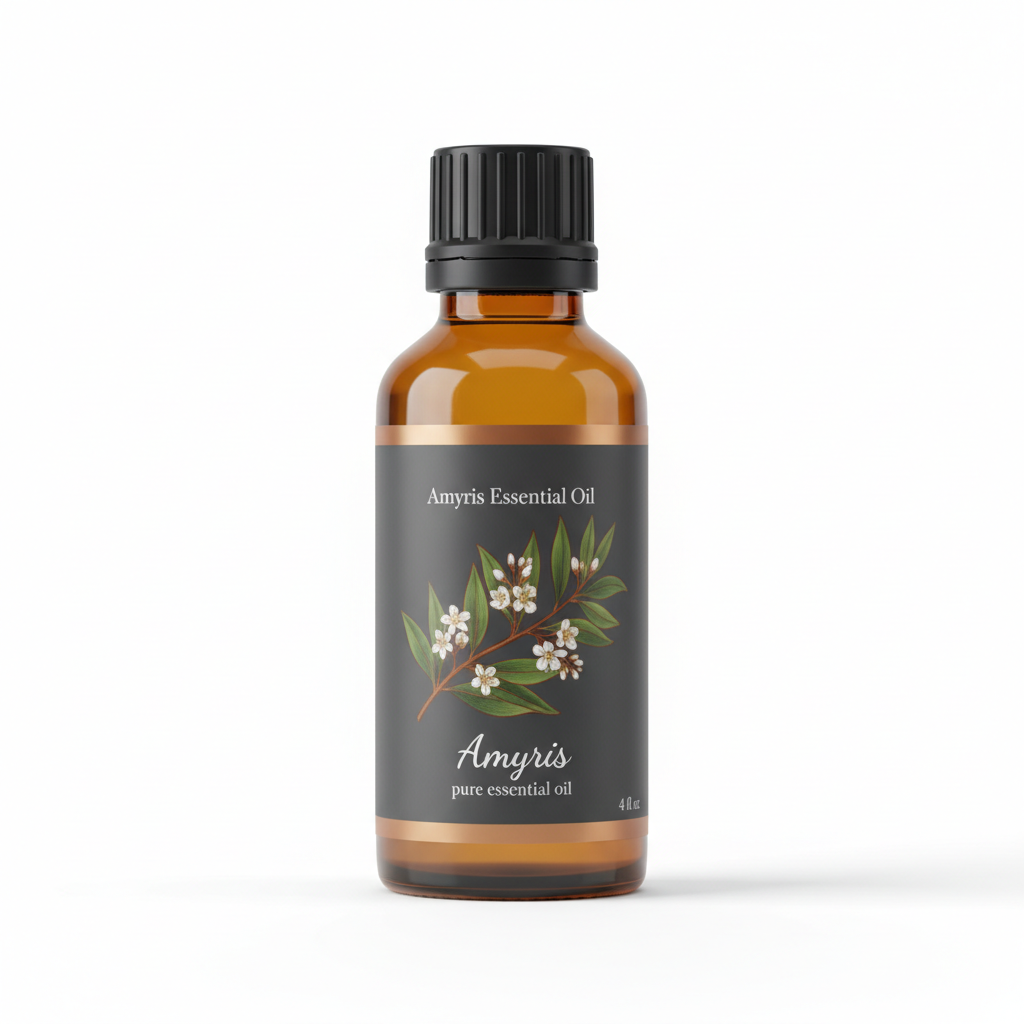
Amyris Essential Oil
Our own Amyris Essential Oil, in sizes from 0.5 oz to bulk.
From $20.99
Shop Now →Where the careful sources disagree, and where they do not
The Tisserand Institute, which publishes widely read aromatherapy safety guidance, is not a flat "never." Its safety guidelines (undated page, read October 2026) say "Do not ingest essential oils unless advised to do so by a practitioner," and in the same passage that "One or two drops of most essential oil can be safely taken in a day, but more than this is not recommended." A Tisserand Institute blog post by Andrea Canales (undated page, read October 2026), written as a diploma project, argues that oral use can be safe only when a trained aromatherapist chooses the oil, dose, duration and carrier, usually in capsules, and calls drinking drops in water a mistake. The National Capital Poison Center (Poison Control, undated page, read October 2026) is blunter: swallowed essential oils can be poisonous, and it tells people to call for help if anyone swallows one.
Reasoning from those three: they agree on the conditions (a practitioner, a calculated dose, no casual use) and differ in tone. None of them describes what most people searching this question have in mind, which is putting drops in a glass of water or a smoothie because a label, a video or a friend said to. We are a shop, not clinicians, and nobody here is qualified to prescribe a dose to anyone. If a physician or a pharmacist with training in aromatherapy wants a patient on an oil by mouth, that is their judgment to make; it is not ours, and it is not something a product page can do for you.
The claims, one at a time
| Claim | What the sources say |
|---|---|
| "Natural means it is safe to swallow." | In a 2007 conference paper (Tisserand, AIA Conference, 2007), Robert Tisserand reports that overdose has caused fatalities, "most commonly in very young children who remove the cap from a bottle of essential oil and drink the contents," and that eucalyptus and pennyroyal oil have each been fatal in 1 oz doses. He also lists seizures after hyssop (2 doses of 10 drops), sage (1 dose of 12 drops) and thuja (5 doses of 20 drops). |
| "A few drops in water dilutes it." | Essential oils do not dissolve in water. Canales makes the same point: the oil floats, so the drink is effectively undiluted oil meeting the stomach lining, which she describes as more sensitive than skin. |
| "Essential oils are food-safe, so drinking them is fine." | FDA's list of substances generally recognized as safe includes a section titled "Essential oils, oleoresins (solvent-free), and natural extractives" (21 CFR 182.20). The wording is "generally recognized as safe for their intended use," and the intended use is flavoring food. It lists peppermint, lavender and lemon, among many others. It does not list amyris or sandalwood in the text we read, so it gives no flavoring status to our oil. |
| "The label says it is okay, so someone approved it." | FDA's aromatherapy page (content current as of 09/08/2023) says the law does not require cosmetics to have FDA approval before sale, and that FDA decides a product's intended use from its labeling and marketing. The page does not mention swallowing at all. |
| "A single drop cannot hurt a child." | Poison Control describes an 18-month-old who swallowed a small amount of lavender extract and was very drowsy and confused three hours later, recovering in about 6 hours, and a 22-month-old who ate a small piece of camphor and had a seizure lasting over an hour. An Australian review of calls to a poisons centre found that 63% of 4,412 essential oil exposures were in people under 15, and the authors warned that as little as 5 mL can cause life-threatening toxicity in children (Lee, Harnett and Cairns, Medical Journal of Australia, 2020). |
| "Only cheap or adulterated oils are dangerous." | The poisonings in the sources above come from the oils' own constituents: Poison Control names camphor, wintergreen (it compares a swallowed amount to "a large number of adult aspirin tablets") and pennyroyal, and Tisserand identifies thujones and pinocamphones behind the seizures. Reasoning from that, a purer and more concentrated oil is a more potent one, not a safer one. |
What goes wrong, in order of how fast it happens
Poison Control says camphor can cause seizures within a few minutes even from a small amount, and that breathing swallowed oil into the lungs can cause pneumonia. It also notes that products often contain other oils or alcohol that add their own toxicity. Canales adds a slower concern: oral doses go through the liver before reaching the rest of the body, and the listed risks of oral use include irritation of mucous membranes and liver and kidney effects. We cite her as a diploma-project summary of secondary sources, not as a toxicology study, and we would not put numbers on any of it.
The Australian data adds a practical point about how these accidents happen. Most of the 4,412 exposures were accidental (80%), and 13% were therapeutic errors, usually a bottle mistaken for a liquid medicine such as cough liquid. The authors recommend keeping essential oils apart from oral medicines. Tisserand's guidelines note that "even two-year old kids have been known to unscrew caps on essential oil bottles and drink the contents," and that an orifice reducer "helps a little." We make no child-resistance claim for our bottles. Store every essential oil out of reach and in a different place from medicines.
The marketing version, and why it is a legal question too
Some sellers pair "take drops daily" with named diseases. FDA's aromatherapy page explains why that matters: a product is a cosmetic when it is intended only to cleanse or beautify, and it is a drug when it is intended for a therapeutic use such as treating or preventing disease. The page adds that "The fact that a fragrance material or other ingredient comes from a plant doesn't keep it from being regulated as a drug." Drugs need FDA approval before sale, and instructions to swallow an oil for a named condition are claims, not safety data.
Where amyris stands
Our shop guidance for amyris says to dilute it to 0.5% to 2% in a carrier oil for skin, patch test first, keep it away from eyes, children and pets, and not to take it internally. We make no medicinal claim for it. We could not find a published oral-safety study for Amyris balsamifera that we could read, and the lack of one is not evidence that swallowing it is safe; it means nobody can give you a dose. Our oil is sold undiluted, which is exactly the form that is most dangerous to swallow.
If someone has swallowed one
Call Poison Control in the US at 1-800-222-1222, which the National Capital Poison Center describes as free, confidential and open 24 hours a day, or use its online tool. The Tisserand Institute's adverse-reaction page (undated, read October 2026) says to get help urgently if a young child swallows any amount, and for swelling of the lips, tongue or throat or difficulty breathing, call emergency services. Have the bottle in your hand when you call so the person on the line can see the oil name and any other ingredients. Do not wait for symptoms, since Poison Control notes seizures can begin within minutes. For questions about oils and your own medicines, a pharmacist is the right person to ask, and a physician for a medical condition. For the wider picture, including skin and eye contact, see our essential oil safety guide.
For related questions, see essential oils and children, essential oils and pets, and why grade labels do not decide safety. Our own short answer is on the page for amyris oil safety basics.
The simplest rule that holds up across every source here is also the least exciting: for most people an essential oil bottle holds a skin, fragrance and diffuser product, and the one thing it adds to a glass of water is risk.
Amyris Essential Oil
Amyris Essential Oil from our own shop, in sizes from 0.5 oz to bulk.
From $20.99
Shop Now →Sources & Further Reading
- Tisserand Institute, undated page, read October 2026. Safety guidelines. tisserandinstitute.org
- Canales A, Tisserand Institute, undated page, read October 2026. To ingest or not to ingest, that is the question. tisserandinstitute.org
- Tisserand R, 2007. Proof of Safety: Challenges Facing Essential Oil Therapy (AIA Conference, Denver). tisserandinstitute.org
- Tisserand Institute, undated page, read October 2026. What to do when experiencing an adverse reaction. tisserandinstitute.org
- National Capital Poison Center (Poison Control), undated page, read October 2026. Essential oil poisoning. poison.org
- Lee, Harnett and Cairns, 2020. Essential oil exposures in Australia: analysis of cases reported to the NSW Poisons Information Centre. Medical Journal of Australia 212(3). mja.com.au
- US FDA, content current as of 09/08/2023. Aromatherapy. fda.gov
- US Code of Federal Regulations, Title 21, section 182.20. Essential oils, oleoresins (solvent-free), and natural extractives (including distillates). law.cornell.edu