What Is Amyris Essential Oil? The Complete West Indian Sandalwood Guide
Key Takeaways
- Amyris essential oil is steam-distilled from the aged heartwood of Amyris balsamifera, a small tree native to Haiti and the wider Caribbean.
- Despite the common nickname "West Indian sandalwood," amyris is a botanically distinct species with its own unique scent profile and price point.
- The oil is prized as a fixative and base note in perfumery, and as a skin-conditioning ingredient in lotions, body oils, and balms.
- Amyris oil is widely regarded as a budget-friendly sandalwood alternative for both cosmetic formulators and home blenders.
- Like all essential oils, amyris requires proper dilution before skin contact. Consult a qualified healthcare provider before use if you have any concerns.
What Is Amyris Essential Oil?
Amyris essential oil is a pale yellow to golden, viscous oil steam-distilled from the wood of Amyris balsamifera, a flowering shrub and small tree that grows throughout Haiti, Jamaica, and the wider Caribbean basin. Its common trade names include West Indian sandalwood oil, torchwood oil, and candlewood oil, though none of these reflects a true botanical relationship to Indian or Australian sandalwood.
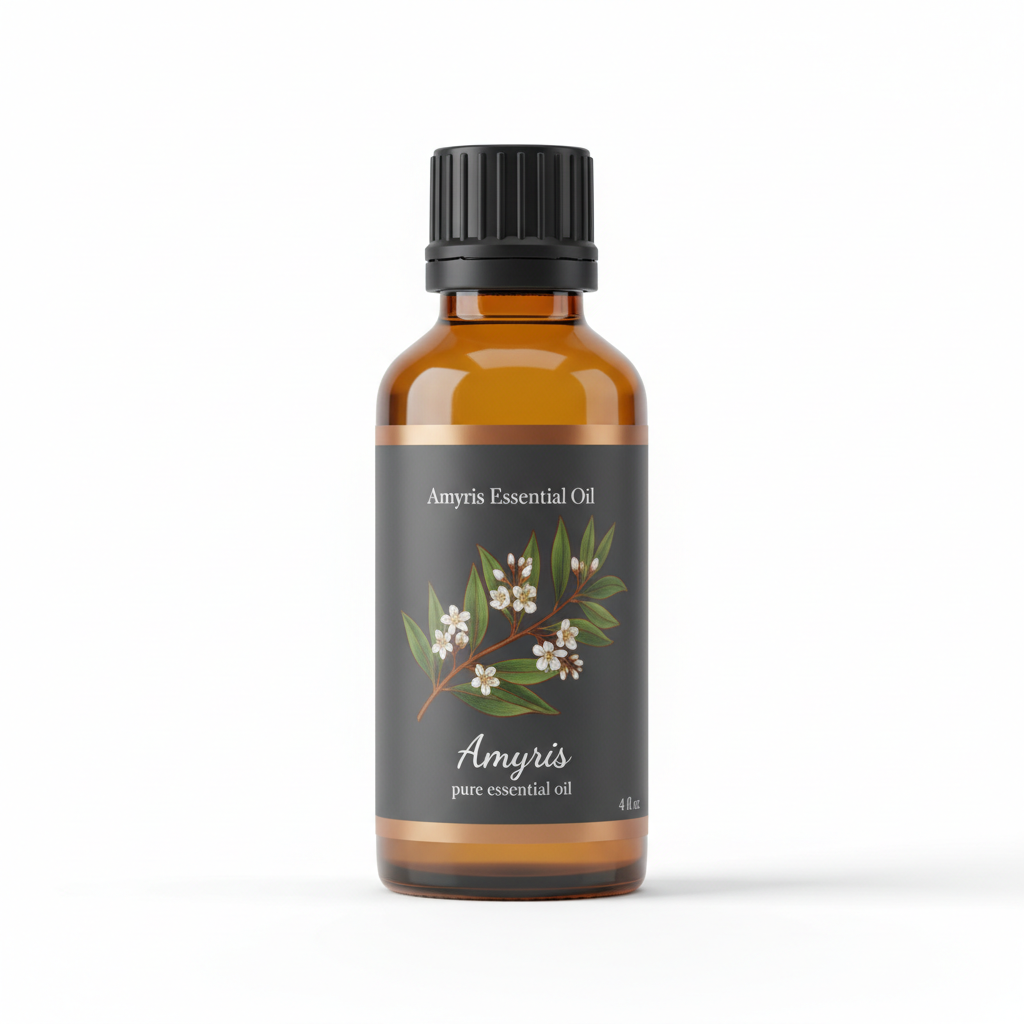
Amyris Essential Oil
Our own Amyris Essential Oil, in sizes from 0.5 oz to bulk.
From $23.99
Shop Now →The oil has a warm, woody, faintly balsamic scent that sits comfortably in the base of a fragrance pyramid. That tenacity is one reason perfumers and soap makers have relied on amyris for generations. It lingers. It rounds out sharper notes. It gives a blend a sense of depth without dominating the composition.
In the world of natural cosmetics, amyris oil also serves a practical second role: skin conditioning. The oil absorbs reasonably well, leaves a soft finish, and carries a pleasing scent that does not overwhelm a formulation. For independent formulators working on body butters, facial serums, or luxury massage blends, it offers genuine versatility at a price that places it far below Indian sandalwood (Santalum album).
This guide covers the entire amyris story: the plant, the production method, the scent, the cosmetic applications, and the practical details any buyer or blender needs before adding a new bottle to the shelf.
The Plant Behind the Oil: Amyris balsamifera
Botanical Classification
Amyris balsamifera belongs to the family Rutaceae, the same broad plant family that includes citrus trees, rue, and burning bush. That places it in surprisingly fragrant company. The genus Amyris comprises roughly 40 species distributed across tropical and subtropical regions of the Americas, but A. balsamifera is the species most commonly harvested for essential oil production.
For a deeper look at the plant itself, see our dedicated profile: Amyris balsamifera: The Caribbean Torchwood Tree Behind the Oil.
Where It Grows
The tree is native to the dry coastal hills and limestone scrublands of Haiti, where the majority of commercial production originates today. It also grows naturally in Jamaica, Cuba, Trinidad, Venezuela, and parts of the Dominican Republic. Historically, Haitian supply has dominated the global market, and most bottles labeled "West Indian sandalwood" trace their origin to Haitian distilleries.
The species is well-adapted to rocky, nutrient-poor soils and tolerates periods of drought. It is not a large tree. Mature specimens rarely exceed 6 meters in height, with gnarled, resin-rich branches that become increasingly oily as the wood ages. That resin is central to the story of the oil.
Why the Wood Is Called Torchwood
The nickname "torchwood" is not poetic license. Amyris balsamifera wood is so saturated with volatile resins that it burns with a bright, sustained flame. Haitian communities historically collected fallen branches and dead wood to use as torches, candles, and kindling. Sailors and rural households prized it for the same reason. The oil-rich character that made it a practical light source is the same quality that makes it valuable for steam distillation.
The name "candlewood" carries the same origin, used in parts of the Caribbean and colonial-era records to describe the brilliance with which the wood burned. Explore the full historical arc in our article: A Short History of Amyris: Candlewood, Torchwood, and Island Trade.
Sustainability Considerations
Unlike true sandalwood, which faces serious pressure from over-harvesting and slow regeneration, Amyris balsamifera is considered a comparatively abundant species in its native range. The tree grows reasonably quickly and regenerates from cut stumps. Haiti's long-standing distillation industry suggests the species can be managed sustainably when harvested responsibly.
That said, buyers who prioritize ethical sourcing should still ask suppliers about their harvest practices. Deforestation pressures in Haiti are real and complex. Responsible sourcing means looking for suppliers who work with traceable, small-scale Haitian cooperatives or can demonstrate replanting commitments.
How Amyris Oil Is Made
The Role of Aged Heartwood
The most important thing to understand about amyris production is that resin content increases significantly as the wood ages. Freshly cut branches yield comparatively little oil. Aged, dead, or fallen wood, especially the dense heartwood at the center of older trunks and branches, contains the highest concentration of the sesquiterpene compounds that give amyris its characteristic scent.
This is why traditional Haitian harvest practices often involve collecting dead standing wood or material that has seasoned naturally on or near the ground. Some producers chip or mill the wood before distillation to maximize surface area exposure during the steam process.
Steam Distillation
Amyris oil is produced almost exclusively by steam distillation, the same method used for most woody essential oils. Wood chips or sawdust are packed into a still, and steam is passed through the material at controlled pressure. The steam volatilizes the aromatic compounds, which travel through a condenser and separate from the water as the condensate cools. The resulting oil floats on the surface and is collected.
Because amyris wood has a relatively high oil content, yields are generous compared to many other wood oils. This contributes directly to its accessible price point. A well-packed still working with properly aged heartwood can produce enough oil to make commercial-scale supply viable even from a small, family-run operation.
Distillation runs for amyris can be lengthy, sometimes exceeding 24 hours, because the heavier sesquiterpene molecules require sustained steam contact to volatilize fully. Shorter runs may produce a thinner, less rounded oil that lacks the depth of a properly extended distillation. This is one of the quality markers worth exploring with suppliers.
Read more about the production process in detail: How Amyris Oil Is Distilled: From Aged Heartwood to Amber Oil.
Key Chemical Constituents
The primary aromatic compounds in amyris essential oil are sesquiterpene alcohols and sesquiterpene hydrocarbons. These are the molecule classes responsible for its fixative quality and woody warmth. Common constituents identified in GC/MS analysis include:
- Valerianol: a sesquiterpene alcohol associated with the creamy, balsamic quality of the oil
- Elemol: contributes a soft, woody, slightly citrus-adjacent nuance
- Eudesmol isomers: present in several woody oils and associated with tenacity and depth
- Intermedeol: another sesquiterpene alcohol found in notable concentrations in high-quality amyris
- Guaiol: present in smaller quantities, adds additional depth to the base profile
The precise proportions vary by harvest region, wood age, and distillation method, which is why scent and viscosity can differ between batches and suppliers. A GC/MS report from a reputable supplier is the most reliable way to verify what you are actually purchasing.
Scent Profile and Fragrance Character
First Impressions on the Strip
Open a bottle of quality amyris essential oil and the first impression is quietly compelling rather than dramatic. The scent is woody, smooth, and slightly sweet, with a balsamic undertone that some describe as faintly reminiscent of vanilla-wood or dried fruit skin. There is no sharp green note, no pronounced resinous bite, and very little of the medicinal character that can appear in some wood oils.
It is a patient scent. It does not announce itself. On a blotter strip, amyris opens slowly and evolves gradually over hours rather than minutes.
The Dry-Down
As the oil dries down, the balsamic sweetness retreats slightly and the woody, creamy facets become more prominent. Some experienced blenders note a faint milky or cashew-like quality in the deeper dry-down, an aspect that makes amyris particularly useful in oriental and gourmand compositions. The scent remains largely linear, meaning it does not transform dramatically but simply becomes cleaner and woodier as time passes.
How It Compares to True Sandalwood
The comparison to true sandalwood is inevitable, given the nickname, but the two oils are genuinely different. Indian sandalwood (Santalum album) has a creamier, more intensely smooth quality with a distinctive milky-wood character that amyris approaches but does not fully replicate. Australian sandalwood (Santalum spicatum) is drier and slightly more astringent. Amyris sits somewhere adjacent to both: warmer and more balsamic than Australian sandalwood, but less voluptuously creamy than Indian sandalwood.
For some compositions, that distinction matters enormously. For others, the overlap is sufficient and the price difference makes amyris the practical choice. A full comparative scent analysis is available in our guide: What Does Amyris Essential Oil Smell Like? A Full Scent Profile.
Position in a Fragrance Pyramid
Amyris is almost always a base note. Its molecules are heavy, slow to evaporate, and persistent on skin and fabric. In a structured fragrance blend, it will still be detectable hours after the top and middle notes have faded. This makes it valuable as both a fragrance ingredient and a fixative, a compound that slows the evaporation of lighter, more volatile notes in a blend.
"Amyris works in a blend the way a well-chosen frame works for a painting. You may not focus on it directly, but without it, everything else feels less anchored."
A perspective shared frequently among natural perfumers
Amyris vs. True Sandalwood: Understanding the Difference
The "West Indian sandalwood" label has caused genuine confusion in the essential oil market for decades. Clearing up the distinction serves both buyers and the broader conversation about ethical sourcing and ingredient transparency.
Botanical Distinction
True sandalwood species belong to the genus Santalum, family Santalaceae. Amyris balsamifera belongs to the genus Amyris, family Rutaceae. These are not related genera. The "sandalwood" name attached to amyris is a trade nickname, likely adopted because the two oils share some olfactory characteristics and because amyris was historically used to extend or substitute for more expensive sandalwood in commercial perfumery and soap-making.
Price and Accessibility
| Feature | Amyris (A. balsamifera) | Indian Sandalwood (S. album) |
|---|---|---|
| Botanical family | Rutaceae | Santalaceae |
| Primary origin | Haiti, Caribbean | India, Australia |
| Scent character | Warm, balsamic, woody | Creamy, milky, smooth wood |
| Relative price | Accessible | Expensive to very expensive |
| Sustainability profile | Relatively abundant; fast-regenerating | Significant conservation concerns for wild-harvested material |
| Use in perfumery | Base note, fixative, blender | Base note, featured accord |
| Viscosity | Moderately viscous | Viscous to very viscous |
When Amyris Is the Right Choice
Amyris earns its place on its own merits, not simply as a substitute. For high-volume cosmetic production where a warm, woody background note is needed across large batches, amyris offers reliable quality at a cost that does not make large-scale use prohibitive. For natural perfumers who want a sustainable base to build upon without the ethical complications surrounding wild-harvested sandalwood, amyris provides a genuine and transparent choice. For home blenders exploring woody compositions for the first time, its forgiving price makes experimentation low-risk.
It is worth being straightforward with end users and customers: amyris is not sandalwood. Label it honestly. The oil has enough genuine quality to stand on its own without borrowed prestige.
Cosmetic and Aromatic Uses
Skin Care Formulations
Amyris oil is a genuinely useful ingredient in skin care formulations. It absorbs without leaving a heavy, greasy residue, and its scent is pleasant enough to double as a natural fragrance component within a product. Formulators working on body oils, facial serums, luxury balms, and moisturizing lotions frequently incorporate it at low percentages to contribute both a conditioning quality and a subtle woody fragrance.
The sesquiterpene alcohols that dominate the oil's chemical composition are known to have good skin affinity. They are not irritating at appropriate concentrations and they tend to play well with other botanical oils and butter-based formulations. Amyris blends particularly smoothly with carrier oils such as jojoba, argan, and rosehip, making it easy to incorporate into complex cosmetic bases.
For a full breakdown of how amyris oil performs in cosmetic applications, visit: Amyris Oil for Skin: Cosmetic Uses in Lotions and Body Oils.
Body and Massage Oils
Body and massage formulations are among the most natural fits for amyris essential oil. Diluted into a carrier oil base at the appropriate percentage, it contributes warmth and a quietly luxurious character to massage blends. Paired with lavender, it softens into something that works beautifully for an evening wind-down ritual. Paired with bergamot or citrus oils, it provides the grounding base note that keeps bright blends from feeling flat.
A simple starting point for a personal body oil: 2% dilution of amyris essential oil in a carrier of your choice. For a 30 ml bottle, that means approximately 12 drops of amyris total (combined with any other essential oils in the blend). Always patch test before full application.
Candles and Room Scenting
In candle making, amyris performs well in both soy and paraffin wax bases. Its heavier molecules mean it holds in wax effectively and releases during the warm burn phase rather than evaporating away at room temperature. The scent throw may be described as intimate rather than large-room filling: it works better in smaller spaces where the woody, balsamic warmth can develop without competition from other strong ambient scents.
Reed diffuser bases are another suitable medium. The oil's viscosity benefits from blending with a light carrier such as dipropylene glycol or fractionated coconut oil to ensure good reed draw, but the scent longevity in a diffuser vessel is excellent.
Soap Making
Amyris oil has a respectable history in soap making. It holds reasonably well through the saponification process in cold-process soap, though some experimentation with usage rates is advisable. Its natural color does not significantly shift soap hue, and it does not accelerate trace dramatically in most base oil combinations. Hot-process soap formulators find it even more predictable, since the oil is added post-cook and avoids the saponification process entirely.
Natural Perfumery
In natural perfumery, amyris functions most reliably as a fixative and base note. It extends the life of a composition on skin. It smooths transitions between the heart and base of a fragrance. It contributes a warm, woody presence that reads as sophisticated without being imposing.
Natural perfumers sometimes blend amyris with vetiver, cedarwood, patchouli, or frankincense to build complex, multi-layered woody bases. At higher concentrations, it can serve as a featured note in its own right, particularly in compositions designed to evoke warm wood, coastal forests, or quiet evenings indoors.
Blending Guide: What Works Well with Amyris Oil
Understanding Amyris as a Blending Partner
Because amyris sits comfortably in the base of a fragrance pyramid and has a relatively neutral, non-competing character, it is one of the more forgiving essential oils to blend with. It rarely clashes, rarely overwhelms, and frequently contributes exactly the grounding warmth that a composition needs without drawing attention to itself.
The main challenge when blending with amyris is ensuring its base-note character is intentional. If you need a light, airy composition, amyris may not be the right anchor. Its presence, however subtle, shifts a blend toward warmth and weight.
Top-Note Pairings
Amyris accepts citrus top notes particularly well. Bergamot, sweet orange, grapefruit, and lemon all interact favorably, with amyris softening the sharpness of citrus and citrus brightening the heaviness of amyris. Petitgrain is another excellent pairing: its green, woody character bridges the gap between the lighter citrus family and the deeper base that amyris provides.
Heart-Note Pairings
Florals such as ylang ylang, rose absolute, and geranium combine beautifully with amyris, which lends floral compositions a grounded warmth that prevents them from reading as purely fresh or soapy. Lavender is perhaps the most reliable heart-note companion, creating a calm, rounded blend that suits evening rituals and bedroom-focused scent products. Clary sage adds an interesting herbal dimension that plays interestingly against amyris's balsamic character.
Base-Note Pairings
Within the base, amyris layers smoothly with cedarwood (both Virginia and Atlas varieties), vetiver, patchouli, frankincense, and labdanum. These combinations can produce rich, complex woody-resinous accords suited to artisan perfumery or luxury diffuser blends. Sandalwood, whether true sandalwood or amyris, deepens the creamy woody dimension, though careful balancing is needed to avoid a one-dimensional result.
Suggested Starting Ratios
| Blend Character | Suggested Components | Approximate Drop Ratio |
|---|---|---|
| Warm citrus-wood | Bergamot, petitgrain, amyris | 3 : 2 : 1 |
| Floral wood | Lavender, geranium, amyris | 3 : 1 : 2 |
| Deep resinous wood | Frankincense, vetiver, amyris | 2 : 1 : 3 |
| Evening calm | Lavender, clary sage, amyris | 3 : 1 : 2 |
These ratios are starting suggestions only. Every nose is different, and every batch of oil varies slightly. Always evaluate blends on a scent strip first, then on skin after proper dilution and a patch test.
Buying Amyris Oil: Quality, Sourcing, and What to Look For
What Genuine Quality Looks Like
High-quality amyris essential oil should be a pale to medium golden-yellow color with a moderately viscous consistency. It should not be watery or thin. It should not be deeply dark brown, which may suggest aged or oxidized oil or blending with other materials. The scent should be clean, warm, and woody without sharp chemical notes, excessive sweetness, or flat, lifeless character.
A reputable supplier will provide a current GC/MS report (gas chromatography-mass spectrometry) for each batch of oil they sell. This is the industry standard for verifying the chemical composition and identity of an essential oil. If a supplier cannot provide one on request, that is a meaningful concern.
Key Supplier Questions to Ask
- What is the country of origin, and can you provide batch-specific documentation?
- Is a GC/MS report available for this specific batch?
- What part of the plant was distilled (heartwood only, or a mix of wood and branches)?
- What is the distillation duration, and is any redistillation or blending performed after primary distillation?
- Does the supplier have any relationship with the Haitian or Caribbean producers they source from?
Red Flags to Watch For
Amyris is one of the less commonly adulterated essential oils because it is already affordable. However, some quality concerns exist. Very thin, watery oil may have been diluted with a carrier or produced from younger, resin-poor wood. Oil with an unusually sharp or solvent-like edge in the scent may have been subject to non-standard extraction practices. Prices far below market norms without explanation deserve scrutiny.
Be cautious of suppliers who label their product exclusively as "West Indian sandalwood oil" without botanical nomenclature. Any legitimate essential oil supplier should list the Latin name (Amyris balsamifera), the country of origin, and the extraction method on the product label or description.
Organic Certification
Certified organic amyris oil is available from some suppliers, though it is less common than organic options for some other essential oils. The small-scale, often rural Haitian production model means that many farms operate with traditional, low-input practices that would qualify for organic certification in principle, but the formal certification process is expensive and logistically challenging for small producers. An uncertified oil from a well-documented Haitian source may in practice reflect more responsible production than a certified oil from a less transparent supplier chain.
Storage and Shelf Life
Properly stored amyris oil has a relatively long shelf life compared to many lighter essential oils. The sesquiterpene-dominant composition is slower to oxidize than the terpene-rich chemistry of citrus or conifer oils. Store it in a dark glass bottle (amber or cobalt), keep it away from heat and light, and ensure the cap is sealed tightly after each use. Under these conditions, amyris oil can remain in good condition for three to five years from the distillation date, sometimes longer.
Label your bottles with the purchase date and the supplier's batch number. When in doubt about the quality of older oil, evaluate the scent: oxidized oil will have a noticeably duller, sometimes slightly rancid character that differs from fresh oil.
Safety, Dilution, and Responsible Use
Amyris essential oil is generally regarded as one of the gentler essential oils for topical cosmetic use, with a low sensitization profile in available safety data. However, like all essential oils, it requires proper dilution and responsible handling. The information below reflects general cosmetic use guidance and does not constitute medical advice. Please consult a qualified healthcare provider with any specific health questions or concerns.
For a comprehensive overview of safety practices specific to amyris, see: Amyris Oil Safety Basics: Dilution, Patch Testing, and Pets.
Dilution Guidelines for Topical Use
Essential oils should never be applied to skin in undiluted form. For amyris oil in cosmetic applications, the following dilution ranges are widely referenced in professional aromatherapy literature:
- General adult body use: 1 to 2% in a carrier oil or lotion base (approximately 5 to 10 drops per 30 ml of carrier)
- Facial use: 0.5 to 1% is a conservative starting point for facial formulations
- Bath products: Essential oils should be dispersed in a solubilizer (such as a liquid castile soap or polysorbate) before adding to bath water; they do not dissolve in water alone
- Diffusion: Follow manufacturer guidelines for your specific diffuser; 3 to 6 drops in a standard ultrasonic diffuser in a ventilated room is a common starting point
Patch Testing
Before using any new essential oil blend on a larger area of skin, perform a patch test. Apply a small amount of your properly diluted blend to the inside of your elbow or wrist. Wait 24 hours and observe for any redness, itching, or other reaction. If any reaction occurs, discontinue use and consult a healthcare provider. This step is especially important if you have a history of skin sensitivity or known botanical sensitivities.
Use During Pregnancy and Breastfeeding
Pregnant and breastfeeding individuals should consult a qualified healthcare provider before using any essential oils. The safety of specific essential oils during pregnancy is not uniformly established, and precautionary guidance varies among practitioners.
Children
Essential oil use around children requires additional caution. Dilution rates for children should be significantly lower than adult rates, and some oils are not appropriate for use around young children at all. Consult a qualified healthcare provider or certified aromatherapist for guidance on appropriate use with children of any age.
Pets
Cats, dogs, and other pets metabolize aromatic compounds very differently from humans. Some essential oils that are well-tolerated by humans can cause significant distress to animals. Do not apply essential oil blends directly to pets, and consult a veterinarian before diffusing essential oils in spaces where pets live. The linked safety article above covers this topic in more specific detail.
Sensitization and Oxidation
Oxidized essential oils carry a higher risk of skin sensitization than fresh, properly stored oil. This is true for amyris as for all essential oils. Using oil from bottles that have been open for extended periods, stored in warm or bright conditions, or show any change in scent character increases the risk of skin reaction. When in doubt, use a fresh bottle.
Amyris oil does not appear on the IFRA (International Fragrance Association) restricted or prohibited materials list as of current guidance, which reflects its favorable general safety profile. However, IFRA guidelines represent a minimum industry standard, not a guarantee of individual suitability.
Ingestion
This guide covers cosmetic and aromatic uses of amyris essential oil only. Do not ingest essential oils without direct guidance from a qualified and licensed practitioner. The cosmetic and food regulatory frameworks for essential oils are distinct, and this content does not address internal use in any form.
Bringing It All Together: Why Amyris Deserves a Place on Your Shelf
Amyris essential oil occupies a quietly important position in the world of natural aromatics. It is not the most glamorous oil in the collection. It does not have the storied cultural prestige of rose absolute or the modern cult following of some other popular extracts. What it has is substance, reliability, and genuine versatility.
For the cosmetic formulator, it contributes a warm, skin-friendly base note and conditioning character to a wide range of products. For the natural perfumer, it anchors blends with a balsamic woodiness that holds the composition together. For the home blender working with a modest budget, it provides genuine quality without the financial pressure of precious sandalwood.
Understanding what amyris essential oil actually is, where it comes from, how it is made, and how to use it responsibly gives you the foundation to work with it confidently. The Caribbean island origins, the resin-soaked torchwood traditions, the careful steam distillation of aged heartwood: all of it feeds into what arrives in that amber bottle. It is a simple oil with a layered story, and the more you work with it, the more that story reveals itself in the blend.
Start with a small bottle. Smell it on a strip. Blend it slowly. Let it teach you what it does well. Amyris rewards patience, which makes sense for an oil that has been quietly working in the background of fragrant traditions for centuries.