How Amyris Oil Is Distilled: From Aged Heartwood to Amber Drops
There is something quietly remarkable about amyris wood oil. It carries a soft, creamy woodiness that sits comfortably in perfume bases, body oils, and evening skincare rituals. Yet most people who use it have little sense of what went into making those pale amber drops. The process is older than modern aromatherapy, rooted in the resinous forests of Haiti and the wider Caribbean, and it rewards a closer look.
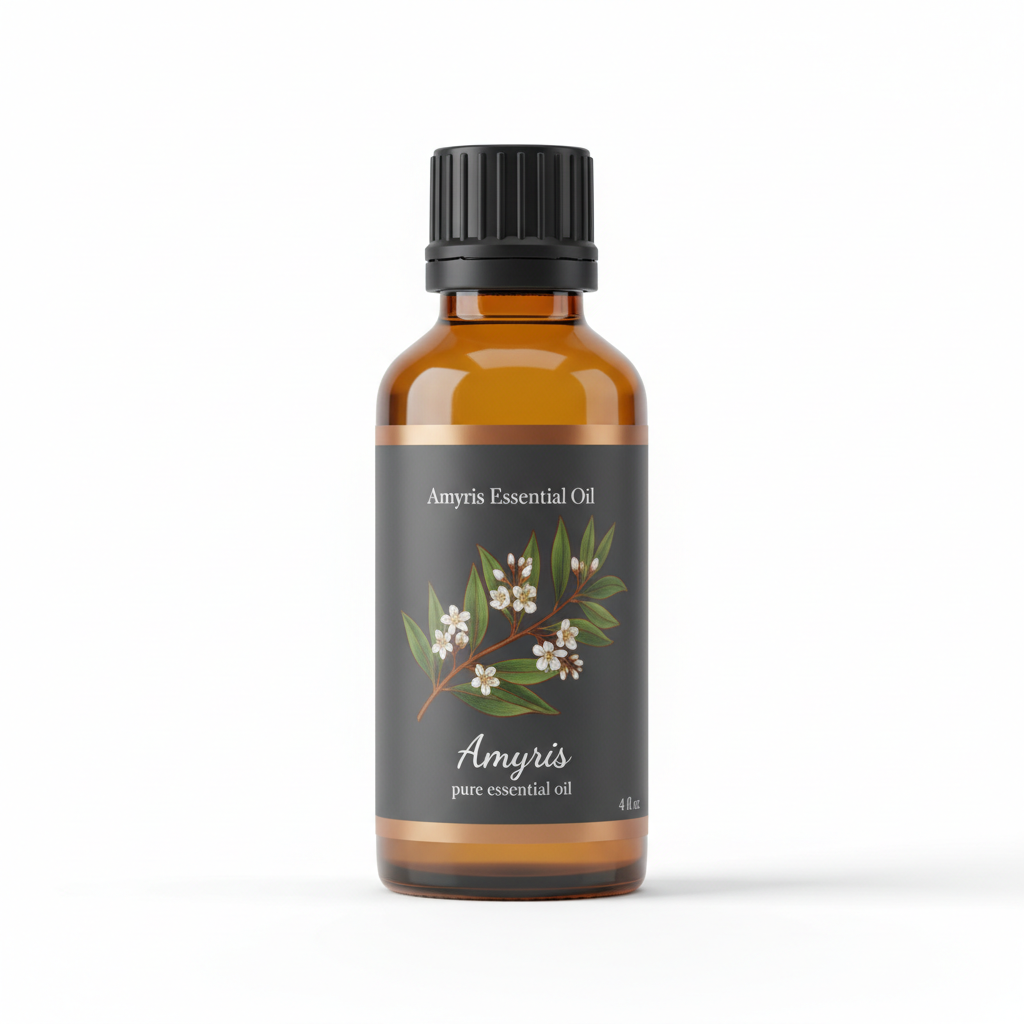
Amyris Essential Oil
Our own Amyris Essential Oil, in sizes from 0.5 oz to bulk.
From $23.99
Shop Now →This guide walks through how amyris oil is made, from the selection of raw timber to the finished distillate. Whether you are a curious formulator, a home blender, or simply someone who wants to understand what is in the bottle, the details here will sharpen your appreciation of this underrated ingredient. For background on the plant itself, the complete guide to what amyris essential oil is covers botany, aroma, and common uses in full.
What Makes Amyris Wood Worth Distilling
Amyris balsamifera is a small, scrubby tree native to Haiti and other parts of the Caribbean. It grows in dry, rocky coastal zones where conditions are harsh. That difficulty shapes the wood. The tree accumulates oleoresins in its heartwood over years, sometimes decades, and those resins are the source of the oil's distinctive scent.
Not all amyris wood is equal. Freshly cut outer sapwood holds little oil. The inner heartwood, particularly from older trees or fallen timber that has seasoned in the sun, is dense with resin. This is why distillers have traditionally favored aged or dead wood over freshly felled trees. The practice also has a conservation dimension: using fallen and harvested timber rather than clearing living trees reduces pressure on the shrubland ecosystem.
The common name "torchwood" comes from the wood's high oil content. Islanders historically lit dried amyris branches as torches because they burned so steadily. That same resin load is precisely what makes amyris oil distillation efficient compared to many other botanical sources. You can read more about the plant's regional history in this short history of amyris as candlewood and torchwood.
Materials Needed for Amyris Oil Distillation
Commercial distillation and small-scale artisan distillation use the same fundamental principles. The equipment scales up or down, but the logic is identical. Here is what the process requires:
- Aged amyris heartwood: Sourced as chips, offcuts, or roughly chipped billets. Heartwood should be visibly resinous, appearing darker and denser than the surrounding sapwood.
- A distillation still: Copper or stainless steel pot stills are both used. Copper is traditional and conducts heat evenly. Stainless steel is easier to clean and more common in commercial operations.
- A condenser: A coiled tube or shell-and-tube condenser that cools steam back into liquid. It connects to the still's vapor outlet.
- A separator (Florentine flask): A vessel that allows oil and distillate water (hydrosol) to separate by density once condensed.
- A clean water source: For generating steam. Water quality matters; hard or mineral-heavy water can affect the distillate.
- A heat source: Wood fire, gas burner, or electric element. Consistency of heat matters more than intensity.
- A wood chipper or hand tools: To reduce heartwood pieces to a workable size, typically chips or coarse shavings between one and three centimeters.
- Storage vessels: Dark glass or food-grade stainless containers for the finished oil. Amber glass is preferred for minimizing light degradation.
How Amyris Oil Is Made: Step by Step
Step 1: Select and Source the Heartwood
Begin with wood that has been properly identified and sourced. In Haiti, where most commercial amyris wood oil originates, cooperatives and small-scale harvesters collect fallen timber and managed coppice. If you are sourcing for artisan or experimental distillation, look for suppliers who can confirm species identification. Amyris is sometimes confused with or adulterated by other woods, so reputable sourcing matters from the start.
Inspect the wood for resin content. True aged heartwood will feel slightly tacky or oily to the touch, and it may show a faint sweet-woody scent even before processing. Pale, dry, lightweight pieces are likely sapwood with minimal oil content and should be set aside.
Step 2: Chip or Shred the Wood
Whole billets of wood do not distill efficiently. The goal is to increase surface area so that steam can penetrate the material and carry volatile compounds up into the still head. Chip or shred the heartwood into pieces roughly one to three centimeters in size. Avoid reducing it to fine dust; overly powdered wood can compact inside the still and impede steam flow.
Some distillers lightly dry their chipped wood in the sun before loading the still. This reduces excess surface moisture and can marginally improve the oil yield from the first distillation run. However, avoid over-drying, as very desiccated wood can scorch against the still walls at higher temperatures.
Step 3: Load the Still
Pack the chipped amyris heartwood into the still chamber. Do not compress it tightly. Steam needs to move through the material, not around the outside of a dense block. A loose, even fill allows consistent vapor penetration across the entire charge.
For hydro-distillation (where the plant material sits directly in water), add enough water to submerge the wood partially. For steam distillation (where steam is introduced from below a perforated plate), fill the water chamber separately and keep the wood above the waterline. Most commercial amyris distillation uses steam distillation because it gives better control over temperature and reduces the risk of scorching the resinous wood.
Step 4: Apply Heat and Generate Steam
Bring the water to a boil steadily. Avoid aggressive heat spikes at the start. Gentle, consistent heating allows steam to build evenly and pass through the wood without channeling or bypassing sections of the charge.
As steam moves through the amyris chips, it picks up volatile aromatic compounds. These compounds have boiling points higher than water on their own, but in the presence of steam they vaporize at lower temperatures. This is the core principle behind steam distillation: it protects heat-sensitive compounds by allowing them to travel with water vapor rather than requiring intense direct heat.
Step 5: Condense the Vapor
Aromatic vapor exits the still head and travels down into the condenser. Cold water running through the condenser shell drops the temperature sharply, converting the vapor back into liquid. What exits the condenser is a mixture of amyris oil and distillate water, known as the hydrosol.
Monitor the condenser coolant temperature. If the coolant water gets too warm, the vapor does not condense fully, and you lose yield. In small operations, running a continuous cool water supply through the condenser is standard practice.
Step 6: Separate the Oil
The condensed liquid flows into the Florentine flask, a separator designed with an internal overflow that lets the lighter layer (or heavier, depending on the oil's density) decant off continuously. Amyris wood oil is denser than water, with a specific gravity typically around 0.950 to 0.975. This means it sinks rather than floats, and the hydrosol overflows from the top of the separator while the oil collects at the bottom.
This is one of the details that trips up people new to amyris oil distillation. Many floral and citrus oils float on water, so their Florentine flasks are configured accordingly. Amyris oil behaves differently, and using the wrong separator configuration will result in oil losses down the overflow drain.
Step 7: Collect and Store the Oil
Drain the collected oil into amber glass bottles or dark stainless containers. Label with the distillation date, wood source, and any lot information. Amyris wood oil is notably stable compared to many essential oils due to its high sesquiterpene content. It does not oxidize quickly, but proper dark, cool storage still extends shelf life and preserves the oil's characteristic soft, balsamic woodiness.
The remaining hydrosol carries a faint woody aroma and may have applications in cosmetic formulations as a botanical water, though it is far milder in scent than the oil itself.
Typical Yield and What to Expect
Amyris is considered a relatively high-yielding distillation wood. Properly aged heartwood can produce roughly two to four percent oil by weight, though yields vary by wood age, chip size, distillation duration, and equipment efficiency. A 100-kilogram charge of good amyris heartwood may yield two to four liters of oil across a full distillation run.
The oil that comes off the still is pale yellow to light amber in color. It is a slightly viscous liquid, noticeably thicker than citrus or lavender oils. The scent fresh from the still is warm, softly woody, and faintly sweet. Some batches carry a subtle creamy note. The aroma deepens and rounds out after a few days of settling in the bottle, which is worth noting before making fragrance evaluations immediately post-distillation.
Common Mistakes to Avoid
- Using sapwood or green wood: Sapwood yields very little oil. Fresh green timber has not accumulated the resin levels that make distillation worthwhile. Aged heartwood is non-negotiable for meaningful output.
- Overpacking the still: Dense packing blocks steam flow and creates uneven extraction. Steam needs pathways through the charge, not around it.
- Running the condenser too warm: Warm coolant means incomplete condensation and lost yield. Keep condenser water cool and flowing consistently.
- Using the wrong separator configuration: Amyris oil sinks. Set your Florentine flask for a heavy oil, not a light one.
- Evaluating the oil immediately from the still: Freshly distilled amyris can smell sharper or slightly sulfurous. Allow it to rest and breathe for 24 to 48 hours before final assessment.
- Storing in clear glass or warm conditions: Though amyris is stable, prolonged light and heat exposure will degrade quality over time. Dark glass and cool storage are always the right choice.
A Note on Commercial vs. Artisan Distillation
Most amyris wood oil on the global market comes from small cooperatives and independent distillers in Haiti. Operations range from modest wood-fired stills producing a few liters per run to larger facilities supplying fragrance houses directly. The variations you encounter between suppliers, in color, viscosity, and scent profile, often trace back to differences in wood age, chip preparation, distillation duration, and how carefully the separator is managed.
When buying amyris oil for cosmetic formulation or blending, look for suppliers who share batch-specific GC/MS reports. These gas chromatography and mass spectrometry analyses confirm the presence and proportion of key compounds such as valerianol, sesquisabinene, and elemol. A reputable report is your best tool for verifying authenticity and ruling out dilution with carrier oils or synthetic additions.
For those formulating with amyris, the oil performs well as a fixative in body oils and lotions. It blends smoothly with sandalwood, vetiver, rose, and citrus. Its gentle aroma makes it accessible for evening skincare and fragrance bases alike. The cosmetic uses of amyris in lotions and body oils covers practical formulation guidance in depth.
Safety Considerations for Home Distillers
If you are attempting small-scale distillation as an educational or hobbyist project, a few practical cautions apply. Always operate distillation equipment in a well-ventilated space. Do not leave a running still unattended. Monitor water levels in the boiler to prevent running dry, which can damage equipment or create a fire risk with wood-fired setups.
The finished oil, like all essential oils, requires proper dilution before skin contact. As a general guideline, most cosmetic applications call for a one to three percent dilution in a suitable carrier oil. Patch testing on a small skin area before full use is always advisable. Consult a qualified healthcare provider if you have any specific concerns about skin sensitivities.
The Wood Behind the Scent
Amyris oil distillation is a process shaped by patience, geography, and the slow work of resin accumulation over years. The best oil comes from wood that has had time to become what it is. Understanding that arc, from living shrubland to aged heartwood to amber drops in a glass bottle, gives the oil a context that most ingredient labels cannot convey.
Next time you open a bottle of amyris wood oil and catch that quiet, balsamic warmth, you will know exactly what went into it.