A Short History of Amyris: Candlewood, Torchwood, and Island Trade
Most essential oil enthusiasts encounter amyris as a budget-friendly alternative to true sandalwood. The amber-colored oil, with its soft woody base note and faint vanilla undertone, tends to appear in formulation guides almost as an afterthought. Yet the plant behind the oil carries a history that stretches across centuries of Caribbean commerce, colonial botany, and everyday ingenuity. Understanding that history changes how you read a supplier's label and how you think about what is actually in the bottle.
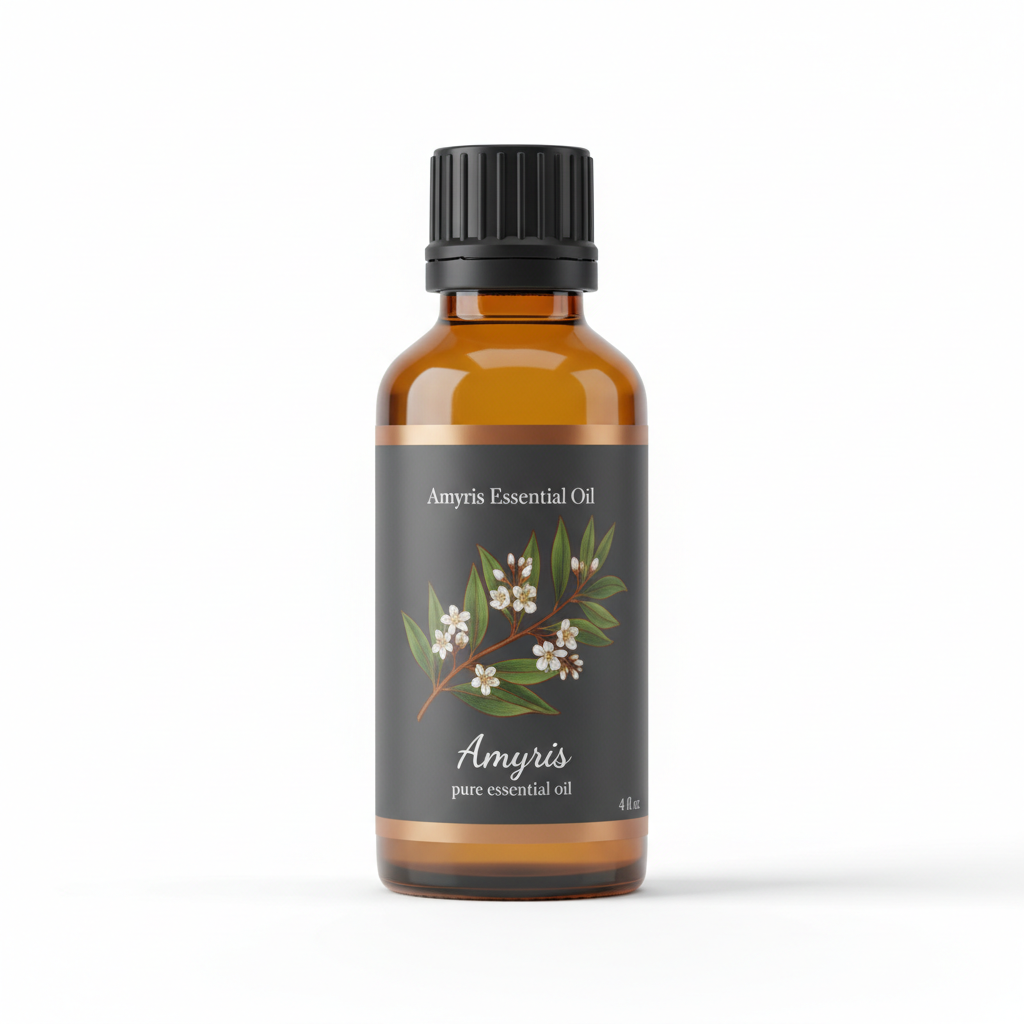
Amyris Essential Oil
Our own Amyris Essential Oil, in sizes from 0.5 oz to bulk.
From $23.99
Shop Now →This case study traces the amyris story from its roots in the Caribbean littoral to its current place in the global fragrance and cosmetic supply chain. The approach here is historical and botanical. The goal is to give formulators, hobbyists, and curious buyers a richer context for a plant that has been quietly useful for a very long time.
Setting the Context: A Tree That Lit the Way
The tree at the center of this story is Amyris balsamifera, a small, shrubby species native to the Caribbean islands and the coastal zones of Central America. It belongs to the Rutaceae family, the same botanical family that includes citrus, which explains the faint brightness that occasionally surfaces in the oil despite its dominant woody character.
Early European settlers and colonial botanists encountered the tree under several common names: candlewood, torchwood, and, most ambitiously, west indian sandalwood. Each name carries a different piece of the story.
The name candlewood came first, and it came from observation. The heartwood of Amyris balsamifera is extraordinarily resinous. Local communities discovered that cut pieces of the wood burned slowly, steadily, and with a pleasant scent. In an era before reliable candles or kerosene lamps, this was not a minor discovery. Fishermen along the Haitian and Cuban coastlines reportedly used bundles of amyris wood as torches to attract fish to the surface at night. Households burned splinters for light the way others burned pine kindling.
The name torchwood reflects exactly this practice, and it appears in historical botanical catalogs from the eighteenth century describing the practical life of Caribbean settlements. It is an honest name, grounded in function rather than aspiration.
The name west indian sandalwood is more complicated. It reflects a commercial impulse rather than a botanical relationship. True sandalwood belongs to the genus Santalum, native to South and Southeast Asia. Amyris is not related. But in the colonial spice and timber trade, merchants recognized that amyris wood shared certain surface qualities with sandalwood: the resinous weight, the slow burn, the warm scent. Calling it west indian sandalwood opened markets. The label stuck, and it continues to create confusion in essential oil sourcing today.
Amyris History Through the Lens of Colonial Botany
The formal botanical record of Amyris balsamifera solidified in the eighteenth century, when European natural historians were systematically cataloging the flora of colonial territories. The species name balsamifera means balsam-bearing, a direct acknowledgment of the resinous sap that made the tree so useful locally.
Botanists noted that the tree thrived in dry, rocky coastal scrub, particularly in Haiti, Cuba, Jamaica, and along the Yucatan Peninsula. It is not a large tree. It typically reaches between three and six meters, with small white flowers and dark, berry-like fruit. Its value was never in timber volume. The value was entirely in that resin-saturated heartwood.
Colonial-era botanical texts from the Caribbean frequently mention the wood in the context of local trade rather than in the context of plantation agriculture. This is a meaningful distinction. Amyris was not cultivated on estates the way sugar cane or indigo was. It was gathered from wild stands, sold in small quantities at coastal markets, and shipped to European ports as part of the miscellaneous cargo that filled out the holds of trading vessels alongside dyewoods, medicinal barks, and exotic curiosities.
The oil itself was not the primary product in this early period. Distillation of Amyris balsamifera essential oil became significant only as the perfumery industry industrialized in the nineteenth and early twentieth centuries, when the demand for reliable base notes and fixatives grew sharply. Before that, the wood was the commodity.
The Shift to Essential Oil Production
As European and American perfumers expanded their palette during the nineteenth century, they turned with increasing urgency to tropical wood oils. True sandalwood from Santalum album in Mysore, India, was prized above almost everything for its tenacity, its smooth dry-down, and its ability to hold other fragrance components in place. Demand chronically outpaced supply.
Amyris oil stepped into this gap. Steam distillation of the resinous heartwood and roots produced a pale yellow to amber oil with a gentle, creamy, woody scent profile. It lacked the milky depth of true sandalwood, and perfumers knew the difference. But it was available, it was affordable, and it behaved well in formulation. It extended sandalwood blends, contributed its own quiet character to oriental bases, and found a stable role as a fixative in soaps and cosmetics.
Haiti became, and largely remains, the primary source of commercial amyris essential oil. The distillation industry there developed in the late nineteenth century, and Haitian amyris oil has been a consistent presence in the global flavor and fragrance supply chain ever since. Secondary production occurs in Jamaica and parts of Central America, but the Haitian origin defines the benchmark quality profile that most buyers expect.
For a deeper look at what makes the oil distinctive on a chemical level, the article on what amyris essential oil is and how it compares to its botanical relatives covers the sesquiterpene composition and scent characteristics in detail.
Observations on Trade, Naming, and Buyer Confusion
One of the more instructive outcomes of tracing amyris history is understanding how the naming problem has compounded over time. The west indian sandalwood label, originally a marketing convenience, now circulates through the essential oil industry in ways that create genuine confusion for buyers.
Some suppliers list the oil as west indian sandalwood. Others use amyris. A smaller number use the Latin name Amyris balsamifera. These all refer to the same oil from the same plant. The confusion becomes costly only when buyers assume they are purchasing true sandalwood (Santalum album or Santalum spicatum) and pay accordingly, or when formulators assume the scent profiles will match.
The key learning here is practical: always verify the Latin binomial on any supplier's certificate of analysis. The common name alone is not sufficient. A supplier listing the Latin name, the country of origin (Haiti, ideally), and the plant part used (wood, roots) is offering meaningful transparency. One offering only a common name is not.
This sourcing principle matters not just for scent accuracy but for understanding what you are actually supporting through your purchase. The candlewood tree is harvested from wild or semi-wild stands rather than certified plantations in most cases. Responsible sourcing questions are legitimate and worth asking.
Amyris in the Contemporary Formulator's World
Today, amyris essential oil occupies a specific and valued niche in natural perfumery and cosmetic formulation. Its low price point relative to true sandalwood makes it accessible for product developers working at volume. Its fixative qualities, derived from the high sesquiterpene alcohol content, make it genuinely useful rather than merely decorative in a blend.
The candlewood tree's long history of providing steady, slow-burning light feels almost metaphorical in this context. The oil does something similar in a formula. It does not announce itself. It supports everything around it, helps the top notes last longer, and contributes a quiet warmth to the dry-down that might not be immediately noticed but would certainly be missed if it were absent.
For those new to working with this oil, a gentle introduction to its behavior in blends and its considerations for safe use is available in the guide on amyris oil safety basics, including dilution and patch testing. And for practical formulation ideas across everyday product categories, the roundup of 12 everyday uses for amyris essential oil at home offers a range of starting points.
Key Learnings
- The candlewood tree was a utility plant long before it was a fragrance ingredient. Its history is rooted in light and local trade, not in the perfume industry.
- The west indian sandalwood label is a commercial artifact, not a botanical fact. Amyris and true sandalwood are unrelated species with overlapping but distinct scent profiles.
- Haiti has been the center of amyris essential oil production for well over a century. Origin matters for quality benchmarking, and Haitian sourcing remains the industry reference point.
- Common names are unreliable guides in purchasing decisions. The Latin name Amyris balsamifera and a country of origin are the minimum information a buyer should request.
- The oil's historical role as a fixative and extender remains its primary commercial function today. It works quietly and consistently, much as the wood itself once did as a source of steady light in Caribbean coastal communities.
The amyris story is a reminder that many ingredients in the modern essential oil market carry histories worth knowing. Those histories shape supply chains, influence naming conventions, and sometimes explain why a particular oil behaves the way it does in a formula. The candlewood tree lit Caribbean nights for generations before anyone thought to distill it. That long, practical relationship with human hands is part of what it brings to the bottle.