
Amyris Balsamifera: The Caribbean Torchwood Tree Behind the Oil
Most people who reach for a bottle of amyris oil know it as a warm, woody base note, a budget-friendly sandalwood substitute, or a reliable fixative in natural perfumery. Far fewer know the tree behind it. Amyris balsamifera is a small, scrubby tropical tree with a resinous heartwood so saturated in volatile compounds that its branches were historically carried as torches through the forests of Haiti and the wider Caribbean. That detail is not merely colorful folklore. It points directly to the chemistry that makes amyris essential oil worth understanding on a molecular level.
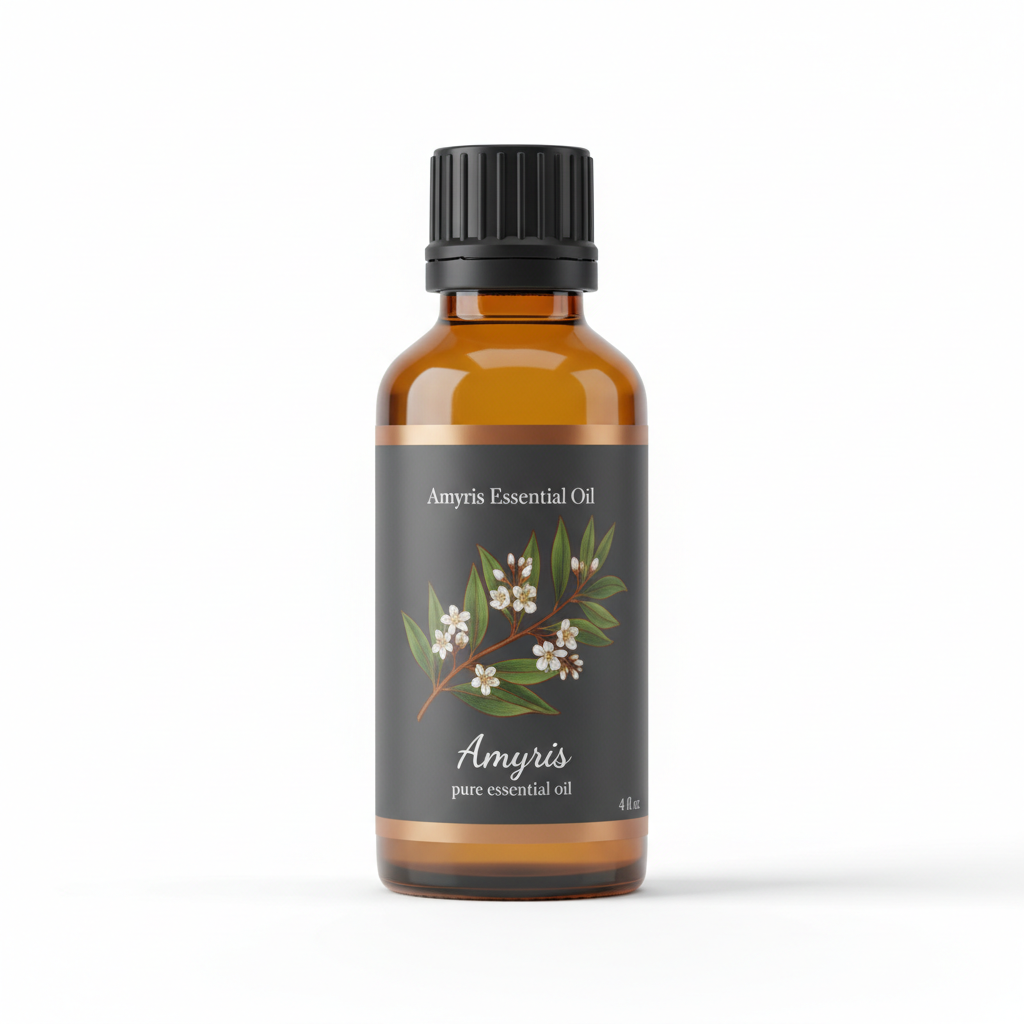
Amyris Essential Oil
Our own Amyris Essential Oil, in sizes from 0.5 oz to bulk.
From $23.99
Shop Now →This article looks closely at the plant itself, what researchers have found inside its oil, what the safety data actually says, and how to recognize a quality-sourced product. Everything is framed as observation and ongoing inquiry, because that is an honest reflection of where the science currently stands.
Meet the Torchwood Tree
Amyris balsamifera belongs to the family Rutaceae, placing it in the same broad botanical family as citrus trees, which partly explains the faint, almost imperceptible brightness that occasionally lifts through its otherwise deep, resinous scent profile. The genus name Amyris derives from the Greek word for "intensely scented," and the species epithet balsamifera simply means "balsam-bearing." The plant earns both names.
Native to Haiti, Cuba, Jamaica, and other Caribbean islands, the torchwood tree thrives in dry, rocky coastal scrubland where most other vegetation struggles. It grows slowly, reaching heights of roughly four to six meters at maturity. The wood is dense, pale to yellowish-brown, and exceptionally resinous. Local communities across the Caribbean historically used dried branches as torches, which is how the common name "torchwood" became attached to the species. The Haitian name "bois chandelle," meaning candlewood, carries the same meaning.
Commercial production of amyris balsamifera oil is concentrated primarily in Haiti, where the species grows wild in sufficient abundance to support a small but consistent export trade. The oil is steam-distilled from the dried, chipped heartwood and branches. Aged wood yields significantly richer oil, a point explored in more detail in our article on how amyris oil is distilled from aged heartwood.
Chemical Composition: What Is Actually in the Oil
The aromatic richness of amyris balsamifera bark oil is grounded in a relatively well-characterized set of sesquiterpene alcohols and hydrocarbons. Sesquiterpenes are 15-carbon compounds, and they dominate this oil's profile in a way that explains its viscous texture, low volatility, and fixative behavior in blends.
Primary Compounds
| Compound | Typical Percentage Range | Compound Class |
|---|---|---|
| Valerianol | 15 – 28% | Sesquiterpene alcohol |
| Eudesmol (alpha + beta) | 10 – 22% | Sesquiterpene alcohol |
| 7-epi-alpha-Eudesmol | 5 – 12% | Sesquiterpene alcohol |
| Elemol | 3 – 10% | Sesquiterpene alcohol |
| Gamma-Eudesmol | 3 – 8% | Sesquiterpene alcohol |
| Rosifoliol | 2 – 6% | Sesquiterpene alcohol |
| Beta-Selinene | 2 – 5% | Sesquiterpene hydrocarbon |
| Alpha-Eudesmol | 2 – 5% | Sesquiterpene alcohol |
These percentages are drawn from published GC/MS analyses in peer-reviewed literature and can shift based on geographic origin, time of harvest, wood age, and distillation parameters. A well-aged Haitian sample will typically read differently from a rapidly processed batch or from oil distilled from leaf material rather than heartwood.
Valerianol is frequently the single most abundant constituent and contributes a soft, slightly earthy, woody sweetness. The eudesmol isomers collectively account for a significant portion of the oil's total volume and are structurally related to compounds found in blue cypress and some eucalyptus species. Elemol, present at lower levels, lends a gentler, almost floral woody nuance that smooths the overall profile.
Minor Compounds and Their Relevance
Beyond the dominant sesquiterpene alcohols, amyris balsamifera oil contains a range of minor constituents that contribute to its complexity. Researchers have identified traces of carotol, daucol, and various eudesmane-skeleton compounds in some samples. The precise contribution of these minor constituents to the oil's overall scent character or performance in cosmetic formulations is an active area of interest, though research is still building a complete picture.
One point worth noting for formulators: the high sesquiterpene alcohol content gives amyris oil a notably low dermal irritation profile relative to many other woody oils. Sesquiterpene alcohols are generally considered among the gentler classes of aromatic compounds in cosmetic safety assessments.
What Research Has Observed
Scientific investigation of amyris balsamifera and its constituents is ongoing. A review of published literature reveals several areas of interest, though it is important to read these findings as preliminary observations rather than established conclusions.
Eudesmol Isomers
The eudesmol isomers found abundantly in amyris balsamifera oil have attracted research attention. Some studies have examined their behavior in laboratory and preclinical settings. Research suggests that alpha-eudesmol in particular shows interesting activity in cell-based models, though translating this to meaningful observations about whole-organism effects remains a complex task that science has not yet fully resolved. These findings are published in journals focused on natural product chemistry and pharmacognosy, and they make for genuinely interesting reading for anyone curious about sesquiterpene biology.
Valerianol
Valerianol, typically the dominant constituent of high-quality amyris balsamifera bark oil, appears in the scientific literature primarily within the context of natural product isolation and compositional analysis. Research has catalogued its structural characteristics in detail. Its potential interactions in biological systems are less well-studied compared to the eudesmol compounds, making it a reasonable subject for future investigation.
General Observations on Sesquiterpene Alcohols
The broader class of sesquiterpene alcohols has been the subject of considerable natural product research. Some researchers have observed that members of this compound class tend to exhibit relatively favorable safety profiles in standardized assessments, which aligns with the long history of use in cosmetic and fragrance applications without widespread reports of adverse events. This should not be read as a blanket safety endorsement for any specific oil or use case, but it provides useful context.
Safety Profile and Contraindications
Amyris oil has a well-established safety record in cosmetic and fragrance use, and it appears on the generally recognized safe lists used by major international fragrance regulatory bodies. That said, responsible use requires understanding a few practical considerations.
Dilution
Like all essential oils, amyris balsamifera oil should be diluted before skin application. For general body care products, a dilution of 1 to 3 percent in a carrier oil or lotion base is a widely cited starting point. For facial applications, many formulators work at 0.5 to 1 percent. Undiluted essential oils applied directly to skin can cause sensitization, even when the individual oil has a gentle compositional profile. Patch testing before broader use is always a sensible step.
Patch test guidance: Apply a small amount of your diluted blend to the inside of your elbow or wrist. Wait 24 hours before broader use. If any redness, itching, or irritation develops, discontinue use and consult a qualified professional.
Pregnancy and Nursing
There is limited specific safety data for amyris balsamifera during pregnancy or nursing. The general guidance from aromatherapy safety literature recommends a conservative approach during these periods: reduced concentrations, limited exposure areas, and consultation with a qualified healthcare provider before regular use.
Children
Essential oil use for young children should follow the guidance of a qualified healthcare provider. Standard pediatric aromatherapy references recommend much lower dilutions and careful attention to any signs of sensitivity.
Oxidation and Storage
The sesquiterpene-rich profile of amyris oil means it is relatively stable compared to high-monoterpene oils like citrus or pine. However, all essential oils will oxidize over time if exposed to air, light, or heat. Oxidized oil carries a higher sensitization risk than fresh oil. Store amyris in a tightly sealed, dark glass bottle away from heat sources, and note the purchase date. Most well-packaged amyris oil has a practical shelf life of three to five years when stored correctly.
No Medical Use Claims
This article covers aromatic and cosmetic applications only. Consult a qualified healthcare provider for any health-related questions. Essential oils are not substitutes for professional medical advice or care.
Sourcing and Quality Indicators
Quality variation in the amyris oil market is real and worth understanding before purchasing, particularly for formulators who need consistency across batches.
Geographic Origin
Haiti remains the primary and most respected source of amyris balsamifera oil. Haitian-origin oil, when properly processed from aged heartwood, tends to have a rounder, more complex scent compared to oil from younger material or other regions. Some suppliers source from other Caribbean islands or blend origins without disclosure, which can affect both scent and chemical consistency.
GC/MS Testing
A current gas chromatography/mass spectrometry (GC/MS) report is the most reliable quality indicator for any essential oil purchase. For amyris, you are looking for a profile dominated by valerianol and eudesmol isomers as described in the composition section above. A report showing significant deviation from this pattern, particularly if unfamiliar synthetic compounds appear, warrants investigation. Reputable suppliers make these reports available on request or publish them directly.
Specific Gravity and Refractive Index
Physical parameters can serve as a quick consistency check. Quality amyris balsamifera bark oil typically presents with a specific gravity in the range of 0.950 to 0.975 and a refractive index around 1.502 to 1.514. Batches that fall significantly outside these ranges may indicate adulteration, extended dilution in a carrier, or significant quality issues.
Viscosity and Color
Authentic amyris oil is noticeably more viscous than lighter essential oils. It pours slowly, almost like a light vegetable oil, and ranges in color from pale straw to golden amber. Very pale, thin, or watery samples should prompt questions about processing or adulteration. Very dark brown samples may indicate overheating during distillation.
Adulteration Patterns
Amyris oil is sometimes extended with fractionated coconut oil, synthetic sesquiterpene alcohols, or cedarwood fractions. None of these are necessarily harmful in a cosmetic context, but they do affect performance and value. The cosmetic applications of amyris, explored in more depth in our guide to amyris oil for skin in lotions and body oils, depend on the authentic sesquiterpene profile delivering the fixative and blending properties formulators expect.
Sustainability Considerations
The torchwood tree grows wild in Haitian scrublands, and commercial harvest is intensive. Responsible sourcing involves working with suppliers who can speak to their harvest practices and who support sustainable wild-harvesting or cultivation initiatives in the region. Some forward-looking suppliers are beginning to invest in cultivated amyris plantings to reduce pressure on wild populations. This is worth asking about directly when evaluating a supplier relationship.
A Chemically Interesting Oil with a Practical Profile
What makes Amyris balsamifera genuinely interesting from a scientific perspective is not any single compound but the coherence of its sesquiterpene-dominant profile. The combination of valerianol, eudesmol isomers, and elemol produces an oil that is simultaneously stable, mild in dermal assessment, richly fragrant, and well-suited to the fixative role it plays in natural perfumery and cosmetic formulation. The torchwood tree, scraggly and slow-growing in its limestone Caribbean habitat, turns out to be a remarkably efficient producer of a chemically sophisticated oil.
For formulators, the practical takeaway is straightforward: source carefully, verify with GC/MS data, dilute appropriately, and store well. For those simply curious about what is in the bottle, the chemistry rewards attention. The eudesmol compounds alone represent an active area of natural product science, and research continues to build a more complete picture of what this modest Caribbean tree produces in its heartwood.
If you are new to this oil and want context before going deeper into the chemistry, our introductory overview covers what amyris essential oil is and its West Indian origins in accessible detail.