
How to Buy Amyris Essential Oil: The Complete Quality and Value Guide
Key Takeaways
- Amyris essential oil comes from Amyris balsamifera, a West Indian shrub. It is not true sandalwood, despite the nickname.
- Pure amyris oil should be pale yellow to light amber, with a soft, creamy, woody scent and a naturally viscous texture.
- GC/MS testing documentation is the single most reliable quality signal a supplier can provide.
- Price alone is a poor quality indicator. Learn the legitimate cost range before you shop.
- Label reading is a core skill. Knowing what the words mean before you purchase protects your formulations and your budget.
- Bulk buying makes economic sense for makers and formulators, but requires additional vetting steps.
What Amyris Essential Oil Actually Is
Before you spend a dollar, it helps to know exactly what you are buying. Amyris essential oil is steam-distilled from the wood and branches of Amyris balsamifera, a flowering shrub native to Haiti and other parts of the Caribbean. It has a soft, warm, woody character: lightly creamy, faintly sweet, and surprisingly long-lasting on the skin and in blends.
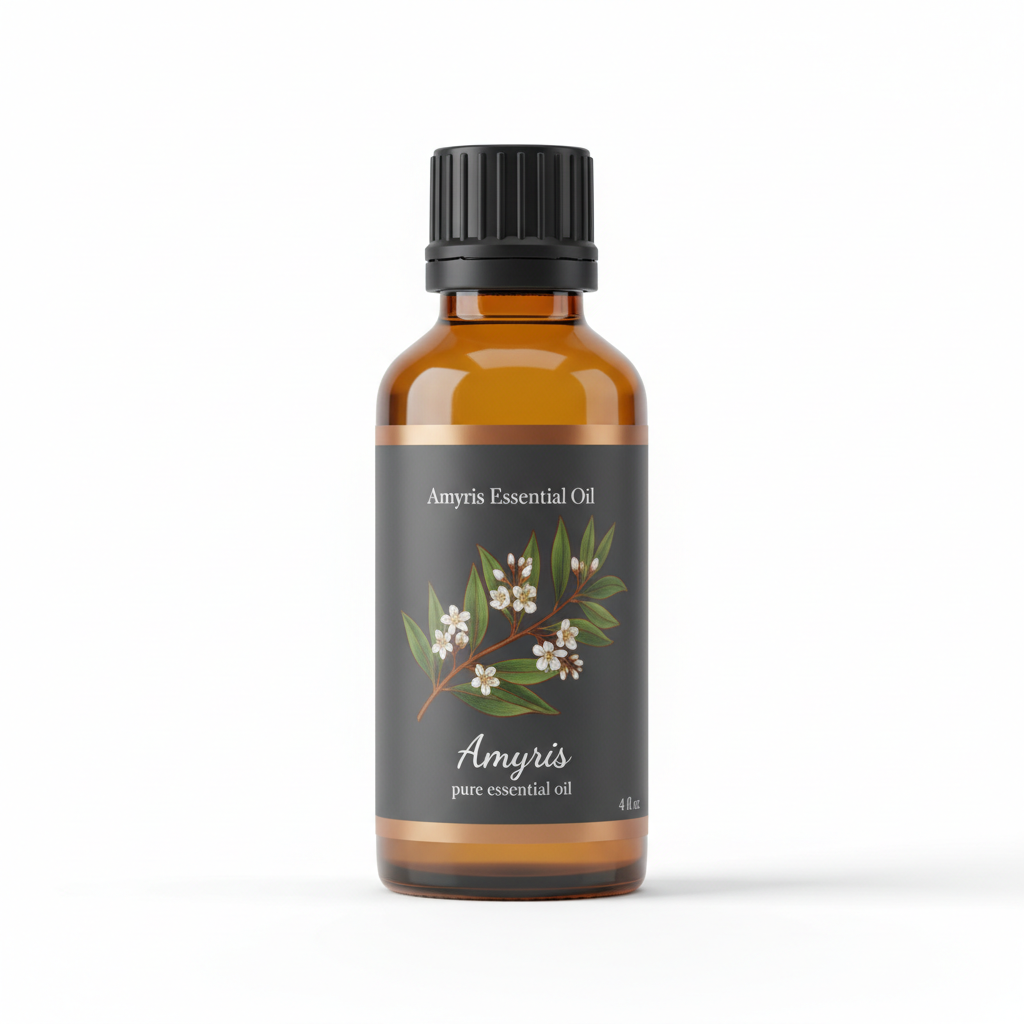
Amyris Essential Oil
Our own Amyris Essential Oil, in sizes from 0.5 oz to bulk.
From $23.99
Shop Now →The oil has picked up a fair amount of confusion along the way. It is sometimes sold as "West Indian sandalwood" or marketed with language that implies it is a sandalwood substitute. That framing is misleading. Amyris and true sandalwood (Santalum album or Santalum spicatum) are botanically unrelated. Their scent profiles overlap in a general woody register, but they are distinct oils with distinct chemistry. Before you buy, make sure you understand what you are actually getting.
For a full breakdown of the naming confusion, read our piece on amyris and the sandalwood naming myths.
The Chemistry Behind the Scent
Amyris oil is rich in sesquiterpene alcohols, with valerianol and 10-epi-gamma-eudesmol among the key constituents. These compounds give the oil its characteristic staying power and its slightly resinous, smooth base note. When you see GC/MS reports (more on those shortly), these are the compounds to look for as markers of authenticity.
The oil is also notably viscous compared to many essential oils. At room temperature, it pours slowly. In cold conditions, it may become quite thick. This is normal behavior, not a sign of adulteration. If anything, an unusually thin, water-like amyris oil is worth questioning.
Primary Uses in Cosmetics and Perfumery
Amyris has a well-established place in cosmetic formulation and aromatic blending. Formulators use it as a fixative in perfume, meaning it helps anchor volatile top notes and extends the overall wear of a blend. In skincare, it appears in facial oils, body butters, and balms, primarily for its emollient character and its ability to blend smoothly into carrier bases.
In diffuser blends, it contributes a grounding, contemplative atmosphere. Many people reach for it during evening routines or quiet work sessions where a soft, non-intrusive background scent is welcome. It pairs naturally with citrus, florals, spices, and other woody notes.
The Quality Markers That Matter
Quality in essential oils is not a single attribute. It is a cluster of indicators that, taken together, build a picture of what you are actually getting. Here are the ones that matter most for amyris specifically.
Botanical Source and Transparency
The first question is: does the supplier tell you exactly where the oil comes from? A reputable source will list the botanical name (Amyris balsamifera), the plant part used (wood), the extraction method (steam distillation), and the country of origin. Haiti remains the dominant source for high-quality amyris, though material from other Caribbean origins also appears on the market.
Suppliers who list only a common name like "amyris" or "West Indian sandalwood" without botanical detail are providing less information than you deserve. That omission is not automatically a sign of poor quality, but it is a reason to ask more questions before purchasing.
GC/MS Testing
Gas chromatography / mass spectrometry (GC/MS) testing is the industry standard for verifying the chemical composition of an essential oil. A GC/MS report will show the percentage breakdown of each constituent, allowing a trained reader to confirm that the oil matches the expected profile for Amyris balsamifera.
Not every small supplier runs their own GC/MS. Many purchase from reputable distillers or brokers who provide batch-specific documentation. What matters is that the report is available, that it matches the specific batch you are buying (identified by lot number), and that the supplier can actually provide it when asked. If a supplier cannot produce documentation and becomes defensive when you request it, that is a clear signal to look elsewhere.
Organoleptic Profile
"Organoleptic" simply means what your senses tell you. For pure amyris oil:
- Color: Pale yellow to light amber. Deeper amber is acceptable in older or more heavily distilled batches. Anything unusually dark or cloudy (without temperature-related explanation) warrants scrutiny.
- Viscosity: Noticeably thicker than water. Should pour slowly. A thin, free-flowing oil is atypical.
- Scent: Warm, woody, faintly creamy. There may be a light resinous undertone. The scent should be smooth and consistent, not sharp, chemical, or oddly sweet in a synthetic way.
- Dry-down: The scent should persist well after application. Amyris is a base note, and a genuine oil will still be perceptible on the skin an hour or more after application (on skin, at appropriate dilution).
Certifications Worth Looking For
Several certifications can add meaningful credibility, though none is an automatic guarantee of quality on its own.
- USDA Organic: Indicates the material was grown and processed according to organic standards. Relevant if your formulations are marketed as organic.
- ISO certification (supplier-level): Suggests the supplier operates quality management systems. Not directly an oil quality certificate, but a useful signal about operational standards.
- Third-party testing: Independent lab results from a facility unaffiliated with the supplier carry more weight than in-house testing.
Certifications cost money. A small independent distiller in Haiti may produce exceptional oil without any formal certification. Evaluate the full picture, not one data point alone.
Reading Labels Before You Commit
Label literacy is one of the most practical skills in the essential oil buyer's toolkit. The label on an amyris oil bottle tells you a great deal, provided you know what to look for and what certain phrases actually mean in practice.
We cover this topic in dedicated depth in our guide to reading labels for pure amyris oil versus diluted blends. Here is the core framework.
"100% Pure" vs. "Pure"
Neither of these phrases is regulated in the way that "USDA Organic" is. A supplier can technically print "100% pure" on a bottle that contains adulterated or diluted oil without immediate regulatory consequence. The phrase is a marketing statement until it is backed by documentation. Use it as a starting point for inquiry, not a conclusion.
Ingredient List Order
If the product is a diluted blend (amyris in a carrier), the ingredient list should reflect that. Carrier oils like fractionated coconut, jojoba, or sweet almond appear as listed ingredients. If the bottle is sold as pure amyris but the ingredient list includes carrier oils, you are buying a diluted product. That is not inherently wrong, but you should know what you are buying and price it accordingly.
Lot Numbers and Batch Codes
Reputable suppliers assign lot numbers to their batches. This makes it possible to trace a product back to its GC/MS report and origin documentation. If a bottle has no lot number or batch code, traceability is essentially impossible. For everyday aromatherapy use, this may feel academic. For formulators and makers who need to document their own batches, it matters significantly.
Country of Origin
As noted, Haiti is the primary source for quality amyris oil. Country of origin on the label is both a traceability signal and a useful cross-reference against any GC/MS documentation provided. Inconsistencies between the label and the batch paperwork are a red flag.
Warning and Safety Language
A responsible supplier includes dilution guidance, keep-away-from-children language, and external-use-only statements. The absence of any safety information is, at minimum, a sign of a less professional operation.
Understanding Price and Value
Amyris is genuinely one of the more affordable woody base-note oils on the market. That accessibility is part of its appeal for formulators. But "affordable" is relative, and the price range is wide enough that it is easy to overpay for mediocre oil or to mistake a suspiciously low price for a deal.
For a full data breakdown, see our dedicated article on amyris oil pricing and value. Below is the working framework.
What Drives the Cost of Amyris Oil
Several factors influence what a supplier charges for amyris:
- Distillation quality: Slow, careful distillation at controlled temperatures generally produces a richer, more complete oil. Higher production care costs more.
- Origin and supply chain length: Directly sourced oil from a known distillery will typically carry a different price structure than material that has passed through multiple brokers.
- Certification: Organic certification adds real cost to production and certification maintenance. Certified organic amyris oil will cost more than conventional.
- Testing and documentation: Batch-level GC/MS testing is not free. Suppliers who provide it have a cost built into their pricing.
- Packaging: Dark amber glass versus clear PET plastic, dropper caps versus standard caps, label quality: these all affect retail price without affecting the oil itself.
The Price Spectrum
At the retail end, quality amyris oil in a 10ml bottle generally falls in a modest range compared to premium oils like true sandalwood or rose absolute. Unusually low prices (significantly below the middle of the market range for comparable volume) often signal dilution, adulteration, or very low-grade material. Very high prices for amyris, by contrast, do not necessarily signal superior quality the way they might for genuinely scarce oils.
Amyris is not a rare or critically endangered species. Its relative abundance means that legitimate pricing has a ceiling. If a supplier prices their amyris oil at levels comparable to true sandalwood, ask pointed questions about what justifies that premium.
Value vs. Price
Value accounts for what you actually get for your money. A slightly more expensive oil with full batch documentation, verifiable origin, and consistent organoleptic quality represents better value than a cheaper oil with no documentation and inconsistent scent between batches. For home aromatherapy users, this distinction matters less. For formulators building a product line, consistency and documentation directly affect your ability to reproduce and verify your own work.
How to Vet a Supplier
The supplier relationship is arguably more important than any single product selection. A good supplier provides consistent quality across batches, communicates honestly about sourcing, and stands behind their documentation. Here is a practical framework for evaluation.
Questions to Ask Before You Buy
Contact the supplier directly (or check their website thoroughly) and look for answers to these questions:
- Can you provide a current GC/MS report for the specific batch I am purchasing?
- What is the botanical name, plant part, and country of origin for this oil?
- How is the oil tested (in-house, third-party laboratory, or both)?
- What is your return or replacement policy if I receive an oil that does not match its documentation?
- Do you use dark glass bottles, and how is the oil stored before shipping?
A supplier who answers these clearly and without hesitation has earned the first layer of trust. A supplier who dismisses the questions, cannot answer them, or deflects with marketing language has not.
Supplier Size and Type
The essential oil market includes a wide range of supplier types: large multi-line retailers, specialty small-batch suppliers, direct distillers, and wholesale brokers. Each type has tradeoffs.
- Large retailers: Convenient, often affordable, typically carry GC/MS data. Quality can be inconsistent across the product range. Amyris specifically tends to be competitively priced.
- Specialty small-batch suppliers: Often more transparent about sourcing and distillation specifics. Can be harder to reach and may have supply limitations.
- Direct distillers: Maximum traceability and freshness. Minimum convenience. Often not set up for small retail orders.
- Wholesale brokers: Relevant primarily for makers and formulators. See the bulk section below.
Online Reputation and Community Feedback
The aromatherapy and natural formulation communities are active online, and supplier reputations circulate widely in those spaces. Forums, professional Facebook groups, Reddit communities focused on natural perfumery, and industry organizations like the National Association for Holistic Aromatherapy (NAHA) can all be useful reference points. Look for consistent patterns in feedback rather than single extreme reviews in either direction.
Transparency About Adulteration Risks
Amyris is sometimes adulterated with cheaper woody aroma compounds or extended with carrier oils without disclosure. A supplier who proactively discusses adulteration risks and explains how their testing process addresses them demonstrates both knowledge and integrity. That kind of transparency is a positive signal, not a reason for concern.
Choosing the Right Bottle Size
Bottle size selection is practical rather than glamorous, but getting it right saves money and protects oil quality. Essential oils degrade with oxygen exposure, so a half-empty large bottle stored for months provides a worse experience than a fresh small bottle.
For a full decision framework, see our guide to amyris essential oil bottle sizes and which one to choose.
Size by Use Case
| Use Case | Recommended Starting Size | Notes |
|---|---|---|
| Home diffusing, personal use | 5ml to 10ml | Low volume use. Smaller bottle minimizes oxidation risk. |
| Cosmetic formulation (small batch) | 15ml to 30ml | Enough to experiment across multiple formulations before committing to larger volume. |
| Natural perfumery | 15ml to 30ml | Amyris is used at relatively low percentages as a fixative, so a small volume goes far. |
| Makers and product formulators | 100ml and above | Cost per ml drops significantly. Ensure proper storage conditions before committing. |
| Wholesale / bulk production | 500ml to 1kg | Requires full supplier vetting and storage infrastructure. See bulk section. |
Storage and Shelf Life Considerations
Amyris oil is relatively stable compared to citrus or high-linalool oils, but it still benefits from proper storage. Keep it in a cool, dark location away from direct sunlight and heat sources. Refrigeration is an option for long-term storage of larger volumes, though allow the oil to reach room temperature before use, as its viscosity at cold temperatures can make accurate measuring difficult.
An unopened, well-stored bottle of amyris oil has a useful life of several years. Once opened, aim to use the oil within 12 to 24 months. Some sources suggest longer viability for sesquiterpene-heavy oils like amyris, but freshness generally correlates with quality in the aromatic experience.
Bulk and Wholesale Considerations
If you are a maker, formulator, or small business, buying amyris oil at retail scale is expensive over time. Bulk purchasing changes the economics substantially, but it introduces a set of considerations that do not apply to single-bottle retail buying.
Our dedicated guide on wholesale amyris oil for makers goes deeper on this topic. Here is the essential overview.
When Bulk Buying Makes Sense
Consider bulk purchasing when:
- You are going through more than 100ml per month consistently.
- You have appropriate storage conditions (cool, dark, sealed).
- You have vetted the supplier sufficiently to commit to a larger volume purchase.
- You are using amyris as a consistent, recurring ingredient rather than a one-off experiment.
Minimum Order Quantities
Wholesale suppliers typically set minimum order quantities (MOQs) that may be defined by weight (250g, 500g, 1kg), volume (100ml, 500ml), or dollar value. Amyris is dense (roughly 0.96 to 0.98 specific gravity), so weight and volume calculations are close but not identical. Confirm with your supplier whether pricing is by weight or volume to avoid calculation errors in your cost-of-goods math.
Documentation Requirements at Bulk Scale
At bulk purchase volumes, the documentation bar should be higher than for retail purchases. Request:
- Batch-specific GC/MS report
- Certificate of Analysis (CoA) with key physical parameters (specific gravity, refractive index, optical rotation)
- Country of origin and distillation date or crop year
- Safety Data Sheet (SDS)
If you are selling finished products containing the oil, you will need this documentation for your own records and potentially for regulatory compliance depending on your market and product type.
Building a Supplier Relationship
Good bulk suppliers value consistent, reliable customers. Once you have found a supplier whose quality and documentation standards meet your needs, invest in the relationship. Communicate clearly about your volume needs and timelines. Ask about new crop availability. Some suppliers will offer preferential pricing or early access to fresh batches for customers who have established a track record.
Do not sacrifice quality vetting for the sake of convenience or a discount. One bad bulk batch can disrupt your production schedule and damage your formulations significantly more than a bad single retail bottle would.
Simple At-Home Quality Checks
You do not need a laboratory to perform meaningful quality assessment on an amyris oil you have just received. Several simple tests can help you identify obvious problems before you incorporate the oil into your work.
For a full protocol, see our article on how to spot low-quality amyris oil with simple at-home checks.
The Blotter Test
Place one drop of amyris oil on a perfumer's blotter strip or a plain piece of white cardstock. Allow it to dry for several hours. Genuine, pure amyris should leave a minimal to faint residue (sesquiterpene-rich oils are relatively low in volatiles) and a woody, soft scent that persists well. If the scent disappears quickly, the oil may be heavily extended with a light carrier or a volatile synthetic compound.
Compare the blotter to a reference sample if you have one from a trusted prior batch. Scent consistency across batches is a useful indicator of supplier reliability.
The Paper Spread Test for Carriers
Place a small drop of the oil on an uncoated piece of paper. Allow it to dry completely (several hours or overnight). A pure essential oil should leave little to no greasy stain. A noticeable, spreading oil stain after drying suggests the presence of a fixed carrier oil. This test is not definitive (some essential oils do leave light marks), but a pronounced greasy ring is a reasonable flag for undisclosed dilution.
Note: This test works better for lighter essential oils. Amyris's natural viscosity means it may leave a faint mark. A pronounced, spreading grease ring is the signal to watch for.
Viscosity Check
At room temperature (approximately 20 to 22 degrees Celsius), amyris should pour noticeably slowly from the bottle. Invert the bottle briefly and watch the flow rate. If the oil pours freely like water, its viscosity profile does not match the expected chemistry for pure amyris. This is a crude test but catches obvious cases of significant dilution with thin carriers.
Scent Reference Calibration
If you are new to amyris, this calibration step is worth the small cost. Purchase a 5ml or 10ml sample from two or three different reputable suppliers before committing to a larger purchase from any one of them. Comparing the oils side by side gives you a sensory reference point. You will quickly develop an intuition for what genuine amyris smells like, which makes it much easier to identify off-notes or inconsistencies in future purchases.
Color and Clarity
Hold your bottle up to natural daylight. Pure amyris oil should be clear to slightly hazy (some natural cloudiness at cool temperatures is normal), pale yellow to light amber. Significant cloudiness at room temperature, unusual darkening, or visible sediment are worth noting and potentially worth querying with the supplier.
Oxidized amyris may shift to a darker amber with a scent that has become musty or flat rather than clean and woody. This is a storage and age issue as much as a quality issue at origin, which is why fresh, properly stored oil matters.
Bringing It All Together: A Pre-Purchase Checklist
Buying pure amyris oil with confidence comes down to asking the right questions before you hand over your money. The checklist below consolidates the key points from this guide into a practical pre-purchase reference.
- Botanical name: Does the label or listing state Amyris balsamifera?
- Plant part and extraction: Wood, steam-distilled?
- Country of origin: Stated clearly? Consistent with documentation?
- GC/MS availability: Can the supplier provide a batch-specific report?
- Lot number: Is one printed on the bottle or available on request?
- Price sanity check: Does the price fall within a reasonable range for the volume and quality level? Is it suspiciously low or unjustifiably high for amyris specifically?
- Packaging: Dark glass? Appropriate sealing?
- Supplier responsiveness: Did they answer your questions clearly and promptly?
- At-home checks planned: Do you have a protocol for verifying quality once the oil arrives?
No oil purchase comes with a zero-risk guarantee. The goal is to reduce unnecessary risk through informed sourcing, and to build supplier relationships that give you increasing confidence over time. Amyris is an accessible, well-priced, and genuinely useful oil for cosmetic and aromatic work. Buying it well is simply a matter of knowing what to look for.
Whether you are sourcing your first small bottle for personal blending or evaluating suppliers for a production run, the principles are the same: prioritize transparency, ask for documentation, trust your senses, and build your knowledge base one purchase at a time.