Is Amyris Really Sandalwood? Naming Myths Explained
Walk into almost any candle shop or natural beauty aisle and you will find amyris listed as "West Indian Sandalwood." It sounds authoritative. It sounds botanical. It also causes a remarkable amount of confusion for anyone who buys or formulates with essential oils.
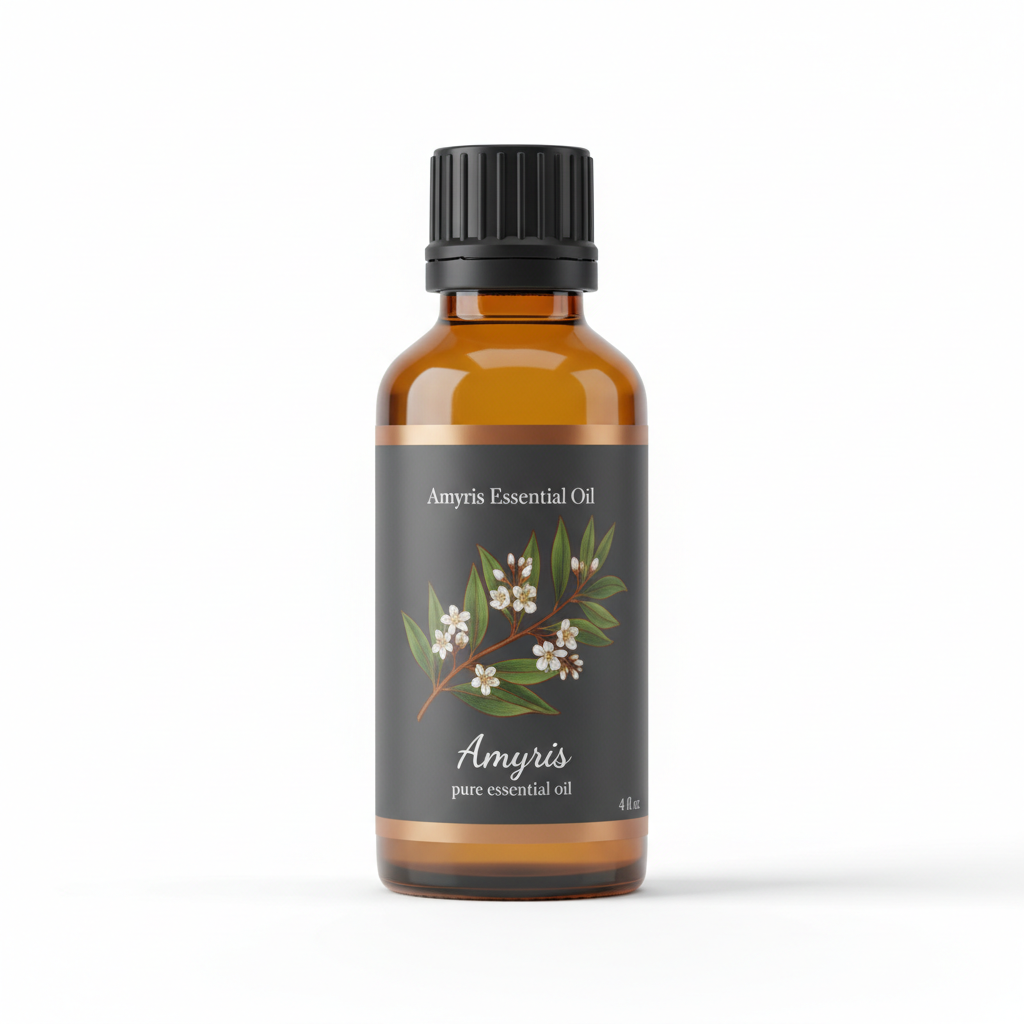
Amyris Essential Oil
Our own Amyris Essential Oil, in sizes from 0.5 oz to bulk.
From $23.99
Shop Now →The name has stuck for centuries, passed down through trade routes and old perfumery catalogs. But the label is misleading in ways that genuinely affect what you buy, how you use it, and what you are actually smelling. This article works through the most persistent myths about amyris oil, examines the evidence behind each one, and gives you a clearer picture of what this wood really is.
Some Quick Grounding: What Is Amyris?
Amyris balsamifera is a flowering tree in the Rutaceae family, the same plant family as citrus. It grows primarily in the Caribbean, with Haiti accounting for the vast majority of global supply. The wood is extraordinarily resinous. Locals in Haiti have long called it bois chandelle, or candle wood, because a dried branch will hold a flame like a torch.
Steam distillation of the wood chips and sawmill offcuts produces an essential oil that is pale yellow, somewhat viscous, and carries a soft, creamy, faintly smoky woodsy scent. It is widely used in perfumery as a fixative and in cosmetics as an emollient. None of that, however, makes it sandalwood.
Myth 1: Amyris Is a Type of Sandalwood
The Myth
Because it is sold as "West Indian Sandalwood," many buyers assume amyris is a regional variety of true sandalwood, the same species just grown in a different climate zone.
The Fact
Amyris and true sandalwood are not related at the species level, the genus level, or even the family level. True sandalwood belongs to the genus Santalum, within the Santalaceae family. Amyris belongs to the genus Amyris, within Rutaceae. Research into plant taxonomy confirms these are botanically distinct lineages with no meaningful shared heritage.
The scent profiles also diverge significantly under close examination. True sandalwood (Santalum album from India, or Santalum spicatum from Australia) carries a rich, milky, deep woodsy character driven primarily by sesquiterpene alcohols called santalols. Amyris oil contains different sesquiterpene compounds, including elemol, eudesmol, and various related alcohols, which give it a softer, drier, slightly more camphorous quality. Experienced noses distinguish them immediately.
Why the Myth Exists
Trade naming in the 18th and 19th centuries was largely a matter of commercial convenience. When European traders encountered a Caribbean wood that burned slowly and produced a faintly sweet woody aroma, the simplest marketing move was to attach a familiar, prestigious name to it. "Sandalwood" carried luxury connotations and commanded attention. The name lodged in the supply chain and has proven nearly impossible to dislodge since.
Myth 2: Amyris Oil Is an Inferior Substitute for Sandalwood
The Myth
Because amyris is far cheaper than genuine Santalum album, it is often framed as a lesser, budget-grade swap-in. The implicit story is: real perfumers use sandalwood; amyris is what you reach for when you cannot afford the good stuff.
The Fact
This framing misunderstands how both oils are actually used in professional formulation. Amyris is not a failed version of sandalwood. It is a distinct material with its own performance profile, and it does specific things that sandalwood does not do as well.
In perfumery, amyris is valued as a fixative. Its heavier molecular compounds help anchor lighter top and heart notes, extending the overall longevity of a fragrance. Evidence from formulation practice suggests it blends particularly well with florals and citrus materials, smoothing transitions between notes in a way that sandalwood, with its stronger presence, sometimes overrides.
In cosmetic formulation, amyris oil contributes an emollient skin feel and mixes cleanly into carrier oils, butters, and wax-based products. Its cost accessibility means formulators can use it at effective concentrations without pushing product prices beyond reach. That is not a compromise. It is a practical advantage.
If you want to understand the full picture of what makes amyris worth sourcing well, the complete guide to buying amyris essential oil covers what to look for across distillation quality, supplier transparency, and batch consistency.
Myth 3: All Amyris Oils Smell and Perform the Same
The Myth
Because amyris is inexpensive and widely available, buyers sometimes assume one bottle is essentially interchangeable with any other. Wood is wood. Oil is oil.
The Fact
Quality variation in amyris oil is significant and worth taking seriously. The age of the wood before distillation matters: older, more resinous heartwood yields a richer, more complex oil than younger sapwood or fresh branches. Distillation conditions affect the final chemical profile. And because amyris is a commodity with thin margins, the market does contain adulterated and diluted material.
Research into essential oil quality assessment shows that GC/MS (gas chromatography/mass spectrometry) analysis can reveal whether an amyris oil matches an authentic chemical fingerprint. Authentic amyris should show a characteristic sesquiterpene profile. Oils stretched with synthetic carriers or cheaper wood distillates will show anomalies in that profile.
For practical at-home checks that do not require a laboratory, the guide on how to spot low-quality amyris oil walks through sensory and physical tests that any buyer can perform before committing to a supplier.
Myth 4: The "West Indian Sandalwood" Label Is Harmless Marketing
The Myth
Some sellers argue the name is just a traditional common name, the way "cedar" appears on many products that are not true cedars. Nobody is being deceived; it is simply the way the trade has always talked about this oil.
The Fact
The naming confusion has real downstream consequences. Buyers expecting the scent of true sandalwood are disappointed or misled into assuming their nose is wrong. Formulators who are not careful may make substitution errors in blends. And in the broader market, the muddled naming allows low-quality suppliers to obscure what they are actually selling, sometimes passing off very cheap amyris as something more exotic.
There is also an ethical dimension. True Santalum album faces serious conservation pressure due to decades of over-harvesting. When products are vaguely labeled as "sandalwood" or "West Indian Sandalwood," consumers cannot easily evaluate whether what they are buying raises sustainability concerns. Clarity in naming helps buyers make informed choices. The west indian sandalwood myth, in other words, is not purely semantic. It affects purchasing decisions and supply chain accountability.
Myth 5: Amyris Comes from Anywhere There Are Tropical Trees
The Myth
Because it is inexpensive and abundant, some buyers assume amyris is just generic tropical wood sourced opportunistically from wherever labor is cheapest.
The Fact
Haiti is the center of global amyris production, and the geography is not incidental. The specific climate, soil conditions, and traditional distillation knowledge concentrated in certain Haitian communities shape the character of the oil that reaches international markets. Haiti's wild amyris populations, combined with generations of local expertise in wood harvesting and small-scale distillation, make the country genuinely central to understanding this material.
The supply chain is also more complex, and more important ethically, than the low price point might suggest. Understanding where amyris comes from and what the trade means for Haitian communities matters for anyone making sourcing decisions. The detailed look at Haiti and the amyris trade provides context that is worth reading before you settle on a supplier.
Putting the Amyris Oil Facts Together
The persistent confusion around amyris is a product of old trade habits, lazy labeling, and a commercial incentive to borrow the prestige of a better-known name. None of that reflects badly on the oil itself.
Amyris balsamifera is a genuinely interesting aromatic material. Its scent is quieter and less assertive than true sandalwood, which makes it more flexible in blending rather than less useful. Its fixative qualities are well-established in perfumery practice. Its skin-feel properties make it a practical cosmetic ingredient. And its connection to Haitian landscapes and communities gives it a provenance story worth understanding.
The key shift is learning to evaluate amyris on its own terms. Stop asking whether it measures up to sandalwood. Start asking whether the specific oil you are buying was distilled from properly aged resinous wood, whether the scent profile is consistent with authentic material, and whether the supplier can speak to sourcing with any transparency.
Those are the questions that lead you toward good amyris oil. And good amyris oil, on its own terms, is genuinely worth having.
A note on terminology: Throughout this article we use the botanical name Amyris balsamifera alongside the common name "amyris" to support clarity. Where you see "West Indian Sandalwood" on a product label, it refers to the same plant. No true sandalwood (Santalum species) is present in those products.