
Essential Oils in Skincare: Dilution, Carriers, Allergy Risk
The oil you pick matters less for your skin than three things most "best essential oils for skin" lists skip: how much of it is in the bottle, what it is dissolved in, and whether your immune system has already learned to react to it. Fragrance ingredients are a well-documented cause of contact allergy, and a skincare blend made of essential oils is a fragrance load whatever benefits are printed on the recipe. This guide is organised as decisions: whether to use an essential oil on skin at all, at what percentage, in what carrier, and when to stop and see a dermatologist.
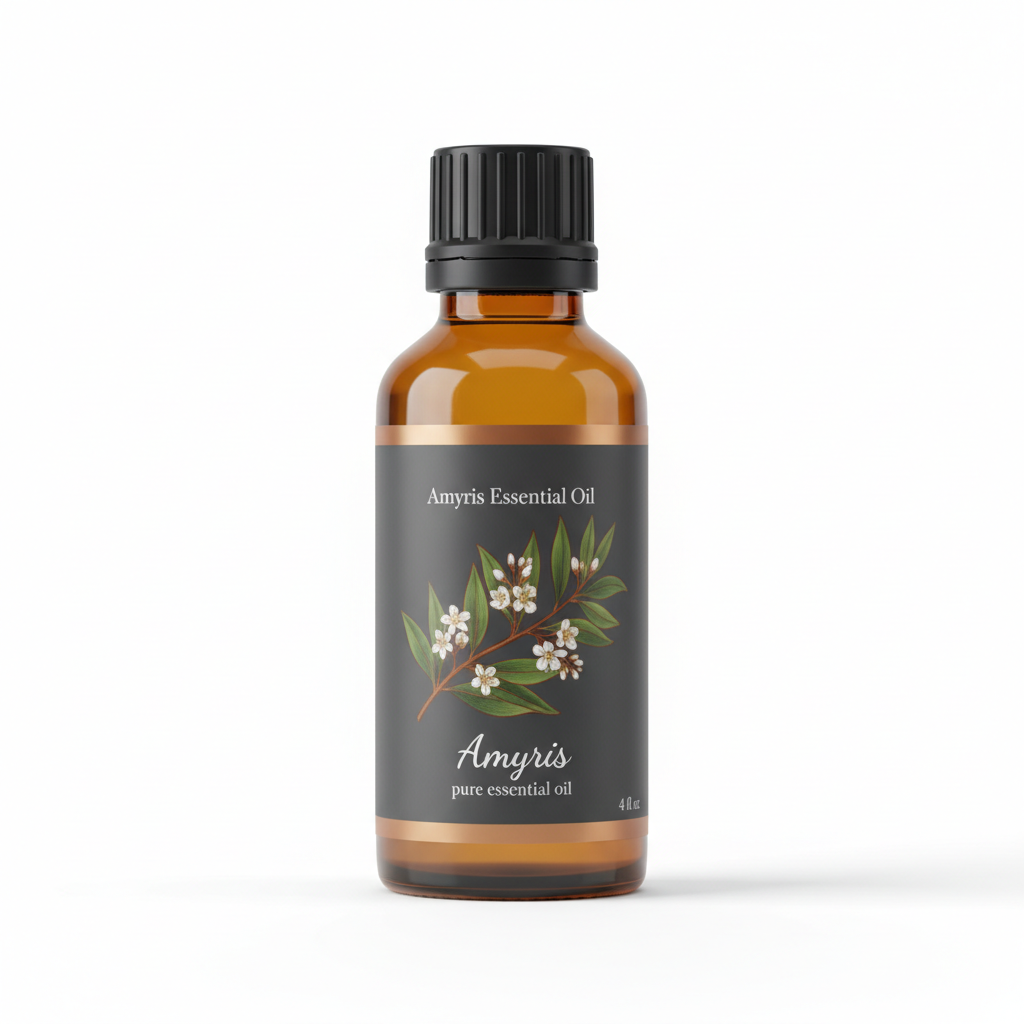
Amyris Essential Oil
Our own Amyris Essential Oil, in sizes from 0.5 oz to bulk.
From $20.99
Shop Now →Start from the allergy data, not the benefits list
The European Commission's scientific committee on consumer safety (SCCS) reviewed fragrance allergens in 2012. A summary page from the Commission describes the original list of 26 fragrance substances that must be named on cosmetic labels in the EU, which includes linalool and d-limonene, two compounds that occur naturally in many essential oils. It also notes that the labelling thresholds of 0.01% for rinse-off products and 0.001% for leave-on products were what the Commission itself calls a "pragmatic administrative decision," because the data to set true safe thresholds were insufficient (European Commission, SCCS summary, undated page, read October 2026). The EU has since widened the list: the Irish regulator HPRA says Regulation (EU) 2023/1545 expands it to more than 80 substances (HPRA, 2026).
Clinical reviews agree on the direction. A 2024 review by Sukakul, Bruze and Svedman states that contact allergy to fragrances "has been reported to be common worldwide" (Acta Dermato-Venereologica, 2024), and a 2025 update by Sukakul and Svedman says fragrances remain the most prevalent cosmetic allergens (Current Allergy and Asthma Reports, 2025). One mechanism worth knowing: linalool exposed to air forms hydroperoxides, and a 2026 study by Botvid and colleagues says these are linked to positive patch tests in 3.9% to 11.7% of those tested, while noting that some of those reactions are doubtful or irritant. In 12 already-sensitised patients in the same study, repeated application of linalool hydroperoxide on skin produced reactions in a dose-dependent way: 4 of 12 at 0.163%, 2 of 12 at 0.054% and 1 of 12 at 0.018%, and none in 20 controls (Botvid et al., Contact Dermatitis, 2026). Those are small numbers from a clinic population and say nothing about how likely any one reader is to react. Reasoning from them, the practical consequence is that an old, half-used bottle of an essential oil is not the same exposure as a fresh one, and that dose matters even at fractions of a percent.
What the "benefits" lists leave out: US labels tell you little
In the United States, the FDA says fragrance ingredients must meet the same safety requirement as other cosmetic ingredients, but there is no pre-market approval, and a label may list them simply as "Fragrance." The FDA also says it lacks the same legal authority to require allergen labelling for cosmetics as for food, and that "unscented" products can still contain fragrance ingredients (FDA, Fragrances in Cosmetics). The FDA's modernization law (MoCRA) directs the agency to write fragrance allergen labelling rules, but the FDA's MoCRA page links no rule, and we found no proposed or final rule to cite (FDA, MoCRA page).
Two consequences follow. First, if you react to a store-bought product, the label may not tell you which fragrance component did it, and a dermatologist's patch testing is the route to an answer. Second, when you blend your own, you are the formulator and the label reader at once: there is nobody between the oil and your skin who set a limit for you.
Decision 1: choose the percentage by where it goes
Robert Tisserand's published ranges are the most widely cited starting points, and he calls them guidelines with exceptions, not rules (Tisserand Institute, dilution article). For skin care they are:
| Situation | Range | What the source says |
|---|---|---|
| Reaction-prone skin or impaired barrier | 0.2-1% | Close monitoring encouraged; introduce oils "in very low concentrations" |
| Face, underarms, facial cosmetics | 0.5-1.2% | Facial products "very often have about 0.5% fragrance" |
| Body oils and lotions | 1-3% | Used for body massage for over 50 years; start low and raise only if needed |
| Wash-off and bath products | 2-4% | Slightly higher so the aroma is noticed |
| Acne spot, wound products | 2-10% | Short-term, targeted use based on effective concentrations |
Our advice, labelled as reasoning from that table: use the bottom of whichever band applies, and treat the top bands as outside what a home skin-care recipe needs. The 2-10% band comes from concentrations used for acne and wounds. We do not suggest any essential oil for acne or wounds, and anyone with either should see a dermatologist. The drops-to-percent arithmetic, with the caveat that droppers vary, is on our dilution chart.
Our own shop guidance for amyris is 0.5% to 2% in a carrier oil. For the face that top end sits above the 1.2% ceiling of the published facial band, so for facial leave-on use we would stay at 0.5% to 1% and go to 0.2% to 1% if your skin reacts easily. For body oils, see our body oil formulas.
Decision 2: the patch test, and where sources disagree
Standard advice, including our own shop page, is to patch test first. The Tisserand Institute's irritation and allergy page is more cautious: it says patch testing "is not 100% reliable," with false positives and false negatives, and that intensive testing can occasionally trigger an allergy itself. For high-risk people it suggests gradual dose escalation instead (Tisserand Institute, irritation and allergic reactions). The same page gives a timing rule useful on its own: irritation tends to resolve within hours, while an allergic reaction may last days or weeks, so a clean result an hour after application does not settle the question.
Reconciling the two, in our reading: a small test on the inner forearm is cheap and catches a strong reaction, but it is a screen, not a clearance. If you have a history of fragrance or cosmetic reactions, start at the lowest band, introduce one new oil at a time, and see a dermatologist or allergist for formal patch testing. Our guide to how to patch test covers the method.
Decision 3: the carrier is half the product
Because the carrier is 98% to 99.5% of a skin-care blend, it deserves as much thought as the oil. A 2017 review of topical plant oils by Lin, Zhong and Santiago reports that olive oil, which is mainly oleic acid, was found in a study by Danby and colleagues to have a detrimental effect on skin barrier function in adult volunteers, while sunflower seed oil, richer in linoleic acid, preserved stratum corneum integrity in the same study. The review also notes a small neonatal pilot where olive and sunflower oil showed no differences (Lin et al., Int J Mol Sci, 2017). That is a disagreement with a lot of DIY advice, which treats olive oil as a default. The full comparison, with oxidation data, is in our carrier oils guide.
A second carrier problem is comedogenicity. The ratings commonly quoted for oils come from the rabbit ear assay, and a 1982 review by Frank in the Journal of the American Academy of Dermatology described "the absence of correlation with experience in the human" (Frank, 1982). A 2006 human study by Draelos and DiNardo, with six participants, concluded that "finished products using comedogenic ingredients are not necessarily comedogenic" (Draelos & DiNardo, 2006). Treat any numerical "comedogenic rating" for an oil as a rough hint at best.
Decision 4: sun, and what we could not source about skin types
Expressed citrus oils such as bergamot carry furanocoumarins that cause phototoxicity. The Tisserand Institute cites IFRA's maximum of 0.4% bergamot oil in a final leave-on product for skin exposed to sunshine, and advises keeping treated skin out of UV for at least 12 hours (Tisserand Institute, phototoxicity). Our phototoxic oils guide lists which oils are affected.
Most skin-care guides then give a chart of oils for oily, dry, sensitive and mature skin. We looked for a primary source for oil-by-skin-type matching and did not find one we could open and cite, so we do not publish such a chart. What the sources above support is a different matching: reaction-prone skin gets the lowest band or no fragrance at all; the face gets the facial band; the body gets the body band; and anything intended for acne, eczema or wounds is a medical question.
What counts as a cosmetic claim
The FDA decides cosmetic versus drug status by intended use. Its guidance gives examples: a massage oil meant only to lubricate skin and add fragrance is a cosmetic, while the same oil intended for a therapeutic use such as relieving muscle pain is a drug, and a fragrance with aromatherapy claims such as sleep aid meets the drug definition (FDA, Is It a Cosmetic, a Drug, or Both?). That is why this guide, and the recipes it links, talk about scent, dilution and tolerance and not about skin conditions. If you make products to give away or sell, the claim you print decides which rules apply.
Where our amyris oil fits, and where it does not
We sell one oil: pure, undiluted Amyris balsamifera, steam distilled from aged heartwood. Our shop describes the scent as creamy, woody and balsamic with a soft vanilla undertone, and as a base note. For skin that means one narrow use: a woody fragrance in a leave-on blend you dilute yourself, 0.5% to 1% for the face and underarms, and within the body band for body oils. Our origin page states that no medicinal claim is made for amyris, and nothing here suggests that it improves any skin condition.
It is not a fit for broken, inflamed or reaction-prone skin (see a dermatologist), for babies and children (ask a pediatrician), in pregnancy (ask an OB-GYN or midwife), or near the eyes. We do not sell carrier oils or any other ingredient mentioned in this guide, and you can buy them from any reputable supplier. For a first recipe, the beard oil formula and the massage oil post show the arithmetic with every step. Scalp and hair questions have their own post: essential oils for hair. Roller bottles are covered in roller blends, where application sites matter. The recipes in these posts are starting formulas worked out from published dilution guidance, and we have not trialled them.
A short checklist before any new blend touches your skin
- Decide where it goes, then take the bottom of that band (0.5% to 1% for the face, 1% for a first body oil).
- Choose the carrier on its own merits, and know whether you have a tree-nut or peanut allergy before buying nut oils.
- Calculate in millilitres or grams, not in drops copied from a recipe.
- Try a small area first, wait longer than an hour, and add one new oil at a time.
- Keep the skin covered or out of the sun if any ingredient is an expressed citrus oil.
- Stop at the first sign of redness, itching or swelling, and see a dermatologist if it lasts more than a day or two or spreads.
The most useful skin-care habit with essential oils is restraint: low percentages, one change at a time, and a clear idea of when the question belongs to a physician.
Amyris Essential Oil
Amyris Essential Oil from our own shop, in sizes from 0.5 oz to bulk.
From $20.99
Shop Now →Sources & Further Reading
- European Commission SCCS, undated page, read October 2026. Perfume allergies: introduction. ec.europa.eu
- HPRA, 2026. Labelling requirements for cosmetic products containing fragrances under Regulation (EU) 2023/1545. hpra.ie
- Sukakul T, Bruze M, Svedman C, 2024. Fragrance contact allergy: a review focusing on patch testing. medicaljournalssweden.se
- Sukakul T, Svedman C, 2025. What is new in contact allergy to cosmetics. pmc.ncbi.nlm.nih.gov
- Botvid S et al., 2026. Repeated exposure to hydroperoxides of linalool induces immunologically verified allergic contact dermatitis. pmc.ncbi.nlm.nih.gov
- FDA, undated page, read October 2026. Fragrances in cosmetics. fda.gov
- FDA, undated page, read October 2026. Modernization of Cosmetics Regulation Act of 2022 (MoCRA). fda.gov
- FDA, undated page, read October 2026. Is it a cosmetic, a drug, or both? fda.gov
- Tisserand Institute, undated pages, read October 2026. Dilution; irritation and allergic reactions; phototoxicity. tisserandinstitute.org
- Lin TK, Zhong L, Santiago JL, 2017. Anti-inflammatory and skin barrier repair effects of topical application of some plant oils. pmc.ncbi.nlm.nih.gov
- Frank SB, 1982. Is the rabbit ear model, in its present state, prophetic of acnegenicity? em-consulte.com
- Draelos ZD, DiNardo JC, 2006. A re-evaluation of the comedogenicity concept. em-consulte.com