Essential Oils for Hair: What Four Studies Did and Didn't Show
The evidence for essential oils and hair is thin, and the three studies behind most "essential oils for hair" lists are a mouse experiment, a 100-person comparison with no placebo group, and a 1998 trial in alopecia areata of a four-oil blend. This page reports what each of them did and did not measure, then covers the better-supported parts: what the carrier oil does to the hair fibre, and how scalp skin reacts to essential oils. None of it is an instruction to use an oil for hair loss, and hair loss itself belongs with a dermatologist.
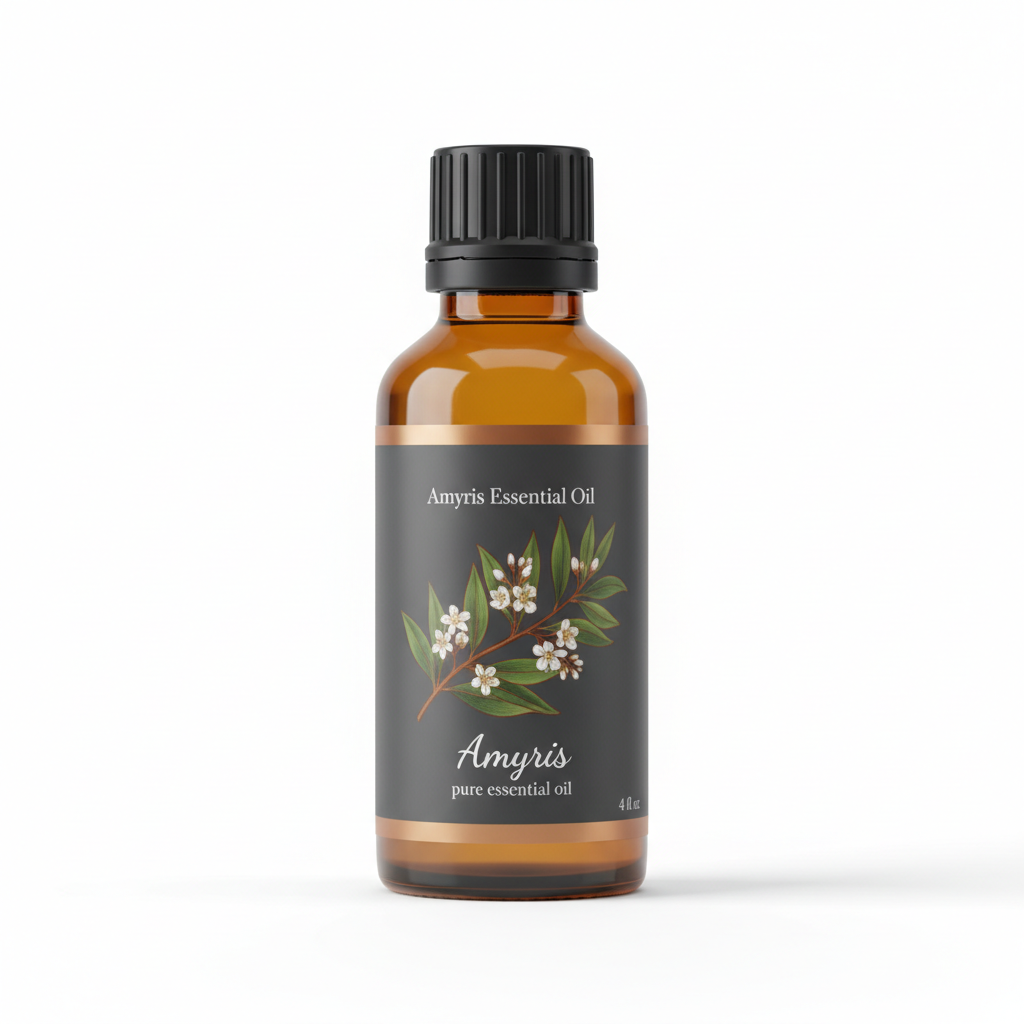
Amyris Essential Oil
Our own Amyris Essential Oil, in sizes from 0.5 oz to bulk.
From $20.99
Shop Now →The studies, in the order the lists cite them
Rosemary against minoxidil. In a 2015 Skinmed trial by Panahi et al., 100 people with androgenetic alopecia were randomised to rosemary oil or 2% minoxidil for six months, with hair counts taken at baseline, three months and six months. Neither group changed significantly at three months, both had improved from baseline by six months, and the two groups did not differ from each other. Scalp itching was reported more often in the minoxidil group. Two limits matter before anyone repeats this at home. Both arms received an active product, so there was no placebo group to show what hair counts do on their own over six months. And no rosemary dilution appears in the abstract, so there is no percentage to copy even if copying were advisable.
Peppermint in mice. Oh, Park and Kim (Toxicological Research, 2014) shaved the backs of male C57BL/6 mice and applied saline, jojoba oil, 3% minoxidil or 3% peppermint oil in jojoba oil, 100 microlitres once a day, six days a week, for four weeks. The peppermint group scored highest on a 0 to 5 hair-growth index (about 92% against about 55% for minoxidil at week 4) and had more and deeper follicles on histology. It is an animal study. The tissue analyses used only three to five mice per time point, and although the title says "without toxic signs," the paper measured body weight and food intake rather than running a toxicity assessment. A 3% peppermint oil leave-on is also well above the dilutions discussed for facial and sensitive skin later on this page. Nothing in a mouse paper tells you what to put on a human scalp.
A four-oil blend in alopecia areata. Hay, Jamieson and Ormerod (Archives of Dermatology, 1998) randomised 86 people with alopecia areata. The active group massaged thyme, rosemary, lavender and cedarwood oils in a jojoba and grapeseed carrier into the scalp daily; the control group massaged in the carrier alone. After seven months, 19 of 43 people (44%) in the active group had improved against 6 of 41 (15%) in the control group (P = .008). The abstract's group sizes add up to 84 rather than 86, which is worth knowing. This is one small trial in a different condition from pattern hair loss, it tested a four-oil blend rather than any single oil, and it is a single trial. The careful reading is that it is a result a dermatologist can weigh, not a recipe.
Tea tree in a shampoo. Satchell et al. (Journal of the American Academy of Dermatology, 2002) gave 126 people aged 14 and over with mild to moderate dandruff either a 5% tea tree oil shampoo or a placebo shampoo daily for four weeks. The quadrant-area-severity score improved by 41% with tea tree oil against 11% with placebo. The American Family Physician summary (2003) adds that allocation concealment was uncertain, that tea tree's odour probably let people guess their group, and that only one patient in each group was completely free of dandruff at four weeks. This is a dandruff result in a rinse-off product. It says nothing about hair growth.
What the carrier does, and why that matters more than the essential oil
If you strip those studies down, the common ingredient is a carrier or a vehicle. Among the oil-on-hair results cited here, the one with a measured effect on the fibre comes from a carrier, not an essential oil. Rele and Mohile (Journal of Cosmetic Science, 2003) compared mineral, sunflower and coconut oil on protein loss from hair, using in vitro and in vivo methods. Coconut oil was the only one of the three that clearly reduced protein loss, in both undamaged and damaged hair; mineral and sunflower oils did not. The authors attribute this to coconut oil's small, linear lauric acid triglyceride, which they say can penetrate the shaft.
The practical consequence, reasoning from that paper: in a scalp or hair oil at 1% essential oil, 99% of the bottle is carrier, and the carrier is the part with a measured effect on the hair. Choosing the carrier is the real formulation decision, and we do not sell carrier oils, so buy one from any reputable supplier. Our carrier oils guide covers the differences.
Scalp skin: dilution and allergy come first
Robert Tisserand's dilution article for the Tisserand Institute (undated page, read October 2026) lists 0.5 to 1.2% for facial cosmetics and other sensitive areas, 1 to 3% for body oils and lotions, and 2 to 4% for wash-off products. It has no scalp category. Reasoning from that, the scalp is closer to the sensitive-area range than to body massage, and our advice is to stay at or below 1% for a leave-in. The shop's own range for amyris is 0.5% to 2% in a carrier oil, with a patch test first; where a published range and the shop range differ, take the lower figure for the scalp.
The 5% in the Satchell shampoo sits above Tisserand's 2 to 4% wash-off range, and the 3% in the mouse study was on a mouse. Neither is a leave-in dilution for people. If you want to try a product with essential oil in it on your own scalp, the arithmetic at 30 drops per millilitre (the average the Tisserand Institute's drop-size page uses, with studies it cites ranging from about 20 to 40 drops per millilitre) is:
| Finished volume | 0.5% | 1% |
|---|---|---|
| 10 mL | 1.5 drops | 3 drops |
| 30 mL (about 1 oz) | 4.5 drops | 9 drops |
| 60 mL (about 2 oz) | 9 drops | 18 drops |
These are arithmetic starting points worked out from published dilution ranges; we have not trialled them. Because drops per millilitre range from about 20 to 40, the 1% column could really land anywhere from roughly 0.75% to 1.5%. That is one more reason to start at the lower percentage. Our dilution chart shows the same table at two drop sizes.
The allergy side is better documented than the hair side. Rutherford et al. (Australasian Journal of Dermatology, 2007) reviewed patch tests over 4.5 years: of 2,320 people tested, 41 (1.8%) reacted to oxidised tea tree oil, and 8 of those 41 had applied it undiluted. Hausen, Reichling and Harkenthal (1999) found that fresh tea tree oil was a very weak sensitiser in guinea pigs while oxidised oil was about three times stronger, with peroxide levels rising sharply within four days of exposure to light and air. The general lesson, which we would apply to any essential oil on a scalp you will use daily, is that an old, half-empty bottle left in a bathroom is a different material from the one you opened. Keep bottles tightly closed, cool and dark, and do the patch test on the inner forearm before the scalp. Our skincare guide explains how a fragrance allergy tends to develop.
Where amyris fits, and where it does not
No study of amyris oil on hair turned up in our reading, and we make no claim for it: the Origin page states that no medicinal claim is made for amyris. If you want a woody scent in a leave-in oil or a pre-wash scalp massage oil, our oil is pure and undiluted Amyris balsamifera, steam distilled from aged heartwood, and the shop's 0.5% to 2% guidance applies, with the lower end advised here. That is a fragrance decision. If a product is meant to do something about shedding, thinning or dandruff, there is no essential oil, ours included, that we would point to as the answer.
Who should skip this, and who to see
See a dermatologist, not a bottle, if you have patchy loss, sudden heavy shedding, a scalp that is painful, scaly or inflamed, or thinning that is progressing; a physician or dermatologist can work out which type of hair loss you have, and that decides what is worth doing. Skip scalp essential oils altogether if you have broken or inflamed scalp skin, a history of fragrance or tea tree allergy, or if you are pregnant (ask your OB-GYN or midwife first). Keep every product away from eyes and away from children and pets, as the shop guidance for our oil says. The honest summary of the rosemary, peppermint, blend and tea tree results is that each is a starting question for researchers and not an answer for a shopper.
Amyris Essential Oil
Amyris Essential Oil from our own shop, in sizes from 0.5 oz to bulk.
From $20.99
Shop Now →Sources & Further Reading
- Panahi et al., 2015. Rosemary oil vs minoxidil 2% in androgenetic alopecia: a randomized comparative trial (Skinmed). pubmed.ncbi.nlm.nih.gov
- Oh, Park and Kim, 2014. Peppermint oil promotes hair growth without toxic signs (Toxicological Research). pmc.ncbi.nlm.nih.gov
- Hay, Jamieson and Ormerod, 1998. Randomized trial of aromatherapy in alopecia areata (Archives of Dermatology). pubmed.ncbi.nlm.nih.gov
- Satchell et al., 2002. 5% tea tree oil shampoo and dandruff (Journal of the American Academy of Dermatology). pubmed.ncbi.nlm.nih.gov
- American Family Physician, 2003. Tea tree oil shampoo in dandruff (summary of Satchell 2002). aafp.org
- Rele and Mohile, 2003. Effect of mineral oil, sunflower oil and coconut oil on prevention of hair damage (Journal of Cosmetic Science), abstract read via Europe PMC. ebi.ac.uk
- Rutherford et al., 2007. Allergy to tea tree oil: retrospective review of 41 cases (Australasian Journal of Dermatology). pubmed.ncbi.nlm.nih.gov
- Hausen, Reichling and Harkenthal, 1999. Degradation products of monoterpenes are the sensitizing agents in tea tree oil (American Journal of Contact Dermatitis). pubmed.ncbi.nlm.nih.gov
- Tisserand Institute, undated page, read October 2026. Dilution for essential oils. tisserandinstitute.org
- Tisserand Institute, undated page, read October 2026. How big is a drop? tisserandinstitute.org