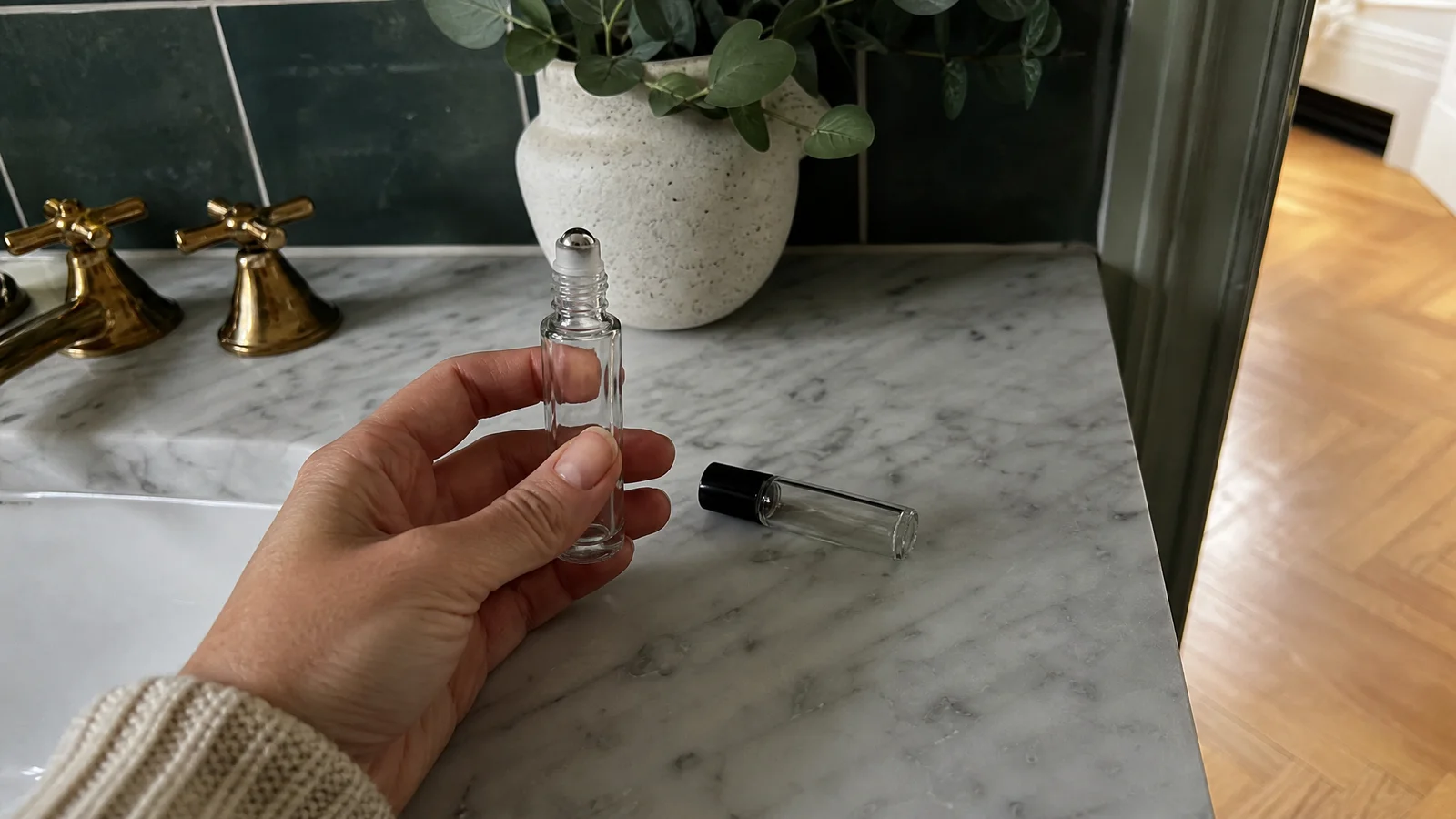
Essential Oil Roller Blends: 10 Formulas, With the Math
The blend matters less than the percentage, and published roller percentages disagree by a factor of ten. Robert Tisserand's range for "feel good" and pain rollerballs is 3 to 10%, his range for facial cosmetics is 0.5 to 1.2%, and our shop's guidance for amyris on skin is 0.5% to 2% in a carrier oil. For a scent roller worn on the wrists and the neck, we would work at 1%, with 2% as a ceiling. The ten blends below are built on that number, and the arithmetic is shown so you can check it.
Amyris Essential Oil
Our own Amyris Essential Oil, in sizes from 0.5 oz to bulk.
From $20.99
Shop Now →Which published number applies to a roller
In his Tisserand Institute article on dilution (undated page, read October 2026), the ranges are: 0.2 to 1% for sensitive or impaired skin, 0.5 to 1.2% for facial cosmetics and underarms, 1 to 3% for body oils and lotions, 2 to 4% for wash-off products, and 3 to 10% for pain and "feel good" rollerballs. He says the rollerball range assumes use on a small area of skin, and that for sensitive skin the oil can go on clothing or a pendant instead.
The 3 to 10% range is justified in that article by pain research, where studies used 3 to 5% for menstrual pain and up to 10% for some musculoskeletal pain. A scent roller has no such purpose, so there is no reason to borrow the top of that range. Where the sources disagree with the shop's own 2% ceiling, the lower figure is the safer one for the places people actually roll a perfume: the neck, behind the ears, the inner wrist. Our editorial position, reasoning from those ranges: 1% as the default, 2% only for wrists on skin you have already patch tested, and anything near the face closer to the 0.5 to 1.2% facial range.
The arithmetic, and how a dropper can change it
For a 10 mL roller at 2%, the formula is 10 mL x 30 drops per mL x 0.02 = 6 drops of essential oil in total, split across the oils in the blend. The 30 drops per millilitre is the average the Tisserand Institute's drop-size page uses, drawn from three studies (1999, 2000 and 2016) in which 20 drops averaged 0.66 g. The same page notes that across those studies drops per millilitre ranged from about 20 to 40.
That range moves a small roller a lot. Worked example, from the arithmetic alone: 6 drops at 20 drops per mL is 0.3 mL of oil in about 10.3 mL, roughly 2.9%. At 40 drops per mL it is 0.15 mL, roughly 1.5%. So a "2%" roller can land anywhere from 1.5% to 2.9% depending on the dropper, and 2.9% is above the shop's ceiling. Two ways to avoid this: count the drops from your own dropper into a measured 1 mL once and use that number, or measure the essential oil with a graduated pipette. To reach 1%, put the same 6 drops into 20 mL of carrier (two 10 mL rollers); the same dropper range then gives about 0.75% to 1.5%. Our dilution chart has the full table at two drop sizes.
Ten starting formulas
These are starting formulas worked out from dilution arithmetic and the published ranges above; we have not trialled them, and we are not describing how any of them smells in a finished roller. Each uses 6 drops of essential oil in 10 mL of carrier (2%), or the same 6 drops in 20 mL (1%). The note roles are the conventional ones: citrus and bright oils at the top, florals in the middle, woods and resins at the base. Amyris is a base note that helps citrus and floral top notes hold, which is why it sits in the first six. It is not required in any of them. Every oil other than amyris is something we do not sell, so buy those from any reputable supplier.
| # | Oils and drops | Note structure |
|---|---|---|
| 1 | Amyris 3, lavender 2, mandarin 1 | Base, heart, top |
| 2 | Amyris 2, frankincense 2, bergamot FCF 2 | Base and resin, top |
| 3 | Amyris 3, vetiver 1, patchouli 2 | All base |
| 4 | Amyris 3, geranium 2, lavender 1 | Base, heart |
| 5 | Amyris 3, cedarwood 2, mandarin 1 | Woods, top |
| 6 | Amyris 2, clary sage 2, bergamot FCF 2 | Base, heart, top |
| 7 | Lavender 3, geranium 2, mandarin 1 | Heart, top (no amyris) |
| 8 | Frankincense 3, lavender 2, bergamot FCF 1 | Resin, heart, top (no amyris) |
| 9 | Cedarwood 3, vetiver 1, bergamot FCF 2 | Woods, top (no amyris) |
| 10 | Patchouli 2, geranium 2, mandarin 2 | Base, heart, top (no amyris) |
Four of the ten have no amyris because amyris is one woody option among several; if a blend of cedarwood or patchouli suits you better, use it. Our roll-on perfume recipes go further on balancing top, heart and base, and amyris as a fixative covers why a low-volatility oil changes how a blend develops. A 1-drop oil in a 6-drop recipe is 0.33% of a 10 mL roller at 30 drops per mL, so each oil on this list stays a fraction of the total.
What these recipes leave out on purpose
Expressed citrus that is phototoxic. Cold-pressed (expressed) bergamot carries furanocoumarins, which react with UVA light. The Tisserand Institute's phototoxicity article cites an IFRA limit of 0.4% for expressed bergamot in leave-on products and advises keeping a treated area out of UV for at least 12 hours; it describes bergamot FCF, with the bergapten removed, as non-phototoxic, and lists expressed mandarin among the citrus oils with negligible furanocoumarins. That is why the table uses FCF bergamot and mandarin. Check the label of any citrus oil for "expressed" and "FCF"; our phototoxic oils guide goes through the rest.
Clove, cinnamon and similar skin irritants. The Tisserand Institute's dilution chart page gives a maximum of 0.5% for clove bud oil on skin-allergy grounds. At 6 drops in 10 mL, a single drop of any oil is already 0.33%, so there is almost no room for a strongly reactive oil in a roller. We left them out.
Peppermint and eucalyptus. We left them out because we could not verify age-specific limits for them: the Tisserand Institute's children's dilution chart is an image we could not read, so we cannot quote its age bands.
Filling, carrier and labelling
Add the essential oils to the roller first, then top up with the carrier, fit the roller ball, and swirl rather than shake hard. Use a bottle that keeps light out, such as amber or dark glass, because light and oxygen change essential oils over time. The clearest evidence we could read is for tea tree oil: Hausen, Reichling and Harkenthal (1999) found that oxidised tea tree oil was about three times as strong a sensitiser in guinea pigs as fresh oil. We have no equivalent data for the oils in this table, so the instruction is reasoning, not a measured result: keep the stock bottles closed and cool, and discard a roller that smells off.
The carrier is the other ingredient you choose. We do not sell carrier oils, so buy fractionated coconut, jojoba or another from any reputable supplier, and read the carrier oils guide before choosing. If anyone who will use the roller has a nut or peanut allergy, avoid nut-derived carriers and ask an allergist; a 2003 cohort study of about 14,000 children (Lack et al., NEJM) linked skin preparations containing peanut oil to later peanut allergy (odds ratio 6.8, wide confidence interval of 1.4 to 32.9, based on interview data), which is one reason we would not pick peanut as a carrier.
Label every roller by hand: the oils, the percentage, the date you made it, and "not for children." A pencilled note is enough. A bottle with no label is the one that gets mistaken for a lip balm or used on the wrong person.
Who should not use these
Do not make these for children: age-specific dilutions are a pediatrician's decision, and the children's safety guide explains why we stop here. Pregnancy and breastfeeding questions belong with an OB-GYN or midwife, and our pregnancy article sets out what is and is not known. Keep rollers away from pets (the pet safety guide explains why).
Patch test first on the inner forearm (our patch test guide has the method), and skip the roller if you have eczema or inflamed skin; a dermatologist is the person to ask. The broader context for fragrance and skin is in our skincare guide.
A roller is a small, low-percentage product, which is the reason to make it carefully: choose the percentage, measure the oil, label the bottle, and the blend is the easy part.
Amyris Essential Oil
Amyris Essential Oil from our own shop, in sizes from 0.5 oz to bulk.
From $20.99
Shop Now →Sources & Further Reading
- Tisserand Institute, undated page, read October 2026. Dilution for essential oils. tisserandinstitute.org
- Tisserand Institute, undated page, read October 2026. How big is a drop? tisserandinstitute.org
- Tisserand Institute, undated page, read October 2026. Phototoxicity: essential oils, sun and safety. tisserandinstitute.org
- Tisserand Institute, undated page, read October 2026. Essential oil dilution chart. tisserandinstitute.org
- Hausen, Reichling and Harkenthal, 1999. Degradation products of monoterpenes are the sensitizing agents in tea tree oil (American Journal of Contact Dermatitis). pubmed.ncbi.nlm.nih.gov
- Lack et al., 2003. Factors associated with the development of peanut allergy in childhood (New England Journal of Medicine). pubmed.ncbi.nlm.nih.gov