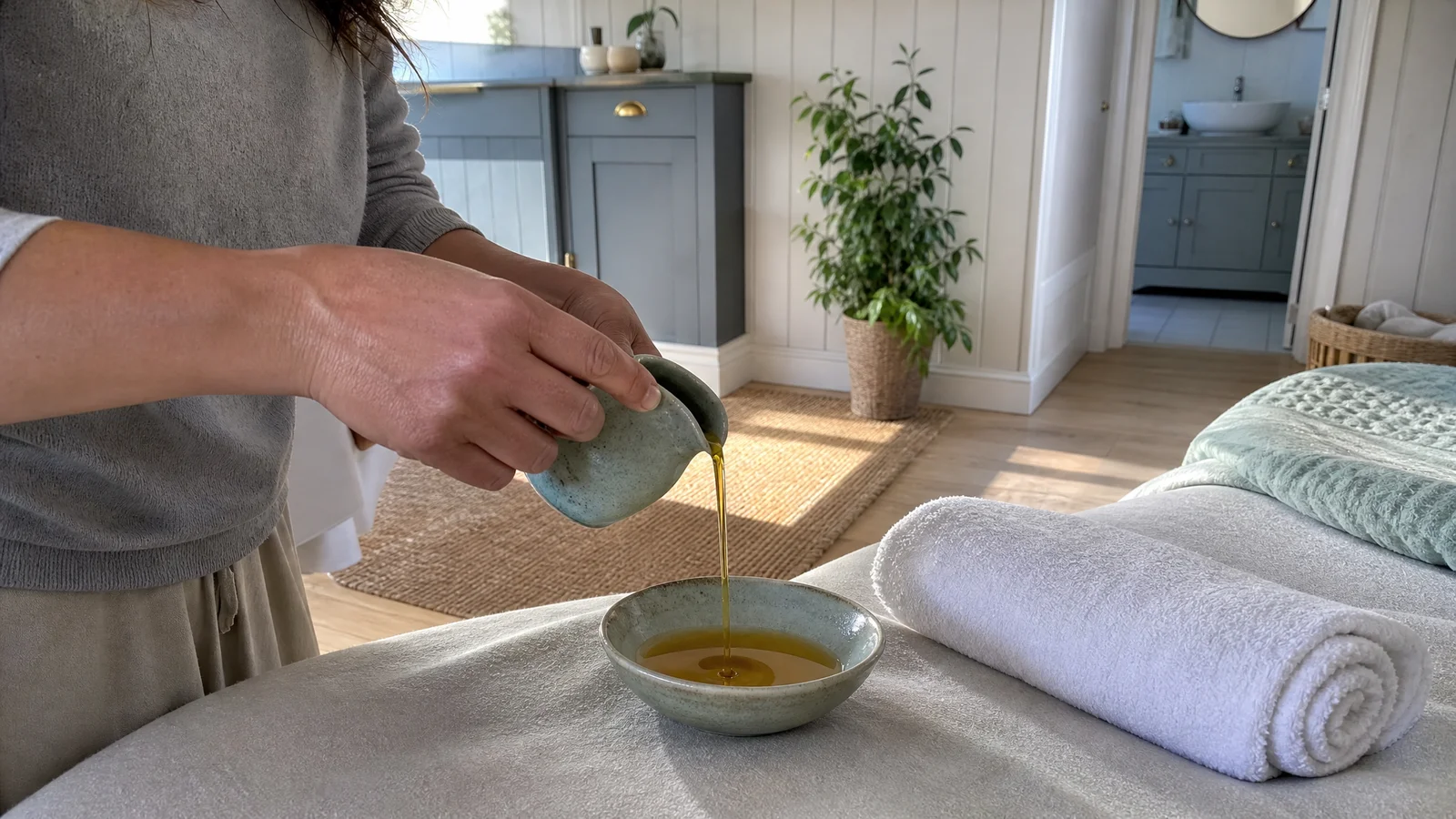
DIY Massage Oil: Why Whole-Body Dilution Should Be Lower
A massage oil is the one essential oil recipe where the usual advice to copy a body-oil percentage can go wrong, because you spread far more oil over far more skin than in a roll-on or a face product. Our advice, reasoning from published ranges and one absorption study, is to make a whole-body massage oil at 1% essential oil and keep 2% for small, local areas. The sections below show the arithmetic, three starting formulas for a 60 mL bottle, and the part people skip: what the oil does to your sheets.
Amyris Essential Oil
Our own Amyris Essential Oil, in sizes from 0.5 oz to bulk.
From $20.99
Shop Now →Why a larger area changes the number
Robert Tisserand's dilution article for the Tisserand Institute (undated page, read October 2026) gives 1 to 3% for body oils and lotions and says that range has been used by aromatherapists for body massage for more than 50 years. The article does not give a separate, lower figure for large areas; its only area-related guidance concerns small areas (rollerballs) and sensitive ones (face, underarms). The shop's own range for amyris is 0.5% to 2% in a carrier oil. Where those disagree, we take the lower end for the larger exposure.
Here is the reasoning in numbers. Jäger and colleagues (Journal of the Society of Cosmetic Chemists, 1992) massaged 1.5 g of a 2:98 lavender oil and peanut oil mix into about 376 cm2 of one 34-year-old man's abdomen for 10 minutes. Linalool and linalyl acetate were in his blood within 5 minutes, peaking at about 121 and 100 ng/mL at 20 minutes, and most had cleared by 90 minutes. It is one subject, so it shows that these components cross the skin during a massage, not how much any person absorbs. The oil he received contained about 0.03 g of lavender oil.
Now a 60 mL whole-body bottle at 1% holds 0.6 mL of essential oil. Using the 0.952 relative density on our published certificate of analysis for amyris (other oils differ), that is about 0.57 g, roughly 19 times the mass in the Jäger experiment. Not all of it reaches the skin or the bloodstream, because much stays on the towel, the sheets and the hands, so this is an upper bound on what is on the skin and not an absorbed dose. But the direction is clear: the more oil and the more area, the more essential oil is in contact, and a percentage chosen for a wrist is not automatically right for a back and both legs.
The arithmetic, at 30 drops per millilitre
The formula is: drops of essential oil = bottle volume in mL x 30 x (percent / 100). The 30 is the average used by the Tisserand Institute's drop-size page, which also reports that across three studies drops per millilitre ranged from about 20 to 40, so a "1%" bottle can really be 0.75% to 1.5%. Count your own dropper into a measured millilitre once, or use a graduated pipette. Our dilution chart shows the full table.
| Bottle | 0.5% | 1% (whole body) | 2% (small area only) |
|---|---|---|---|
| 10 mL | 1.5 | 3 | 6 |
| 30 mL (about 1 oz) | 4.5 | 9 | 18 |
| 60 mL (about 2 oz) | 9 | 18 | 36 |
| 120 mL (about 4 oz) | 18 | 36 | 72 |
Three starting formulas for 60 mL at 1% (18 drops total). These are worked out from dilution arithmetic and published usage levels; we have not trialled them, and we make no claim about how any of them smells once blended or feels in use.
- Amyris alone: 18 drops of amyris. Our oil is pure and undiluted Amyris balsamifera, a base note with a creamy, woody, balsamic scent and a soft vanilla undertone.
- Amyris and lavender, with mandarin: 9 amyris, 6 lavender, 3 mandarin.
- Amyris, frankincense and geranium: 8 amyris, 6 frankincense, 4 geranium.
Lavender, frankincense, geranium and mandarin are not products we sell; buy them from any reputable supplier. We make no relaxation or muscle claim for any oil in these formulas, and the Origin page states that no medicinal claim is made for amyris. For a local massage on shoulders or feet in a 10 mL bottle, 2% is 6 drops, which is the shop's ceiling.
The carrier decides how it feels, and what it can set off
We do not sell carrier oils, so the carrier comes from a reputable supplier of your choice; our carrier oils guide compares them. Two practical points we can state without trialling anything. First, "glide" is the carrier's job, not the essential oil's: at 1%, 99% of what you rub in is carrier, so choose it for how you want the hands to move and how quickly it is absorbed, and expect to adjust after your first use. Second, choose the carrier with allergy in mind. A 2003 cohort study of about 14,000 British children (Lack et al., New England Journal of Medicine) found an association between skin preparations containing peanut oil and later peanut allergy (odds ratio 6.8, 95% confidence interval 1.4 to 32.9), with the authors suggesting sensitisation through inflamed skin. The result rests on interview data from a small number of cases and the authors asked for confirmation, so treat it as a reason for caution, not proof. Nut-derived carriers, including sweet almond, deserve the same question for anyone with a nut allergy; an allergist is the person to ask.
The warming claim
Many commercial and home recipes promise a "warming" massage oil. Reasoning from how such recipes are built, the warm feel typically comes from adding spice-type oils that provoke the skin, and a sensation of heat is the skin reacting. We found no source showing that a warming oil is more effective or safer. For scale: the Tisserand Institute's dilution chart page gives a maximum of 0.5% for clove bud oil on skin-allergy grounds, below the whole-body percentage in this article. If you want warmth, warm the bottle in a bowl of warm water and keep the room comfortable.
Sheets, towels and the dryer
A massage leaves oil on linen, and vegetable-oil-soaked laundry can start a fire in or after the dryer. In April 2009 the City of Madison Fire Department traced a house fire to spontaneous combustion of oily rags in the dryer; its advice is that vegetable oils can self-heat during drying or after the clothes come out, so wash oil-soiled items more than once, preferably hang them to dry, use the lowest heat and a cool-down cycle if you do use a dryer, and do not leave dried items in the dryer or piled in a basket. Keep a dedicated set of old towels and a sheet for massage, and treat them as oily laundry.
Oil on a bathroom floor or in a tub is a slip hazard (reasoning, not a sourced figure). Do not put massage oil in bath water to "finish" a session; it coats the tub.
Who should skip this, and what to do first
Patch test on the inner forearm before anyone gets a full massage; our patch test guide has the method. Anyone who is pregnant should ask an OB-GYN or midwife before using essential oils on the skin; the pregnancy article covers what is and is not known. If the person has eczema, psoriasis, broken or inflamed skin, or is being massaged for a medical reason, ask a physician or dermatologist first, and see a licensed massage therapist for therapeutic work; there is no one at this business who can advise on that. Keep oil away from eyes and from children and pets, and do not take it internally. The body oil recipe covers after-shower use, and the skincare guide sets out the wider logic.
The percentage, the carrier and the laundry are the three decisions that count in a massage oil; the oil blend is the last and least risky one.
Amyris Essential Oil
Amyris Essential Oil from our own shop, in sizes from 0.5 oz to bulk.
From $20.99
Shop Now →Sources & Further Reading
- Tisserand Institute, undated page, read October 2026. Dilution for essential oils. tisserandinstitute.org
- Tisserand Institute, undated page, read October 2026. How big is a drop? tisserandinstitute.org
- Tisserand Institute, undated page, read October 2026. Essential oil dilution chart. tisserandinstitute.org
- Jäger, Buchbauer, Jirovetz and Fritzer, 1992. Percutaneous absorption of lavender oil from a massage oil (Journal of the Society of Cosmetic Chemists). library.scconline.org
- Lack et al., 2003. Factors associated with the development of peanut allergy in childhood (New England Journal of Medicine). pubmed.ncbi.nlm.nih.gov
- City of Madison Fire Department, 2009. Spontaneous combustion caused east side dryer fire. cityofmadison.com