DIY Body Oil: Strength, Carrier and Sun Rules for 100 mL
A body oil is the easiest essential oil blend to get right and the easiest to make too strong: 1 mL of amyris in a 100 mL bottle is 1%, a sensible first strength, and the published body-oil range goes to 3%. This page gives the arithmetic for 50 mL and 100 mL bottles, a carrier choice that accounts for how long the bottle will sit, and the practical hazards a recipe usually skips: sun on the skin, a slippery shower floor, and oily towels. The recipes are starting formulas worked out from published dilution guidance, and we have not trialled them.
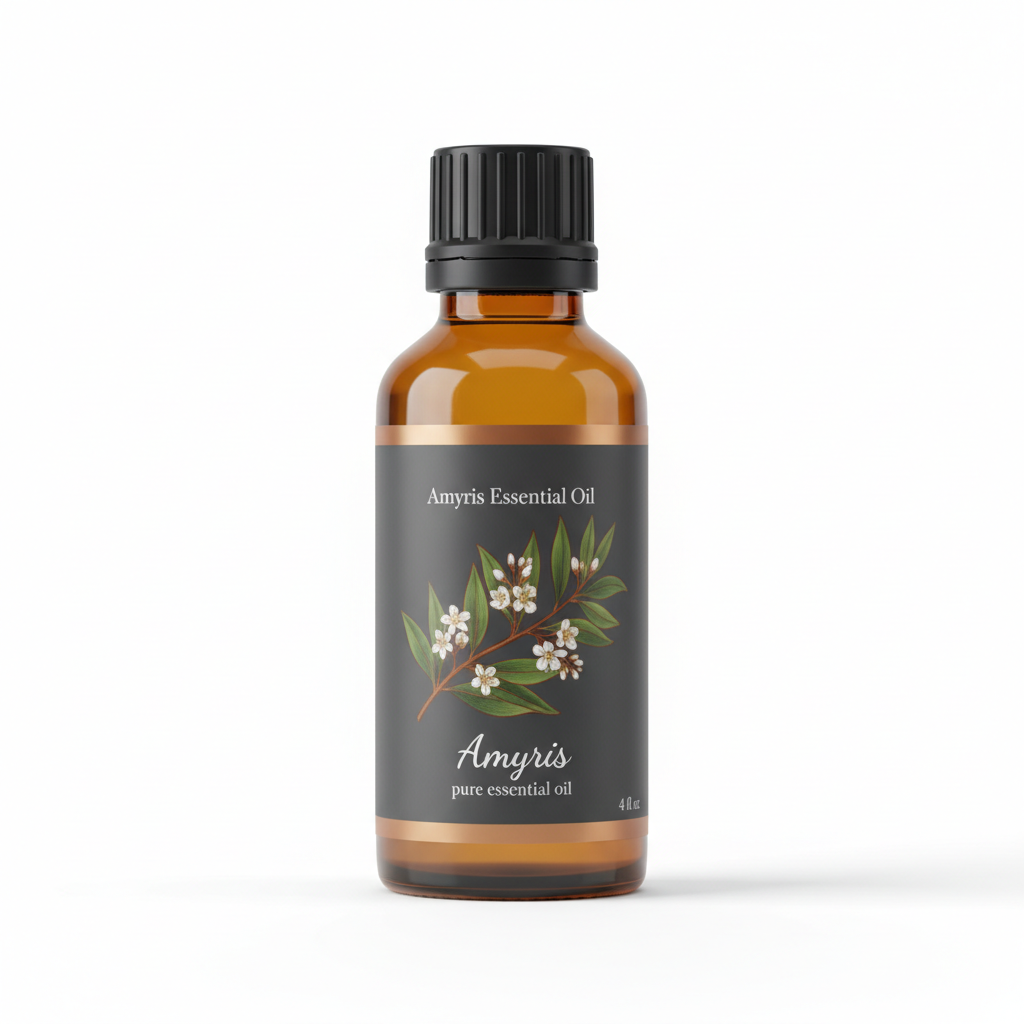
Amyris Essential Oil
Our own Amyris Essential Oil, in sizes from 0.5 oz to bulk.
From $20.99
Shop Now →Pick the strength first
The Tisserand Institute gives 1% to 3% for body oils and lotions, noting that this matches fragrance levels in commercial personal care products, that aromatherapists have used it for body massage for over 50 years, and that you should "start low and increase the concentration only if needed" (Tisserand Institute, dilution article). The same article puts reaction-prone or impaired skin at 0.2% to 1% and the face at 0.5% to 1.2%. Our shop guidance for amyris is 0.5% to 2%, which sits inside the body band at the low end. Our advice, reasoning from those two sources: make 1% your default, use 0.5% if you are unsure of your skin or the oil will be used daily, and treat 2% as the ceiling. Do not use the body-oil strength on the face; the beard oil formula shows facial arithmetic.
The arithmetic
Volume of amyris = bottle volume times percentage. At 30 drops per mL, which is the assumption behind Tisserand's chart (Tisserand Institute, How big is a drop?), a drop is about 0.033 mL. The same source reports that real droppers range from about 20 to 40 drops per mL, so for a 100 mL bottle we recommend a 1 mL graduated pipette or a 0.01 g scale instead of counting. The weight column uses the relative density of 0.952 at 20 C on the published certificate of analysis for one batch of our oil.
| Strength | 50 mL bottle | 100 mL bottle | Approx. weight in 100 mL |
|---|---|---|---|
| 0.5% | 0.25 mL (7 to 8 drops) | 0.5 mL (15 drops) | 0.48 g |
| 1% | 0.5 mL (15 drops) | 1 mL (30 drops) | 0.95 g |
| 2% | 1 mL (30 drops) | 2 mL (60 drops) | 1.90 g |
Fill the rest of the bottle with carrier oil. Two starting formulas follow, both for 100 mL: Everyday, 99.5 mL carrier and 0.5 mL amyris; Standard, 99 mL carrier and 1 mL amyris. For a blend with rose, see our sister recipe rose and amyris body oil. For more on drops versus millilitres, see the dilution chart.
Choose a carrier for the bottle's lifespan
We sell no carrier oils, so buy from any reputable supplier. A body oil bottle is large, and a 100 mL bottle used once a day goes slowly, so oxidation matters. In a 2026 study of four oils by Fagoaga and colleagues, Rancimat induction periods at 373 K were 39.80 hours for jojoba, 27.50 for olive, 10.39 for sunflower and 4.45 for rosehip, with the ranking tied to polyunsaturated fatty acid content (Fagoaga et al., Antioxidants, 2026). Those are accelerated-heat hours, not shelf life. Reasoning from them: a high-PUFA oil like sunflower suits a 50 mL batch you will finish in weeks, and a low-PUFA oil suits a bigger batch.
Skin behaviour is a second axis. A 2017 review by Lin and colleagues reports that in a study by Danby and others, olive oil, which is mainly oleic acid, had a detrimental effect on skin barrier function in adult volunteers while sunflower seed oil preserved stratum corneum integrity (Lin et al., Int J Mol Sci, 2017). A pilot in infants showed no difference between them, so the evidence is not settled, but it is a reason not to default to olive oil for daily whole-body use. If you have eczema, ask a dermatologist before using any plant oil. For tree-nut, peanut or sesame allergy, avoid those oils entirely and ask an allergist. The full comparison is in our carrier oils guide.
Sun: the citrus caution
A body oil is worn on skin that may be in daylight, which is when citrus oils become a problem. The Tisserand Institute says phototoxicity is mainly caused by furanocoumarins in expressed citrus oils, cites IFRA's maximum of 0.4% for bergamot oil in a final product on sun-exposed skin, and advises keeping treated skin out of UV for at least 12 hours (Tisserand Institute, phototoxicity). Amyris is not on any phototoxic list we opened, but that does not make a blend safe: if you add a pressed citrus oil as a top note, stay well under the published maximum for that oil and see our phototoxic essential oils guide. The simplest approach is an amyris-only body oil, or a partner oil that the guide shows is not phototoxic.
Applying it, and the bathroom hazards
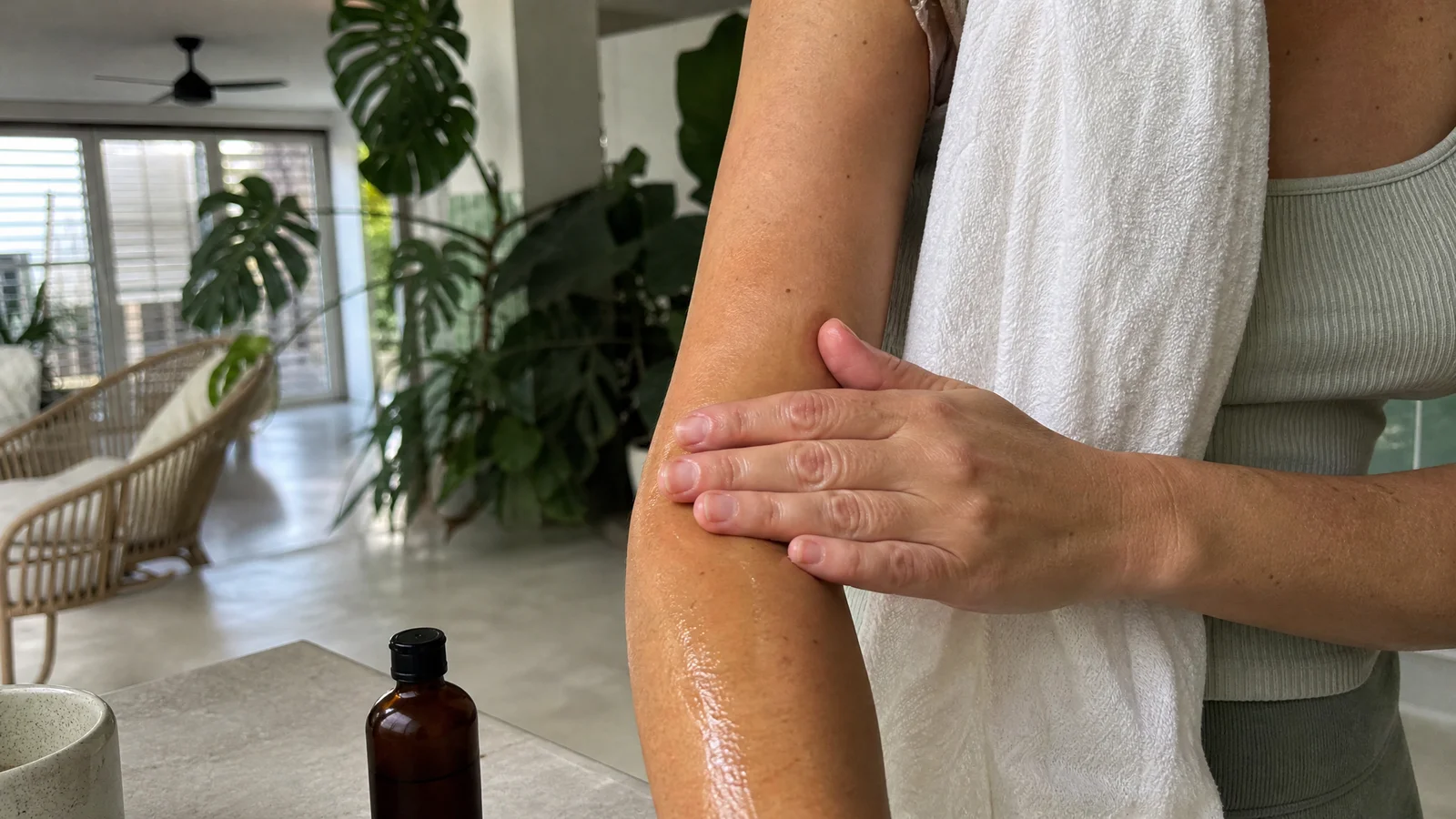
The usual advice is to apply on damp skin right after a shower. Reasoning, not a tested result: water on the skin lets a small amount of oil spread further, so you use less. We have not measured absorption or feel, and the claim is only about convenience. The hazards matter more.
- Slipperiness. Oil on feet and the floor of a tub or shower is a fall risk. Apply after stepping out, on a mat, not in the tub, and wipe the floor if oil reaches it.
- Stains and towels. Oil marks fabric, and oxidising oil produces heat. A Safe at Work California page on rags says oil-soaked rags are a spontaneous combustion hazard because oxidising oil releases heat that can build up and ignite them if it cannot dissipate, and advises sending them to an industrial laundry that is told what oils they contain (Safe at Work California, undated page, read October 2026). That page is about workplace rags, not towels with a thin film of body oil, and we found no source that quantifies the household risk. Reasoning from the oxidation research above, higher-PUFA oils are the ones to be more careful with. A sensible precaution: keep oily towels separate, wash them promptly, and do not leave warm laundry piled up.
- Skin check. Try a small area first, wait a day, and stop at redness, itching or swelling. The Tisserand Institute notes irritation usually resolves within hours while an allergic reaction can persist for days or weeks (Tisserand Institute, irritation and allergic reactions).
Who should skip it, and what we will not claim
Skip a scented body oil on broken or inflamed skin, and ask a dermatologist about any skin condition. In pregnancy, ask an OB-GYN or midwife first; for babies and children, ask a pediatrician. We make no claim that amyris or any body oil improves skin: the FDA treats a product meant to lubricate skin and add fragrance as a cosmetic, and a product intended for a therapeutic use as a drug (FDA, Is It a Cosmetic, a Drug, or Both?). Our origin page says no medicinal claim is made for amyris.
Our oil is pure, undiluted Amyris balsamifera with a creamy, woody, balsamic scent and a soft vanilla undertone, and it is a base note, so in a body oil it provides the fragrance, nothing more. For larger-area massage use, see DIY massage oil, and for the framework behind these numbers see essential oils in skincare.
Amyris Essential Oil
Amyris Essential Oil from our own shop, in sizes from 0.5 oz to bulk.
From $20.99
Shop Now →Sources & Further Reading
- Tisserand Institute, undated pages, read October 2026. Dilution; How big is a drop?; irritation and allergic reactions; phototoxicity. tisserandinstitute.org
- Fagoaga C et al., 2026. Oxidative stability and kinetics of oxidation of rosehip, sunflower, olive and jojoba oils. pmc.ncbi.nlm.nih.gov
- Lin TK, Zhong L, Santiago JL, 2017. Anti-inflammatory and skin barrier repair effects of topical application of some plant oils. pmc.ncbi.nlm.nih.gov
- Safe at Work California, undated page, read October 2026. Storage and disposal of oil or solvent soaked rags. safeatworkca.com
- FDA, undated page, read October 2026. Is it a cosmetic, a drug, or both? fda.gov