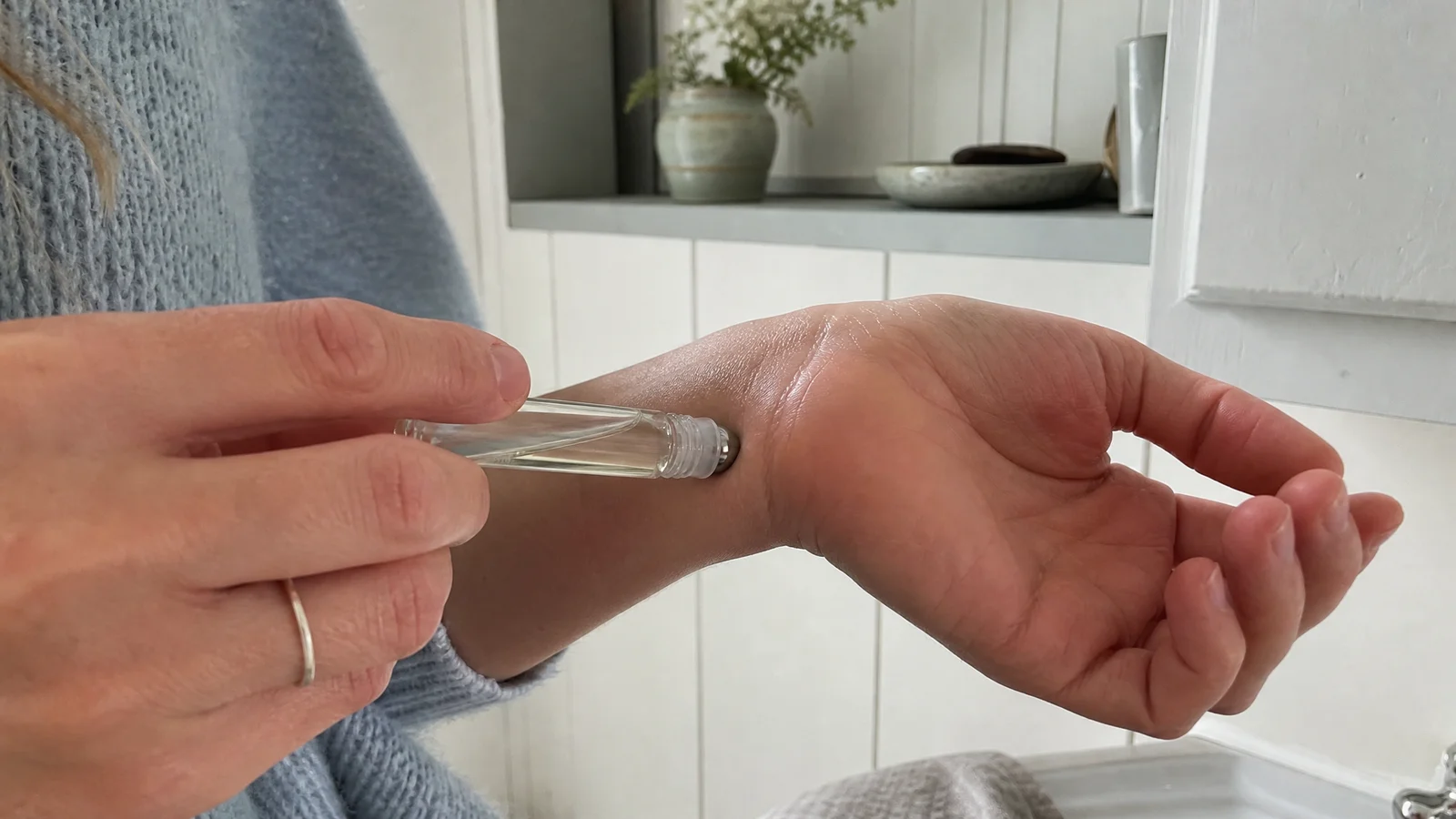
DIY Roll-On Perfume: Dilution Math and Three Starting Formulas
A roll-on perfume that goes on your skin is a dilution problem before it is a scent problem. Alcohol-based fine fragrance is conventionally 15 to 20% aromatic material or more, while published dilution guidance for skin products runs from about 0.5% to 3%, so a home roll-on made to the skin range will be a close-range, body-scent product and not a miniature eau de parfum. The recipes below are arithmetic starting formulas: we have not trialled them, and they are built from the sources cited.

Amyris Essential Oil
Our own Amyris Essential Oil, in sizes from 0.5 oz to bulk.
From $20.99
Shop Now →Two numbers that do not agree, and the one we would pick
There are two scales in circulation. Wikipedia's summary of the trade's concentration classes (which cites a New York Times piece, and itself warns the percentages are imprecise) lists parfum at 15 to 30%, eau de parfum at 15 to 20%, eau de toilette at 5 to 15%, eau de cologne at 2 to 3% and eau fraiche at 3% or less (Wikipedia, Perfume, read October 2026). Those are fine-fragrance conventions for products sold in alcohol.
The skin-safety scale is much lower. In his page on dilution, Robert Tisserand gives 0.2 to 1% for sensitivity issues or impaired skin, 0.5 to 1.2% for facial cosmetics and deodorants, and 1 to 3% for body oils and lotions, and notes that the 1 to 3% band "corresponds with the range of fragrance used in commercial personal care products" (Tisserand Institute, undated page, read October 2026). The same page says facial products often carry about 0.5% fragrance.
| Scale | Range | What it describes |
|---|---|---|
| Eau de parfum (trade convention) | 15 to 20% | Alcohol-based fine fragrance |
| Eau de cologne (trade convention) | 2 to 3% | Light alcohol-based splash |
| Tisserand, body oils and lotions | 1 to 3% | Leave-on body products |
| Tisserand, facial cosmetics | 0.5 to 1.2% | Face and underarms |
| Tisserand, sensitive or impaired skin | 0.2 to 1% | Reactive skin |
| Our shop guidance for amyris oil | 0.5 to 2% | Dilute in a carrier oil, patch test first |
Our shop guidance (0.5 to 2%) sits inside Tisserand's body range but above his facial and sensitive-skin ranges. A roll-on gets rolled on the neck, which is next to the face, so our advice, reasoning from those ranges, is to make 1% the default and treat 2% as the ceiling for adult skin that has already passed a patch test. If you have reactive skin, stay at or under 1% and talk to a dermatologist before using a new fragrance product. The practical cost of going low is projection: a 1% roll-on is an intimate scent, noticed by someone standing close.
The arithmetic for a 10 mL roller
Drops of oil = mL of finished blend x drops per mL x percent / 100. The Tisserand Institute's dilution chart assumes 30 drops per mL, and its review of dropper studies found counts from about 20 to 40 per mL, so a drop is "not a precise measure"; its advice is to use weight or volume consistently, and a 0.01 g balance if you have one (Tisserand Institute, drop size, read October 2026). At 30 drops per mL, 10 mL at 2% is 6 drops and 10 mL at 1% is 3 drops.
Three drops cannot be split into useful proportions, so we would not make 1% in a 10 mL bottle. Make 20 mL instead: the same 6 drops now give 1%, and you fill two rollers, one to keep and one to give away. If you want to check your own dropper, count once how many drops of the oil itself fill a 1 mL syringe; a dropper at 20 per mL puts 6 drops of oil into 10 mL at about 3%, not 2%, which is a real difference at the facial end of the range.
A measuring note on our oil: its published relative density is 0.952 at 20 C (standard range 0.946 to 0.978, from the Certificate of Analysis for batch AMYQGAABHTC003A), so 6 drops at 30 per mL is about 0.2 mL, close to 0.19 g. That is a number to use if you weigh.
Three starting formulas, in drops
Each formula is 6 drops of essential oil. In 10 mL of carrier it is 2%; in 20 mL it is 1%. The oils are chosen from materials whose odor type and listed tenacity we could read in The Good Scents Company's database, a perfumery reference that gives a "substantivity" figure in hours without stating the method (so treat the figures as one database's numbers, not measurements of ours): amyris wood oil 400 hours, Virginian cedarwood 388, vetiver 400 and lavender 12 (amyris wood oil, cedarwood Virginia, vetiver Haiti, lavender France).
| Formula | Drops | Why this shape |
|---|---|---|
| Woody | 3 amyris, 2 Virginian cedarwood, 1 vetiver | All three are listed woody with tenacity near 400 hours, so the scent should change little as it wears |
| Floral-herbal | 3 lavender, 3 amyris | Lavender is listed as odor type floral but with a 12-hour figure; amyris is the slow-leaving anchor |
| Fresh | 3 bergapten-free bergamot, 1 lavender, 2 amyris | Citrus opens the blend; amyris is what remains |
The reasoning behind the second and third rows is a published relationship. A 2013 paper in Sensors by Manuel Zarzo compared perceptual freshness ratings with tenacity values from the literature and reported a strong negative correlation (r = -0.85) between fresh odor character and substantivity (Zarzo, 2013). Reasoning from that, the practical consequence is that a fresh formula will smell like its base within the first hour or two, and a roll-on built mostly from fast materials will seem to fade. Our shop copy describes amyris as a base note that helps citrus and floral top notes hold; that is why it appears in all three rows. We do not have a dry-down timeline for these blends and are not claiming one.
Every other oil in the blend counts toward the total percentage and has its own limits. Cedarwood, vetiver and lavender are not our products; buy them from any reputable supplier and check the supplier's safety information for each one.
Carrier, and why jojoba is the usual one
Jojoba is technically a liquid wax rather than a fat. A 2021 review describes it as almost 98% wax (mainly wax esters), reports high thermal and oxidative stability for the natural oil, and notes that refined or bleached jojoba has low oxidative stability because the natural antioxidants are removed (Jojoba oil review, 2021). A 2022 study heated jojoba, olive oil and squalene at 60 C for 60 days and found jojoba the most stable against autooxidation of the three, with crude jojoba oils varying among themselves (Tsuchimoto et al., 2022). Reasoning from both, a perfume that sits in a handbag for months favours an unrefined jojoba,. The review also reports that patch tests did not reveal allergic reactions except in hyperallergic people, which is a reason to patch test the finished blend, not the carrier alone. We do not sell jojoba or roller bottles.
Making it, and what resting can and cannot do
Measure the carrier into the bottle first, add the drops, cap and roll the bottle between your palms for a minute. Label it with the date and the formula. Resting a blend is a perfumery habit, and the sources are weaker than the habit: Frederic Malle's house states that classics were macerated for 4 to 8 weeks, and a perfume writer who quoted it called the idea of resting mainstream perfume "probably a bit of an old wives tale" while allowing that small independent blends benefit (Musings of a Muse, 2021). Those accounts concern alcohol perfumes. We found no source on resting oil-based roll-ons, so any duration we gave you would be invented; what we would do is smell the blend on a blotter after a day and again a week later before gifting it, and change one oil at a time if it needs adjusting. That is a process suggestion, not a result.
Before it touches skin
Patch test first (see how to patch test an essential oil) and keep the blend away from eyes. Citrus needs a specific check: the Tisserand Institute notes that most phototoxic essential oils are expressed (cold-pressed) citrus oils, that distilled citrus oils contain virtually no furanocoumarins, and that bergapten-free bergamot is considered non-phototoxic, with an IFRA guideline of 0.4% for ordinary bergamot in leave-on products on sun-exposed skin (Tisserand Institute, phototoxicity, read October 2026). In the fresh formula, 3 drops of bergamot in 20 mL is 0.5% by our arithmetic, over that figure if the bergamot were ordinary, which is why the formula names the bergapten-free kind. See phototoxic essential oils for the wider list.
Limits
This is not a product for people with broken, inflamed or very reactive skin, or for anyone who has reacted to fragrance before; a dermatologist or allergist is the right person to ask. It is not for babies or children, and it is not a replacement for a skin-safety conversation about pregnancy or medication, which belongs with a physician or midwife. Do not add oils faster than your skin has been tested against them. For the dilution maths behind other bottle sizes, use the dilution chart, and for other roller ideas see essential oil roller blends.
Where our oil fits is narrow: it is a base to anchor a roll-on, sold pure and undiluted, with independent third-party laboratory testing and reports on request. If you want a deeper note on building a blend one change at a time, how to blend essential oils and amyris as a fixative cover the method, and a wax version of this idea is in DIY solid perfume.
Amyris Essential Oil
Amyris Essential Oil from our own shop, in sizes from 0.5 oz to bulk.
From $20.99
Shop Now →Sources & Further Reading
- Tisserand Institute, undated page, read October 2026. Dilution for essential oils. tisserandinstitute.org
- Tisserand Institute, undated page, read October 2026. How big is a drop? tisserandinstitute.org
- Tisserand Institute, undated page, read October 2026. Phototoxicity: essential oils, sun and safety. tisserandinstitute.org
- Wikipedia, read October 2026. Perfume (concentration classes). en.wikipedia.org
- The Good Scents Company, read October 2026. Amyris wood oil; cedarwood oil Virginia; vetiver oil Haiti; lavender oil France. thegoodscentscompany.com
- Zarzo, M., 2013. What is a fresh scent in perfumery? Perceptual freshness is correlated with substantivity. Sensors 13(1). riunet.upv.es
- Jojoba oil: an updated comprehensive review on chemistry, pharmaceutical uses, and toxicity, 2021. pmc.ncbi.nlm.nih.gov
- Tsuchimoto, S., Sakai, H., Fukui, K., 2022. Oxidative stability of jojoba oil. BPB Reports 5(6). jstage.jst.go.jp
- Musings of a Muse, 2021. How to macerate your perfume and do you really need to do it. musingsofamuse.com