Amyris as a Fixative: Making Your Fragrance Blends Last Longer
There is a quiet frustration familiar to anyone who blends their own fragrances at home: you build something beautiful, spray it on, and within an hour it has simply vanished. The citrus notes bloom and fade. The florals drift off. What you are left with is skin and disappointment.
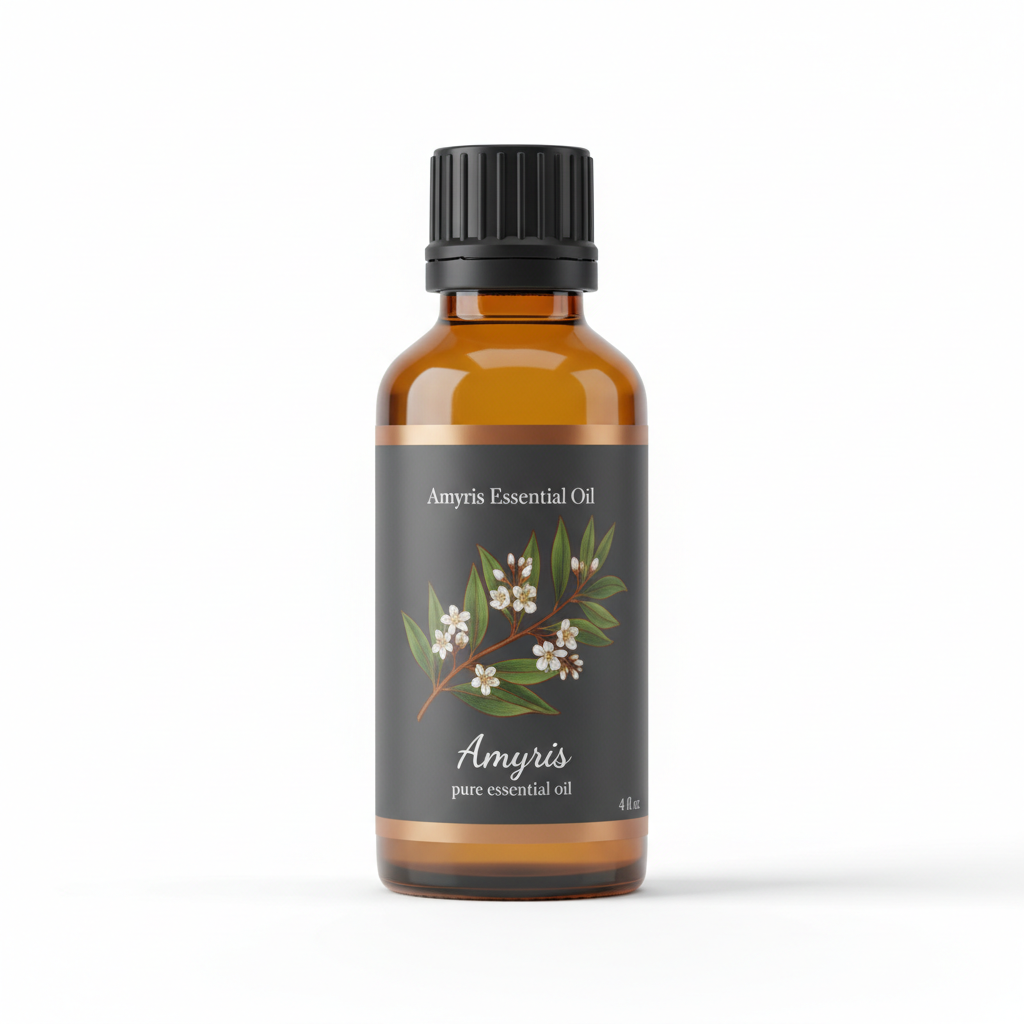
Amyris Essential Oil
Our own Amyris Essential Oil, in sizes from 0.5 oz to bulk.
From $23.99
Shop Now →The solution, more often than not, is a fixative. And one of the most accessible, affordable, and genuinely pleasant-smelling fixative essential oils available to the home blender is amyris. If you have not yet worked with it, this guide will walk you through exactly how to use amyris as a fixative in your own blends, from materials to method to the small adjustments that make a real difference.
What Makes Amyris a Fixative?
Amyris balsamifera, sometimes called West Indian sandalwood, produces an oil that is rich in heavier sesquiterpene molecules. These large, slow-moving compounds evaporate at a much lower rate than the lighter molecules that carry top and middle notes. When you blend amyris into a fragrance, it essentially acts as a molecular anchor, slowing the overall evaporation of the blend and extending the life of the scent on skin and fabric.
It also happens to smell good. Amyris brings a soft, creamy woodiness with subtle balsamic undertones. It does not compete aggressively with other notes. For a deeper look at why its chemistry makes it so well-suited to this role, the article on the chemistry of amyris oil, including valencene, eudesmol, and its soft aromatic character is worth reading before you begin.
For blending purposes, what matters most is this: amyris is a true long-lasting perfume base note. It sits at the bottom of your fragrance pyramid, supporting everything above it and slowing the departure of the whole structure.
Materials You Will Need
Before you start mixing, gather everything. Working with essential oils rewards preparation. Hunting for a bottle mid-blend disrupts your focus and invites mistakes.
- Amyris essential oil (look for 100% pure, unadulterated oil from a reputable supplier; see notes on quality below)
- Your chosen top notes (citrus oils, light herbs, or green notes work well)
- Your chosen middle notes (florals, spice oils, or warm resins)
- A carrier medium: perfumer's alcohol (such as 190-proof or cosmetic-grade ethanol) for spray perfumes, or a carrier oil (jojoba is a popular choice) for oil-based formulas
- Small glass or stainless steel mixing bowls or beakers
- Glass droppers or pipettes (one per oil if possible, to avoid cross-contamination)
- A digital scale accurate to 0.01 grams (drops are inconsistent; weight is reliable)
- Small dark glass bottles for storing your blends during maceration
- Scent strips (blotter strips) for evaluating your work
- A notebook for recording every measurement
A note on alcohol: if you are blending a spray perfume, high-proof ethanol is the standard carrier in perfumery. Isopropyl alcohol is not a suitable substitute for a wearable fragrance. For an oil-based cologne or perfume balm, jojoba oil is widely favored because its own scent is minimal and it is stable over time.
Understanding the Fragrance Pyramid Before You Blend
A brief orientation helps if you are newer to this. Fragrances are traditionally structured in three layers:
| Layer | Evaporation Rate | Examples | Typical % of Blend |
|---|---|---|---|
| Top Notes | Fast (15 to 30 minutes) | Bergamot, lemon, grapefruit, petitgrain | 20 to 30% |
| Middle Notes | Medium (1 to 3 hours) | Lavender, geranium, clary sage, cardamom | 40 to 50% |
| Base Notes | Slow (several hours to all day) | Amyris, cedarwood, vetiver, benzoin | 20 to 30% |
Amyris lives in the base. You can use it as your sole base note or combine it with other base materials. When used as a fixative, it serves double duty: contributing its own character while extending the longevity of the notes above it.
Step-by-Step: Building Your Amyris-Fixed Fragrance Blend
Step 1: Decide on Your Concentration
For a wearable perfume spray, the standard concentration ranges are as follows. Eau de cologne is typically 2 to 5% total essential oil in alcohol. Eau de toilette runs 5 to 15%. Eau de parfum sits at 15 to 20%. Extrait de parfum goes above 20%.
For beginners, starting at 10 to 12% total essential oil in perfumer's alcohol is a reasonable middle ground. It is strong enough to perform well on skin without overwhelming in a small space.
Step 2: Start with Your Base
Build from the bottom up. Add your amyris first. A useful starting point for amyris as a fixative is 10 to 15% of your total essential oil volume. So if you are making a 10 ml blend with a 10% concentration of oils, your total oil portion is 1 ml (roughly 20 drops). Amyris might account for 2 to 3 of those drops, or more if you want its woodiness to feature prominently.
Smell it on a blotter strip before adding anything else. Get familiar with what you are working with. Amyris on its own is soft and pleasant. It should not smell chemical, harsh, or sharp. If it does, that may indicate a quality issue with the oil you have sourced.
Step 3: Layer in Your Middle Notes
Add your middle notes to the base, one at a time. Smell after each addition. Record your drops. Do not rush this step.
Amyris pairs exceptionally well with warm, resinous, or spiced middle notes. It also works harmoniously with florals. For specific pairing guidance, the article on how to blend amyris with citrus, spice, and floral oils covers many of these combinations in practical detail.
Step 4: Add Your Top Notes Last
Top notes are volatile. Adding them at the end helps you calibrate how much brightness you want without losing them to the mixing process. Citrus oils in particular can smell deceptively strong in isolation and then recede quickly once diluted into a blend.
Add your top notes in small increments: one drop, evaluate, one more drop, evaluate. Top notes can easily overwhelm a carefully built base if you are not measured about it.
Step 5: Add to Your Carrier
Once you are satisfied with the concentrated oil blend, add it to your carrier. For a spray perfume, slowly combine the oil blend with your perfumer's alcohol, stirring gently. For an oil-based formula, blend into your carrier oil in the same way.
Work in a well-ventilated area. Avoid open flames. Perfumer's alcohol is flammable.
Step 6: Allow the Blend to Macerate
This is the step most home blenders skip, and it makes an enormous difference. Seal your bottle and leave it somewhere cool and dark for a minimum of 48 hours. Ideally, allow two to four weeks of maceration before making final judgments about the blend.
During maceration, the molecules in your blend interact and integrate. The fragrance you smell at day one is often noticeably different from the blend at day fourteen. Amyris, in particular, seems to become better integrated over time, its balsamic base smoothing out the transitions between layers.
Step 7: Evaluate and Adjust
After at least 48 hours, apply a small amount to your inner wrist and evaluate over several hours. Note when each layer of the fragrance becomes prominent, how long the overall scent lasts, and whether the base feels too heavy or too light relative to the top and middle.
If the fragrance fades quickly, consider increasing the amyris percentage slightly in your next iteration. If the base feels muddy or heavy, reduce it and perhaps add a lighter base note like cedarwood alongside the amyris.
Tips for Better Results
Source Matters
Not all amyris oil is equal. The quality of your fixative directly affects how well it performs and how pleasant the final fragrance smells. Look for oils that come with GC/MS testing documentation, disclose their country of origin, and are sold by suppliers who are transparent about their sourcing. Haiti is a primary producing region. For a fuller discussion of what to look for when purchasing, the complete guide to amyris in perfumery covers sourcing and quality considerations in depth.
Warm Your Amyris Slightly Before Blending
Amyris oil can be thick and slow-moving, especially in cooler temperatures. Placing the closed bottle in a small bowl of warm (not hot) water for a few minutes before working with it makes dispensing much easier and more accurate.
Keep a Detailed Notebook
Write down every drop, every weight, every observation. Fragrance development is an iterative process. Without records, you cannot replicate what worked or identify what went wrong.
Do Not Skip Patch Testing
Even well-diluted fragrance blends can cause skin sensitivity in some individuals. Before wearing any new blend for an extended period, apply a small amount to the inner elbow and wait 24 hours to check for any reaction. If you notice redness, irritation, or discomfort, discontinue use. Consult a qualified healthcare provider if you have concerns about skin sensitivity to botanical ingredients.
Respect Dilution Ratios
Essential oils used in leave-on products like perfumes should be kept within safe dilution limits. For most adults, a total essential oil concentration of 0.5 to 3% in a leave-on product is considered appropriate for general use according to industry guidelines from organizations like IFRA. Higher concentrations in spray perfumes are acceptable in professional formulation contexts but require careful attention to individual oils' safety limits. When in doubt, dilute further.
Common Mistakes to Avoid
- Overloading the base: More fixative does not always mean a better or longer-lasting fragrance. Too much amyris can make a blend feel flat, heavy, and one-dimensional. Start conservatively.
- Evaluating too soon: Judging a blend immediately after mixing rarely gives you an accurate picture. The 48-hour minimum maceration period is not optional if you want reliable results.
- Using drops instead of weight: Drop sizes vary significantly between different oil viscosities and dropper types. For reproducible results, always weigh your oils on a digital scale.
- Ignoring the carrier's contribution: Both perfumer's alcohol and carrier oils have their own characters. Perfumer's alcohol has a sharp initial note that fades. Jojoba has a very subtle warmth. Factor these into your evaluations.
- Working in a strongly scented environment: Your nose acclimates to ambient smells. Blend in a well-ventilated but neutral-smelling space. Take breaks and step outside to reset your olfactory palate.
What to Expect from a Well-Fixed Blend
A fragrance built with amyris as a fixative may exhibit noticeably improved longevity compared to the same formula without a base note anchor. People working with amyris-fixed blends often report that their fragrances remain detectable on skin for several hours longer than unanchored versions. The dry-down tends to be smooth, with the woody, balsamic quality of the amyris becoming more prominent as the top notes lift away.
Every skin is different. Factors like pH, hydration level, and individual body chemistry all influence how a fragrance performs and how long it lasts. Results will vary, and part of the pleasure of home perfumery is learning how your own skin interacts with different ingredients.
Amyris rewards patience. Give your blends time, keep good notes, and adjust methodically. The oil's quiet, supportive nature makes it a genuinely useful foundation for almost any fragrance direction you want to explore.