Amyris in Perfumery: The Ultimate Guide to an Affordable Woody Base Note
Key Takeaways
- Amyris essential oil is a soft, creamy woody base note distilled from the wood of Amyris balsamifera, a small tree native to Haiti and the wider Caribbean.
- Despite its common name "west indian sandalwood oil," amyris is botanically unrelated to true sandalwood. It shares a similar role in a formula but has its own distinct scent personality.
- Amyris works as a natural fixative, helping other notes in a blend last longer on skin and fabric.
- Its affordable price point makes it one of the most accessible woody base notes available to independent perfumers and formulators.
- The oil blends beautifully with citrus, floral, resinous, and spice accords, and it anchors blends without overpowering them.
- Quality varies significantly between suppliers. Knowing what to look for will save you money and frustration.
1. What Is Amyris? Botanical Background and Sourcing
Amyris essential oil comes from Amyris balsamifera, a flowering shrub or small tree in the Rutaceae family. It grows in dry, rocky coastal areas throughout Haiti, the Dominican Republic, and other parts of the Caribbean. The wood is dense and highly resinous, which is precisely why it yields an oil so rich in sesquiterpene alcohols.
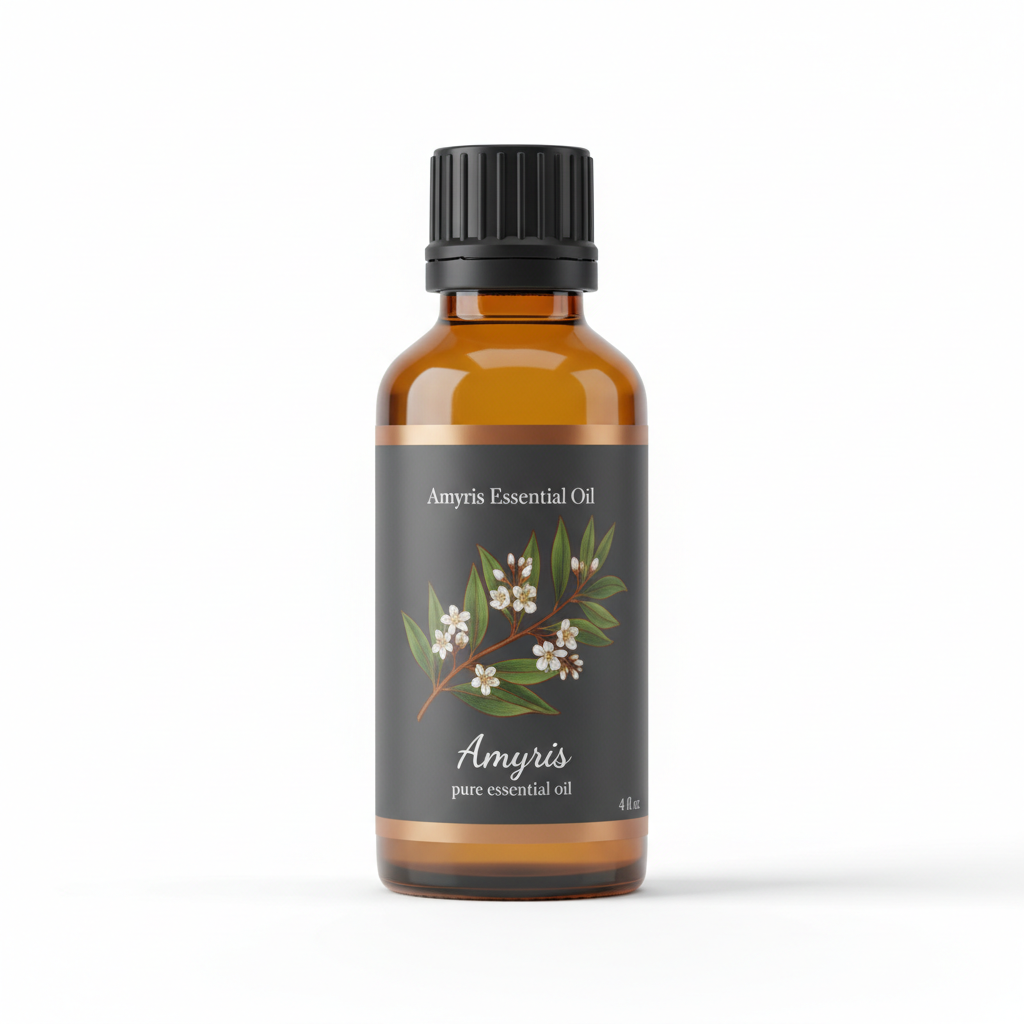
Amyris Essential Oil
Our own Amyris Essential Oil, in sizes from 0.5 oz to bulk.
From $23.99
Shop Now →The common name "west indian sandalwood" has followed this plant for centuries, partly because sailors and traders noticed that the wood burned with a similar warm, slightly sweet quality to Asian sandalwood. It was used as torch wood, which earned it another nickname: candlewood. Neither name tells the full botanical story. Amyris is not a sandalwood. It belongs to a completely different genus and family. But the nickname has stuck in commercial channels, which is something any serious formulator should know before purchasing.
Production and Distillation
The essential oil is steam-distilled from the wood chips and branches of mature amyris trees. Haiti remains the primary producing country. The trees grow on hillsides that are often difficult to farm commercially, and the harvest is largely carried out by small-scale rural producers.
Unlike some essential oil crops, amyris trees are not currently considered endangered. The wood is sometimes harvested as a byproduct of land clearing, which gives the oil a somewhat opportunistic sourcing profile. That said, sourcing transparency still matters. Some suppliers source from sustainably managed stands; others do not provide this information at all. If ethical sourcing is a priority for your brand, it is worth pressing suppliers for documentation.
The yield from distillation is relatively generous compared to some precious woods, which contributes directly to the oil's low price. A single kilogram of amyris wood typically yields around 3 to 5 percent oil by weight. That efficiency, combined with the tree's abundance in Haiti, keeps the cost accessible.
2. The Scent Profile of Amyris: What Does It Actually Smell Like?
If you are encountering amyris for the first time, the scent is easier to understand by what it evokes than by a single descriptor. Open the bottle and the first impression is quiet. There is no sharp top-note rush, no brightness, no green lift. Amyris announces itself slowly, the way a warm wooden room does when you step inside from the cold.
The primary character is woody and dry, with a softness underneath that pushes toward creaminess. Some noses pick up a faint balsamic quality, a barely-there sweetness that never becomes sugary. Others detect a subtle milky undertone, particularly in oils from well-seasoned wood. There is also a faint rubbery or slightly smoky nuance in some batches, which can be useful or distracting depending on the blend.
Comparing Amyris to Other Woody Base Notes
| Oil | Character | Creaminess | Sweetness | Relative Cost |
|---|---|---|---|---|
| Amyris | Dry, soft, woody, faintly balsamic | Moderate | Low to moderate | Very affordable |
| Australian Sandalwood (S. spicatum) | Dry, woody, slightly earthy | Low | Low | Moderate |
| Mysore Sandalwood (S. album) | Rich, creamy, milky, smooth | High | Moderate | Very expensive |
| Cedarwood (Virginian) | Pencil shavings, dry, sharp | Low | Low | Very affordable |
| Ho Wood | Soft, floral-woody, rosy | Moderate | Moderate | Affordable |
What separates amyris from cedarwood or vetiver is its willingness to fade into the background. It supports a composition rather than dominating it. Many perfumers describe it as a "team player" note. That quality is underrated. Not every base note needs to be a statement. Sometimes you need a foundation that holds other materials together without pulling attention to itself.
How the Scent Evolves on Skin
Amyris develops slowly. In the opening minutes on warm skin, the dry woody quality is most prominent. As time passes, the creamier, slightly balsamic facets become more noticeable. The drydown is calm, lingering, and pleasant. This slow evolution is part of what makes it valuable as a base: it sticks around without changing dramatically, giving a blend a reliable woody foundation across its entire lifecycle on skin.
3. Amyris as a Perfumery Base Note: Role, Function, and Structure
In classical perfumery structure, a fragrance is divided into three stages: top notes, heart (or middle) notes, and base notes. Top notes are the first impression, bright and volatile. Heart notes carry the character of the fragrance. Base notes are the slowest to evaporate and the longest to linger. They anchor everything above them.
Amyris sits firmly in the base. Its high proportion of sesquiterpene alcohols, particularly valerianol and eudesmol, gives it the low volatility that base notes require. It will not lift off skin quickly. It stays.
Concentration Ranges in Perfumery Formulas
In practical terms, amyris is used at varying concentrations depending on the application:
- Fine fragrance (eau de parfum, parfum): Typically 5 to 20 percent of the woody-base accord portion of a formula. In a full formula, this might translate to 2 to 8 percent of total composition.
- Eau de toilette: Similar range, often at the lower end since the overall formula is more dilute.
- Solid perfume: Can be used more generously because the wax carrier already slows volatility.
- Personal care and cosmetic products: Typically 0.5 to 2 percent in leave-on products, always within IFRA guidelines for the specific product category.
Because amyris is gentle, it rarely overwhelms a formula even at moderate concentrations. This is one of its practical advantages for formulators who are still learning to balance a composition.
Amyris in Accord Building
An accord is a miniature blend of materials that smells like a unified new note rather than its individual components. Amyris appears in several classic accord types:
- Woody amber accords: Amyris alongside benzoin, labdanum, or vanilla creates a warm, enveloping base with both depth and softness.
- Fougère base: In the classic fougère family (think mossy, aromatic, fern-like fragrances), amyris can supplement or partially replace sandalwood to add creaminess without the expense.
- Chypre structures: Paired with oakmoss (or a modern substitute), patchouli, and bergamot, amyris provides the woody component of a chypre base without sharpness.
- Incense accords: Combined with frankincense, myrrh, or elemi, amyris deepens the smoky resinous quality and rounds sharp edges.
4. Fixative Properties: How Amyris Anchors a Fragrance Blend
The word "fixative" gets used loosely in natural perfumery circles, so it helps to be precise about what it means and how amyris fits the definition.
A fixative is a material that slows the evaporation of more volatile components in a blend. It does not necessarily extend the life of every note equally. Instead, it creates a kind of olfactory gravity. Lighter, faster-evaporating notes linger a little longer when they have a heavy, stable base to anchor them. Amyris functions this way because of its molecular weight and the low vapor pressure of its dominant constituents.
For a deeper look at how this mechanism works in practice, including how to calculate fixative ratios and test longevity on different substrates, see our dedicated guide: Amyris as a Fixative: Making Your Fragrance Blends Last.
Practical Fixative Testing
If you want to observe amyris working as a fixative, try this simple test. Create two versions of the same citrus-forward blend: one with amyris as the base and one without any base note. Apply both to fragrance strips or fabric. Smell them at one hour, four hours, and eight hours. The version with amyris will retain its overall character longer, and the citrus notes will be more perceptible even as they naturally fade, because they are riding on the stable woody foundation rather than disappearing into nothing.
Natural vs. Synthetic Fixatives
Amyris competes in the market with both other natural fixatives (benzyl benzoate, labdanum, orris) and synthetic musks and woody molecules (Iso E Super, Ambroxan, Galaxolide). Each has strengths. Amyris offers a specific advantage: it contributes a discernible, appealing scent of its own while fixing. Many synthetic fixatives are nearly odorless by design. Amyris does both jobs at once.
5. The Chemistry Behind the Scent
Understanding the chemistry of amyris oil helps explain why it smells the way it does, how it behaves in a formula, and what to look for when evaluating quality. You do not need a chemistry degree to use this information practically.
Amyris oil is dominated by sesquiterpenes and sesquiterpene alcohols. These are larger, heavier molecules than the monoterpenes found in most citrus and herb oils. Their size is precisely what gives amyris its low volatility and long persistence on skin.
Key Constituents
| Constituent | Typical Range (%) | Sensory Contribution |
|---|---|---|
| Valerianol | 20 to 30% | Woody, slightly fatty, soft |
| Eudesmol | 10 to 20% | Woody, creamy, mild |
| 10-epi-gamma-eudesmol | 5 to 15% | Woody, faintly sweet |
| Elemol | 5 to 10% | Soft, woody, slightly floral |
| Guaiol | Trace to 5% | Woody, rose-like at low levels |
| Gamma-eudesmol | 5 to 10% | Woody, soft |
The predominance of eudesmol isomers and valerianol is what links amyris to sandalwood in spirit, if not in genetics. Mysore sandalwood is dominated by alpha- and beta-santalol. Amyris has different molecules, but some of them occupy a similar olfactory territory: soft, woody, and gently creamy.
For a thorough breakdown of these constituents and how each one contributes to the overall aromatic character, visit our full article: The Chemistry of Amyris Oil: Valencene, Eudesmol, and Soft Woody Molecules.
Why Batch Variation Matters
Because amyris is harvested from wild or semi-wild trees across different growing regions and seasons, the constituent profile can shift between batches. An oil with a higher eudesmol content will smell creamier. One with more valerianol may lean drier. Gas chromatography-mass spectrometry (GC-MS) reports from reputable suppliers allow you to verify constituent ratios before committing to a large purchase. For small-batch formulators, a GC-MS report is not always accessible, but it is worth asking for.
6. Blending Guide: What Works Well with Amyris
One of the best things about working with amyris in perfumery is its cooperative character. It rarely clashes. It has no sharp facets to navigate around, no insistent personality that demands center stage. This makes it an ideal note for formulators who are building complex blends and need a woody base that does not compete.
For detailed drop-by-drop blending protocols and percentage ratios across fragrance families, see: How to Blend Amyris with Citrus, Spice, and Floral Oils.
Amyris with Citrus Notes
Bergamot, lemon, sweet orange, grapefruit, and yuzu all benefit from an amyris base. Citrus notes are among the most volatile in perfumery, which means they tend to disappear quickly on skin. Pairing them with amyris as a fixative extends their presence. The creamy, dry woody quality of amyris also softens the sharper, more acidic edges of citrus, creating a rounder overall impression. A blend of bergamot, petitgrain, and amyris makes a simple but elegant cologne structure.
Amyris with Floral Notes
Rose absolute and amyris is one of those combinations that just works. The guaiol content in amyris contributes a faint rosy-woody facet that creates a bridge between the two materials. Jasmine, ylang ylang, and tuberose also work well. These heavy white florals can become cloying without a dry woody element to balance them. Amyris provides that dryness without smelling harsh. For a ready-to-try formula, explore our recipe guide: DIY Rose and Amyris Body Oil: A Soft Woody Floral Recipe.
Amyris with Spice Notes
Black pepper, cardamom, clove bud, and ginger all have a natural affinity for woody bases. Amyris softens their sharper edges, particularly the eugenol-driven harshness that clove can project at high concentrations. A blend of cardamom, pink pepper, and amyris produces a modern aromatic woody accord with genuine depth. Black pepper and amyris on their own make a spare, sophisticated base worth exploring.
Amyris with Resins and Balsams
This is where amyris really shines as a collaborator. Frankincense (boswellia sacra or carterii), benzoin, labdanum, myrrh, and styrax all have a natural compositional affinity with amyris. The combination creates deep, slow-burning, incense-like accords. Adding a touch of vanilla or tolu balsam to an amyris-frankincense base produces something that feels ancient and grounded. These kinds of accords suit evening wear, candle fragrance work, and slow, contemplative scent rituals.
Amyris with Green and Herbal Notes
Vetiver, clary sage, and cedarwood interact interestingly with amyris. Vetiver adds a smoky, rooty depth that contrasts with amyris's creaminess. The two together create a complex woody base with both dry and humid dimensions. Clary sage and amyris produce a slightly nutty, herbaceous woody accord that works well in gender-neutral formulas. Patchouli and amyris together are a reliable combination for earthy, grounded blends with staying power.
Notes That Require Care
Amyris rarely causes outright clashes, but a few pairings require attention to proportion:
- Eucalyptus and camphor-forward oils: Their sharp medicinal character can overwhelm amyris's subtlety. Use with restraint and let amyris anchor the base rather than compete.
- Very heavy musks: Some synthetic musks can muddy the creamy woody facets of amyris, producing a slightly indistinct result. Test before committing.
- Oakmoss and chypre bases: The combination is historically valid but can skew quite green and mossy. This may be exactly what you want, or it may not. Test carefully.
7. Buying Amyris Oil: Quality, Sourcing, and What to Avoid
Amyris is one of the least expensive woody essential oils on the market, which is genuinely good news. It also means the market includes some poor-quality or adulterated material. Knowing what to look for protects your formulas and your investment.
What Good Quality Amyris Looks Like
A high-quality amyris essential oil should be:
- Color: Pale yellow to light golden. Very dark oil may indicate age or overheating during distillation.
- Viscosity: Slightly viscous, noticeably thicker than water or thinner oils like lavender. It should pour slowly but not be thick like a resin.
- Scent: Woody, soft, faintly creamy. No sharp chemical notes, no solvent smell, no rancid or musty undertones.
- Specific gravity: Typically 0.940 to 0.990 at 20°C. Values outside this range warrant scrutiny.
- Refractive index: Typically 1.503 to 1.513. Suppliers with robust quality control will provide this data.
Common Adulteration Issues
Because amyris is already inexpensive, heavy adulteration is less of an economic incentive than with premium oils. However, some suppliers dilute the oil with fractionated coconut oil or other carrier oils to increase volume. This is detectable by a noticeable reduction in viscosity and a weakened scent profile. Adulteration with synthetic woody molecules is also documented. A GC-MS report from a reputable third-party laboratory is the most reliable way to verify purity.
Suppliers Worth Knowing
For independent perfumers and formulators, a few supplier characteristics signal reliability:
- They provide batch-specific GC-MS reports on request or as a standard document download.
- They list the country of origin (Haiti is the benchmark for genuine west indian sandalwood oil).
- They specify the plant part (wood) and extraction method (steam distillation).
- They provide a safety data sheet (SDS) and IFRA compliance documentation.
Price alone is not a reliable quality indicator with amyris. Even a legitimate, high-quality oil is not expensive. If a supplier is charging premium sandalwood prices for amyris, ask detailed questions about why.
Storage and Shelf Life
Store amyris in a tightly sealed dark glass bottle, away from light and heat. Properly stored, the oil maintains good quality for at least three to four years. Its high sesquiterpene alcohol content makes it less prone to rapid oxidation than citrus or pine oils, but proper storage still matters. Label your bottles with the batch date so you can track age.
8. Amyris vs. True Sandalwood: Honest Comparisons for Practical Perfumers
The name "west indian sandalwood oil" creates expectations that amyris cannot always meet, particularly for formulators who have worked extensively with genuine Mysore or Hawaiian sandalwood. Understanding the differences precisely, rather than vaguely, helps you make better decisions.
For a full side-by-side comparison including price analysis, scent mapping, and use case recommendations, see: Amyris vs. Sandalwood Oil: Scent, Price, and When to Use Each.
Where Amyris Falls Short of True Sandalwood
Let's be direct about this. Genuine Santalum album from Mysore has a depth, richness, and milky smoothness that amyris does not fully replicate. The alpha- and beta-santalol content in true sandalwood gives it a complex creaminess with a faintly rosy, milky, almost skin-like quality. Amyris is softer, drier, and less complex in the base. If a formula is specifically designed around the unique character of S. album, substituting amyris will change the fragrance noticeably.
Where Amyris Performs as Well or Better
On the other hand, amyris genuinely excels in several contexts:
- As a fixative: Amyris fixative performance is comparable to or better than many sandalwood varieties in terms of cost-per-unit-of-fixation.
- As a blending note: Its quieter personality allows other notes to speak more freely. Sandalwood's strong personality can sometimes dominate a formula that was designed to feature something else.
- In high-volume production: The cost difference is significant enough that blending amyris with a smaller percentage of a premium sandalwood can extend the sandalwood budget while retaining the overall accord character.
- In body care formulations: For a subtle woody note in a body oil or lotion where the concentration is low, amyris delivers a pleasant result at a fraction of the cost.
A Practical Strategy: Amyris as a Stretcher
Many independent perfumers use amyris strategically alongside a small percentage of genuine sandalwood. A formula might use 8 percent amyris and 2 percent Australian sandalwood (S. spicatum) to create a woody base that captures some of the sandalwood character at a manageable cost. This blended approach is not a compromise. It is thoughtful formulation. Some of the best commercial fragrances use exactly this kind of layered base strategy.
9. Recipes and Applications: Putting Amyris to Work
Theory and scent knowledge only go so far. The real education happens when you start working with the oil in actual formulas. The following starting points are designed to give you practical entry points into amyris perfumery. These are starting frameworks, not finished perfumes. Adjust ratios based on your specific materials and olfactory preferences.
For a curated collection of complete, tested blends, visit: 5 Signature Amyris Perfume Blends for Slow Evenings.
Starting Framework 1: Simple Woody Citrus Cologne
This is a good first exercise for anyone new to working with amyris as a base note. The formula is spare and educational.
- Bergamot essential oil: 30 drops
- Sweet orange essential oil: 20 drops
- Petitgrain essential oil: 15 drops
- Amyris essential oil: 20 drops
- Cedarwood (Virginian) essential oil: 10 drops
- Vetiver essential oil: 5 drops
Dilute in 10 ml of perfumer's alcohol or fractionated coconut oil. Let the blend rest for 48 hours before evaluating. This resting period, sometimes called maceration, allows the notes to integrate and softens any sharp initial impressions.
Safety Note: Always dilute essential oils before skin application. A 2 to 3 percent dilution in a carrier oil is appropriate for leave-on skin products. Patch test on a small area of skin before full application. Bergamot contains furanocoumarins that may increase photosensitivity; consider using bergapten-free bergamot for products that will be applied to sun-exposed skin. Consult a qualified aromatherapist or dermatologist if you have any sensitivities or concerns.
Starting Framework 2: Resinous Incense Accord Base
This is a building-block accord rather than a finished perfume. Use it as the base layer in a larger formula, or explore it as a standalone diffuser blend (not for skin use at these undiluted concentrations).
- Amyris essential oil: 40 drops
- Frankincense (Boswellia sacra) essential oil: 25 drops
- Myrrh essential oil: 15 drops
- Benzoin resinoid: 15 drops
- Black pepper essential oil: 5 drops
This accord is dark, smoky, and quietly sweet. It works well as the base for a woody oriental fragrance when topped with rose absolute, oud, or a spicy heart accord.
Starting Framework 3: Soft Floral Woody Body Oil
This is a ready-to-apply skin formula at a 2 percent dilution, appropriate for most adults as a leave-on body oil. Patch test before full application.
- Fractionated coconut oil or jojoba: 30 ml (carrier base)
- Amyris essential oil: 6 drops
- Rose absolute (diluted 10% in jojoba): 4 drops
- Ylang ylang essential oil: 2 drops
- Palmarosa essential oil: 3 drops
- Benzoin resinoid: 3 drops
The amyris provides the quiet woody foundation. Rose and palmarosa bring a soft floral character. Ylang ylang adds depth without becoming overwhelming at this low concentration. Benzoin rounds the base and extends the overall scent on skin.
Safety Note: Ylang ylang can cause sensitization in some individuals, particularly at higher concentrations. Adhere to IFRA guidelines for the specific product category. Keep all essential oil products away from eyes and mucous membranes. This formula is for external use only. Not suitable for use during pregnancy without guidance from a qualified healthcare provider.
Amyris in Candle and Diffuser Work
Amyris works in aroma diffusion and candle-making, though its heavier molecular weight means it performs better in warmth than in cold air diffusion. In a candle, the heat releases its woody character well. In a cold diffuser (ultrasonic), the performance is more muted than lighter oils. Combining it with a more volatile oil like bergamot or juniper berry helps carry the amyris note into the room.
For candle work, amyris is compatible with most natural waxes (soy, coconut, beeswax). Fragrance load typically sits between 6 and 10 percent of total wax weight depending on wax type and wick selection. Amyris's relatively good hot throw makes it a practical choice for woody scented candles.
Amyris in Cosmetic Formulations
Beyond perfumery, amyris appears in hair care, skin care, and soap formulations as a fragrance ingredient. It is stable in most formulation environments and does not typically cause significant discoloration in finished products at low percentages. In cold-process soap, some slight acceleration of trace is possible, as with many woody oils, but it is generally manageable.
Always verify IFRA compliance limits for the specific product category before finalizing any formulation intended for sale or sharing.
Working with Amyris: A Note on Patience
Amyris rewards patience. It is not a dramatic oil. It will not transform a blend instantly or announce itself loudly on a fragrance strip. Its gifts are quieter: longevity, warmth, a soft woody presence that makes other notes feel more settled and complete.
The best perfumers who use this material tend to give their blends time to breathe. Macerate for at least 48 hours before evaluating. Smell on fabric as well as skin. Give the drydown time to develop fully before making adjustments. Amyris is the kind of note that reveals itself gradually, and that pace is worth honoring in your creative process.
For formulators working with tight budgets, amyris is one of the most generous materials available. It delivers genuine woody depth, fixative function, and aromatic complexity at a price that does not require compromise elsewhere in the formula. Used thoughtfully, it makes any blend richer than it would be without it.
Start with small experiments. Let the oil speak. Add it to blends where you feel something is missing in the base, or where other notes are fading too quickly. Notice what it does for the overall structure. Over time, your nose will develop an intuitive sense of when and how to reach for it. That intuitive knowledge, built through direct experience with the material, is what turns a good formulator into a genuinely skilled one.