How to Blend Amyris with Citrus, Spice, and Floral Oils
Amyris essential oil is one of those quiet workhorses that blenders often overlook until they actually use it. Its scent sits somewhere between soft sandalwood and a freshly sharpened pencil: creamy, a little milky, gently woody. What makes it genuinely useful on the blending bench is how it behaves with other oils. It softens sharp edges, stretches expensive ingredients, and anchors a blend without announcing itself. If you have been curious about how to blend amyris oil but were not sure where to start, this guide walks you through the process from your first drop to a finished formula.
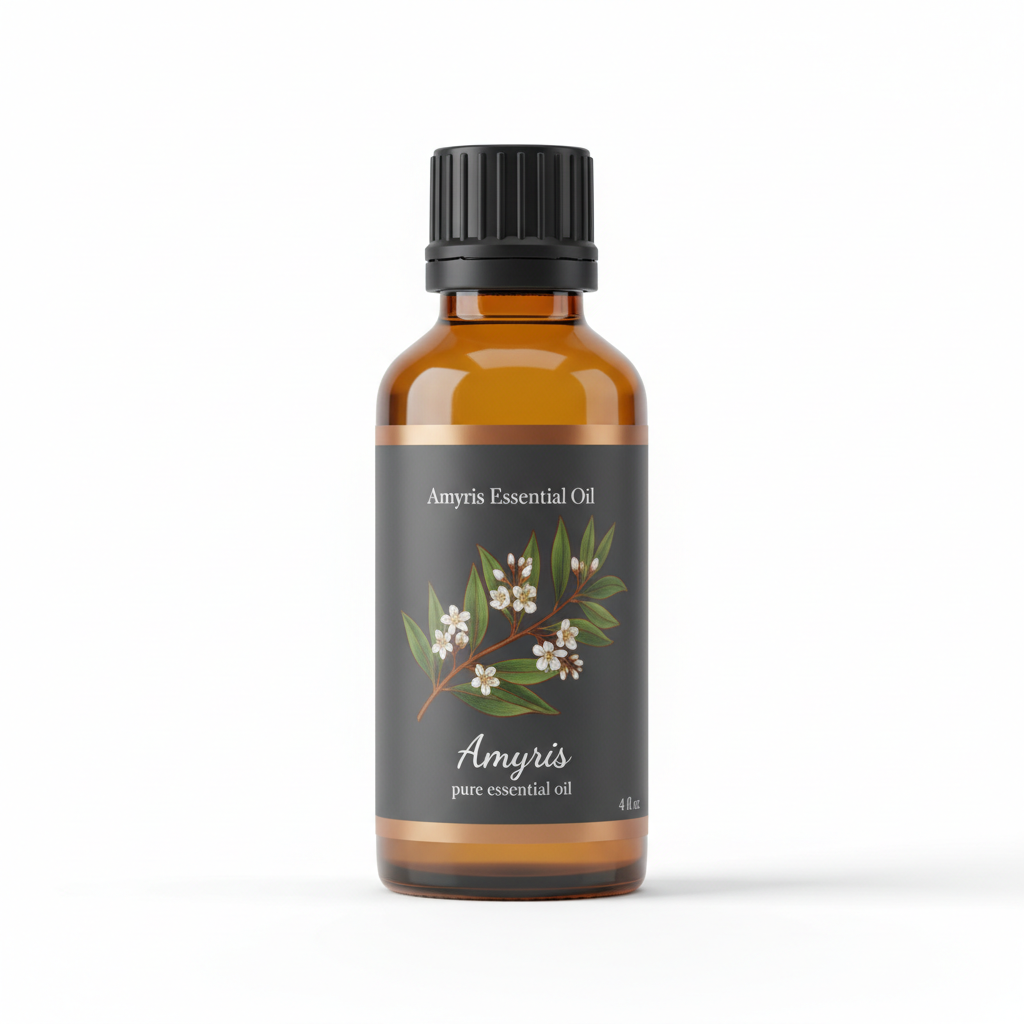
Amyris Essential Oil
Our own Amyris Essential Oil, in sizes from 0.5 oz to bulk.
From $23.99
Shop Now →Why Amyris Is Such a Cooperative Base Note
Before you measure anything, it helps to understand what amyris actually brings to a blend. The oil is steam-distilled from the wood of Amyris balsamifera, a tree native to Haiti and the wider Caribbean. Its main aromatic compounds, primarily sesquiterpenes like valerianol and eudesmol, evaporate slowly. That slow evaporation is exactly what you want in a base note: it holds the faster top and heart notes in place and gives a blend longevity on skin or in a diffuser.
Because amyris is relatively affordable compared to true sandalwood, it is widely used as a fixative and extender in natural perfumery. For a deeper look at its role in finished fragrances, see our ultimate guide to amyris in perfumery.
Practically speaking, amyris blends well with an unusually wide range of oil families. Citrus oils gain warmth and staying power. Spice oils become rounder and less aggressive. Florals pick up a soft, almost powdery depth. That range is what we will work through below.
What You Will Need
Essential Materials
- Amyris essential oil (sourced from a supplier who provides GC/MS test results)
- A selection of citrus, spice, and floral essential oils (see recommended options below)
- A carrier oil for skin application: fractionated coconut oil, jojoba, or sweet almond oil work well
- Small amber or cobalt glass dropper bottles (5 ml or 10 ml)
- Pipettes or calibrated dropper inserts (one per oil to avoid cross-contamination)
- A perfumer's notebook or simple spreadsheet to record your formulas
- Scent strips (also called blotter strips)
- A small digital scale accurate to 0.01 g, if you prefer to work by weight
Recommended Partner Oils
Citrus family: bergamot, sweet orange, grapefruit, lemon, yuzu
Spice family: cardamom, black pepper, ginger, coriander seed, clove bud (use sparingly)
Floral family: rose absolute, geranium, ylang ylang, neroli, lavender
You do not need all of these to start. Pick one from each category and work with those three plus amyris before expanding your palette.
Understanding Proportions Before You Begin
Amyris is a base note, which means it should generally form the foundation of your blend, not the loudest voice. A useful starting framework for a simple three-part blend is:
| Role | Suggested Proportion | Example Oil |
|---|---|---|
| Base (amyris) | 40 to 50% | Amyris |
| Heart note | 30 to 40% | Rose absolute, geranium |
| Top note | 15 to 25% | Bergamot, lemon, cardamom |
These are starting points, not rules carved in stone. Some blenders prefer amyris at a lower percentage (20 to 30%) when they want the heart note to carry more presence. Others push it higher when they want a woodier, quieter result. Adjust after smelling your first draft.
Step-by-Step: How to Blend Amyris Oil with Citrus, Spice, and Florals
Step 1: Smell Each Oil Individually on a Scent Strip
Label one scent strip per oil. Apply a single drop to each strip, then wave each one in the air for a few seconds before smelling. Rest them on the edge of a glass or prop them up so they do not touch each other. Give each oil at least 30 seconds of your attention before moving to the next. You are building a mental map of what each ingredient brings before any of them meet.
Pay particular attention to amyris on its strip. Notice how the scent evolves over five to ten minutes: what reads as milky wood at first will soften into something almost balsamic as it dries down.
Step 2: Test Two-Oil Combinations First
Before you build a full blend, test amyris against each of your partner oils in isolation. This is the most educational step in the process, and most beginners skip it.
On a fresh scent strip, place one drop of amyris and one drop of your chosen citrus oil. Smell immediately, then again after five minutes. Repeat this exercise with your spice oil and your floral oil. Write a short note about each pairing: does one oil overpower the other? Does amyris seem to lift the partner or pull it down? Does anything smell unexpected or off?
Common observations at this stage: bergamot next to amyris often smells warmer and slightly creamier than it does alone. Black pepper with amyris can develop a quietly smoky quality. Rose absolute next to amyris may gain a soft, almost powdery background.
Step 3: Build Your First Draft Blend
Work in small quantities. A ten-drop total is enough for a first evaluation. Use the proportion table above as your guide.
Into a clean 5 ml bottle, add your drops in this order: base note first, then heart, then top. Adding the slowest-evaporating oil first lets you layer more volatile oils on top without losing them to evaporation before the bottle is sealed.
For a simple starting formula, try:
- 5 drops amyris (base)
- 3 drops geranium (heart)
- 2 drops bergamot (top)
Cap the bottle, roll it gently between your palms for about twenty seconds, then open and smell. Apply a single drop to a scent strip and evaluate again at the five-minute mark and the thirty-minute mark.
Step 4: Evaluate and Adjust
Ask yourself four questions after smelling your draft:
- Is the base too heavy, making the whole blend feel flat or muddy?
- Is the top note sharp or fleeting, disappearing before the blend settles?
- Does the heart note hold its own, or does it feel buried?
- Is there a gap, something missing in the middle of the scent experience?
If amyris feels too dominant, reduce it by one drop and increase the heart note. If the top note disappears too quickly, consider adding a drop of a bridging ingredient: cardamom and coriander seed both sit between top and heart on the volatility scale and can connect citrus to wood very effectively. That middle space is where an amyris blending guide earns its keep.
Step 5: Let the Blend Rest
Cap your test bottle and set it aside for at least 24 hours. Longer is better: 48 to 72 hours will show you how the blend truly smells once the molecules have had time to interact and the most volatile components have settled. Many blends that smell sharp or slightly discordant on day one become rounder and more cohesive by day three.
This resting period is especially important with spice oils. Clove bud and black pepper can smell aggressively bright right after blending, but they mellow significantly over 48 hours in the bottle.
Step 6: Dilute for Skin Application and Patch Test
Once you are happy with your undiluted blend, dilute it into a carrier oil before any skin contact.
Safe dilution guidelines for adults:
- Body oil or massage blend: 2% dilution (approximately 12 drops of essential oil blend per 30 ml of carrier)
- Facial application: 1% or lower
- Bath or foot soak (in a dispersant): 1% or lower
Patch test procedure: Apply a small amount of your diluted blend to the inside of your forearm. Leave it uncovered and unwashed for 24 hours. If you notice any redness, itching, or discomfort, discontinue use and rinse the area with plain water. Consult a qualified healthcare provider if any reaction persists.
Safety note: Citrus oils, particularly expressed (cold-pressed) bergamot, lemon, and grapefruit, may increase skin sensitivity to sunlight. Use steam-distilled or bergapten-free versions if applying to skin that will be exposed to sunlight. People who are pregnant, nursing, or managing a health condition should consult a qualified healthcare provider before using essential oil blends on the skin.
Three Blend Directions Worth Exploring
Amyris with Citrus: Warm and Grounded
The classic pairing here is amyris with bergamot or sweet orange. The citrus provides brightness and lift; amyris provides depth and longevity. Without the base note, citrus blends can feel thin and disappear within an hour in a diffuser. With amyris, they linger. Try a simple 50/30/20 split of amyris, sweet orange, and a touch of cardamom for an approachable, quietly spiced citrus accord that works well in a reed diffuser or a roller bottle blend.
Amyris with Spice: Quiet and Complex
Amyris blends well with spice oils when you keep the spice percentage modest. Black pepper at 10 to 15% of the total formula adds a dry, slightly smoky quality that pairs beautifully with amyris's woodiness. Cardamom brings a fresher, almost eucalyptus-adjacent edge that opens up what might otherwise be a heavy, resinous combination. For a more complete exploration of spice-forward amyris profiles, the 5 signature amyris perfume blends for slow evenings feature covers several well-tested formulas.
Amyris with Florals: Soft and Lasting
This is where amyris truly earns its place. Rose absolute is expensive, and a little goes a long way. Blending it with amyris as the base allows you to use less rose while maintaining a full, rounded floral character, because amyris props up the rose's dry-down and keeps it present on skin for longer. Geranium is a more affordable entry point that delivers a similar softening effect. If you want a detailed skin-care formula built around this pairing, the DIY rose and amyris body oil recipe is a good next step.
Common Mistakes to Avoid
- Adding too many oils at once. Three to four ingredients is enough for a first blend. Each new oil you add increases complexity and the chance that something will clash.
- Skipping the resting period. Evaluating a blend immediately after mixing gives you an inaccurate picture. Always wait.
- Overusing spice oils. Clove bud and cinnamon bark in particular can overwhelm every other ingredient if used above 5% of the total formula. Start at 2 to 3% and adjust from there.
- Not keeping records. If you do not write down your drops as you go, you will not be able to reproduce a blend you love. Record every drop in real time, not from memory afterward.
- Smelling too many strips in one session. Olfactory fatigue sets in quickly. Limit your evaluation sessions to 30 to 45 minutes, and smell coffee beans or your own skin to reset between samples.
What to Expect from Your Finished Blends
A well-constructed amyris blend may produce a scent that feels more complex and more enduring than the sum of its parts. People who use amyris-based blends in diffusers often report that the ambient scent of a room lingers noticeably longer compared to citrus-only blends. Those who use diluted blends on skin frequently notice a quieter, woodier drydown several hours after application.
These are scent and sensory observations, and individual experience will vary based on skin chemistry, the specific oils used, and dilution ratios. No blend is a guaranteed outcome.
What you can count on is the process itself being educational. Every test blend teaches you something about how amyris behaves, what it softens, what it amplifies, and where it simply gets out of the way and lets another ingredient lead. That quality, that cooperative quietness, is what keeps blenders coming back to it.
Start with one combination that genuinely appeals to you. Mix a small batch. Let it rest. Smell it honestly. Adjust. The best amyris blending guide is the notebook you fill over time with your own observations, written in your own shorthand, from your own bench.