
The Chemistry of Amyris Oil: Valencene, Eudesmol, and Soft Woods
Amyris oil tends to get overlooked. It is often filed under "budget sandalwood alternative" and left at that. But spend a little time with its gas chromatography data, and the picture becomes far more interesting. This is a sesquiterpene-rich oil with a distinct chemical fingerprint, a reasonably well-studied compositional profile, and some genuinely unusual aromatic behavior. The soft, creamy woodiness that makes amyris so useful in perfumery and cosmetic formulation is not an accident. It is chemistry.
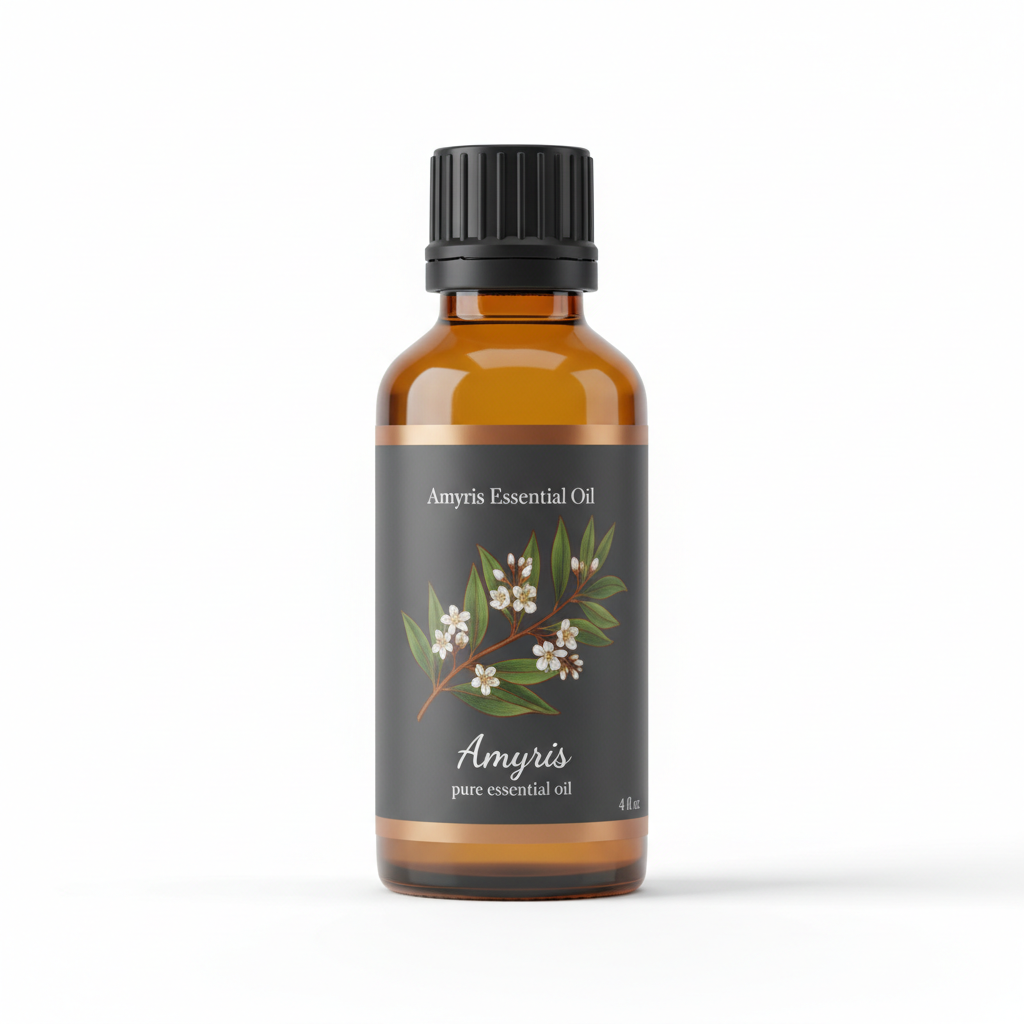
Amyris Essential Oil
Our own Amyris Essential Oil, in sizes from 0.5 oz to bulk.
From $23.99
Shop Now →This deep dive moves through the key compounds, what research observations tell us about them, how to read a quality report, and what formulators and curious hobbyists alike should know before working with this oil.
What Is Amyris Oil, and Where Does It Come From?
Amyris essential oil is steam-distilled from the wood and branches of Amyris balsamifera, a shrubby tree native to Haiti and other Caribbean islands. The tree is sometimes called "West Indian sandalwood" or "torchwood," though it belongs to the Rutaceae family and is botanically unrelated to true sandalwood (Santalum species). The confusion is understandable: both oils share a soft, balsamic, woody character. The chemistry, however, diverges significantly.
Haitian production dominates the global supply. The wood is often harvested from cleared or coppiced shrubland, and distillation is typically carried out close to source. This matters for quality, as we will discuss later. Oil yield varies with wood age and moisture content, but mature, resinous heartwood consistently produces richer, denser oil.
For a broader look at how this oil functions in fragrance contexts, the complete guide to amyris in perfumery covers its olfactory role in considerable depth.
The Sesquiterpene Backbone
Amyris oil chemistry is built almost entirely on sesquiterpenes and sesquiterpene alcohols. Sesquiterpenes are 15-carbon compounds formed from three isoprene units. They tend to be heavier and less volatile than the monoterpenes that dominate oils like lemon or peppermint, which is why amyris has such a slow, lingering dry-down and low vapor pressure. It does not flash off quickly. It settles.
Published compositional analyses, including work by Sylvestre and colleagues (2007) and various Caribbean aromatic crop studies, typically identify the following primary constituents in Amyris balsamifera essential oil:
- Valencene: often the dominant compound, ranging from roughly 20 to 45 percent depending on origin and distillation conditions
- Eudesmol (alpha, beta, and gamma isomers): sesquiterpene alcohols collectively making up a significant portion of the oxygenated fraction
- Elemol: a monocyclic sesquiterpene alcohol contributing to the soft, earthy facets
- Gamma-eudesmol: frequently cited as a contributor to the creamy, sandalwood-adjacent character
- 10-epi-gamma-eudesmol: a stereoisomer with similar sensory properties
- Beta-eudesmol and alpha-eudesmol: present in varying ratios across samples
- Zizaene and other sesquiterpene hydrocarbons: contributing to the woody, slightly smoky depth
The exact percentages shift depending on tree age, seasonal harvesting, wood portion used (heartwood versus sapwood versus branches), and distillation duration. This variability is normal and expected. It is also why reading a certificate of analysis matters.
Valencene: The Compound Worth Understanding
Valencene is the headline molecule in amyris oil chemistry, and it deserves more attention than it typically receives in aromatics writing. Its name comes from Valencia oranges, where it was first characterized, and it also occurs naturally in grapefruit peel oil. In amyris, it appears in much higher concentrations than in any citrus source.
Structurally, valencene is a bicyclic sesquiterpene hydrocarbon with the molecular formula C15H24. It contributes a soft, woody-citrus quality to the overall scent profile. In amyris, this citrus suggestion is subtle: you may not consciously identify it, but it is part of what keeps the oil from smelling flat or purely resinous. Valencene has a relatively low odor threshold, meaning it is perceptible even at low concentrations.
From a research standpoint, valencene appears in several observational studies related to flavor and fragrance science. Some research suggests it may have surface-active properties relevant to formulation stability, though peer-reviewed work specifically on amyris-sourced valencene in cosmetic contexts remains limited. Most studies on valencene draw from citrus sources. Formulators working with sesquiterpene-rich oils often note that valencene-forward materials tend to blend smoothly with citrus top notes and soft florals. If you are interested in practical blending applications, the guide on blending amyris with citrus, spice, and floral oils explores those relationships in detail.
Eudesmol Isomers: The Sandalwood Connection
If valencene explains amyris's subtle brightness, eudesmol explains its depth. The eudesmol group comprises several stereoisomers (alpha, beta, gamma, and the 10-epi variant) all sharing the same eudesmane sesquiterpene skeleton. They are sesquiterpene alcohols, meaning they carry a hydroxyl (-OH) group that gives them more polarity and a rounder, more persistent scent character than the corresponding hydrocarbons.
Gamma-eudesmol in particular has been noted in fragrance literature as having a creamy, woody, sandalwood-like quality. This is a significant part of why amyris has historically been used as a fixative and a sandalwood extender in perfumery. The eudesmol fraction slows evaporation of more volatile compounds and contributes substantivity to a blend.
Research observations on eudesmol isomers span multiple disciplines. Some studies have examined their behavior in biological systems at a basic science level. These are preliminary findings from laboratory or in vitro settings, not clinical demonstrations, and they do not establish that using amyris oil on skin produces any specific effect. The research is worth noting as context for ongoing scientific interest in this compound class, but it should be read carefully and without overinterpretation.
Elemol and Minor Constituents
Elemol appears across multiple wood-derived essential oils, including Ho wood and some frankincense species. In amyris, it tends to occupy a secondary position compositionally, but its contribution to the scent is not negligible. Elemol has a soft, slightly rosy-woody character that smooths transitions between the brighter valencene facets and the heavier eudesmol base.
Other minor sesquiterpene constituents, including various zizaene isomers and curcumene, contribute to the overall texture of the oil without dominating it. Collectively, these minor components are part of what makes whole amyris oil smell richer and more complex than isolated valencene or synthetic eudesmol would suggest. The matrix matters. Gas chromatography identifies individual compounds, but the perceptual experience of the oil comes from all of them together.
Safety Profile: What Formulators Should Know
Amyris oil has a well-established safety record in cosmetic and aromatic applications. The Research Institute for Fragrance Materials (RIFM) has reviewed the oil, and it is permitted for use in leave-on and rinse-off cosmetic products. The International Fragrance Association (IFRA) does not currently list any specific restriction for amyris oil, though all users should work within IFRA concentration guidelines for the relevant product category.
Dilution
For topical use in leave-on products such as body oils, serums, or balms, amyris oil is typically used at concentrations between 0.5 and 3 percent in a carrier. For rinse-off products, higher concentrations are sometimes used in keeping with industry norms. Undiluted application directly to skin is not recommended. Always dilute in an appropriate carrier oil or cosmetic base before skin contact.
Patch Testing
Even well-tolerated oils can cause reactions in sensitive individuals. Before incorporating amyris oil into a new formulation or personal blend, apply a small diluted amount to the inner forearm and wait 24 hours. Discontinue use if any redness, itching, or irritation develops.
Contraindications and Special Populations
Amyris oil is not recommended for use during pregnancy without guidance from a qualified healthcare provider. The same applies to use with infants and young children. People with known sensitivities to sesquiterpene-rich plant materials should exercise additional caution. If you are under medical supervision or managing any health situation, consult your healthcare provider before adding essential oils to your routine.
Oxidation
Like all essential oils, amyris oil is subject to oxidation over time, particularly when exposed to light, heat, or air. Oxidized oils carry a higher potential for skin sensitization. Store in dark glass bottles, keep lids tight, and use within 2 to 3 years of opening for optimal freshness.
Sourcing and Quality Indicators
Quality in amyris oil is not always obvious from appearance or price. Here is what to look for when evaluating a supplier or batch.
Certificate of Analysis (COA)
A reputable supplier will provide a gas chromatography/mass spectrometry (GC/MS) report for every batch. For amyris oil, look for:
- Valencene as the dominant or co-dominant peak (typically 20 percent or above in quality oil)
- Eudesmol isomers clearly identified and present in meaningful proportions
- A diverse sesquiterpene profile rather than a simplified or reconstituted one
- No unexplained peaks suggesting adulteration with synthetic compounds or carrier oils
Botanical and Origin Verification
Confirm that the botanical name on the COA reads Amyris balsamifera. The country of origin should be Haiti in most cases, though some legitimate production occurs in other Caribbean nations. Vague labeling such as "West Indian sandalwood" without a Latin binomial is a flag worth investigating further.
Adulteration Awareness
Amyris oil is sometimes adulterated with synthetic valencene, vegetable carrier oils, or blended with copaiba or other inexpensive resins to increase volume. Dilution with carrier oil is often detectable by leaving a drop on blotter paper: pure amyris will leave only a faint, slow-evaporating residue, while carrier-diluted oil will leave a distinct greasy ring.
Color and Viscosity
Quality amyris oil is typically pale yellow to light amber and has a slight viscosity relative to thin oils like lavender or lemon. Very dark coloration may indicate overheating during distillation or age-related degradation. Very thin, water-like texture can suggest adulteration or excessive dilution.
Distillation Method
Steam distillation is standard. Some suppliers offer a version distilled from chipped, pre-soaked heartwood, which tends to yield richer eudesmol content. Ask suppliers about their wood sourcing, whether they use heartwood or whole branches, and typical distillation duration. Longer distillation cycles tend to extract more of the heavy sesquiterpene alcohol fraction.
Amyris in Practice: Chemistry Meets Formulation
Understanding the chemical composition of amyris oil helps explain its practical behavior. The high sesquiterpene content gives it fixative properties, meaning it extends the longevity of more volatile compounds in a blend. Its low vapor pressure contributes to its reputation as a base note. The valencene fraction bridges the gap between the oil's woodiness and brighter, citrus-forward materials.
In cosmetic formulation, amyris oil emulsifies reasonably well in cream bases and blends cleanly into anhydrous products like balms and salves. Its scent is stable at moderate processing temperatures but should not be added to formulations above 50 degrees Celsius if scent integrity matters.
For fragrance blending, the chemistry supports combinations with citrus top notes (valencene affinity), soft musks (eudesmol resonance), and warm spice materials like cardamom or black pepper where the woody base provides grounding. Some curated starting points for those combinations are outlined in the collection of signature amyris blends for slow evenings.
A Note on Research and Realistic Expectations
The chemistry of amyris oil is genuinely interesting, and the research landscape around sesquiterpenes is active. Some observations from laboratory studies suggest properties worth continued investigation. What those studies do not establish is that diffusing, applying, or inhaling amyris oil produces any specific, predictable effect in any individual. Research observations from controlled laboratory settings and real-world use in cosmetic or aromatic contexts are different things.
Approach this oil for what it demonstrably is: a well-composed, sesquiterpene-rich aromatic material with a long history in fragrance and cosmetic use, good stability, and a scent character that earns its place in serious formulation work. That is a reasonable and honest case, and it does not require overstating the science.
| Compound | Compound Class | Typical Range | Scent Contribution |
|---|---|---|---|
| Valencene | Bicyclic sesquiterpene | 20 to 45% | Soft woody-citrus |
| Gamma-eudesmol | Sesquiterpene alcohol | 5 to 20% | Creamy, sandalwood-like |
| Beta-eudesmol | Sesquiterpene alcohol | 5 to 15% | Woody, rooty |
| Elemol | Monocyclic sesquiterpene alcohol | 5 to 15% | Soft, rosy-woody |
| 10-epi-gamma-eudesmol | Sesquiterpene alcohol | 3 to 12% | Warm, balsamic |
| Zizaene isomers | Sesquiterpene hydrocarbon | 2 to 8% | Dry, smoky wood |
Amyris oil is not a replacement for sandalwood and should not be sold as one. Its chemical profile is distinct, its scent character is its own, and it deserves evaluation on those terms rather than as a proxy for something else.
The chemistry tells a clear story: this is a coherent, complex, sesquiterpene-dominant material with specific aromatic properties that follow logically from its composition. Knowing what is in the bottle changes how you use it, how you store it, and how you evaluate quality. That is exactly what ingredient literacy is for.