Natural Perfume Fixatives: What Actually Makes a Scent Last
"Fixative" is not one thing, and most natural materials sold under the word do not physically slow evaporation at the amounts a home perfumer can safely use. Perfumery references describe four different effects behind the label, and only one of them is a true physical slowing of the lighter materials. Knowing which one you are buying decides whether it will help your blend last, change how it smells, or do very little.
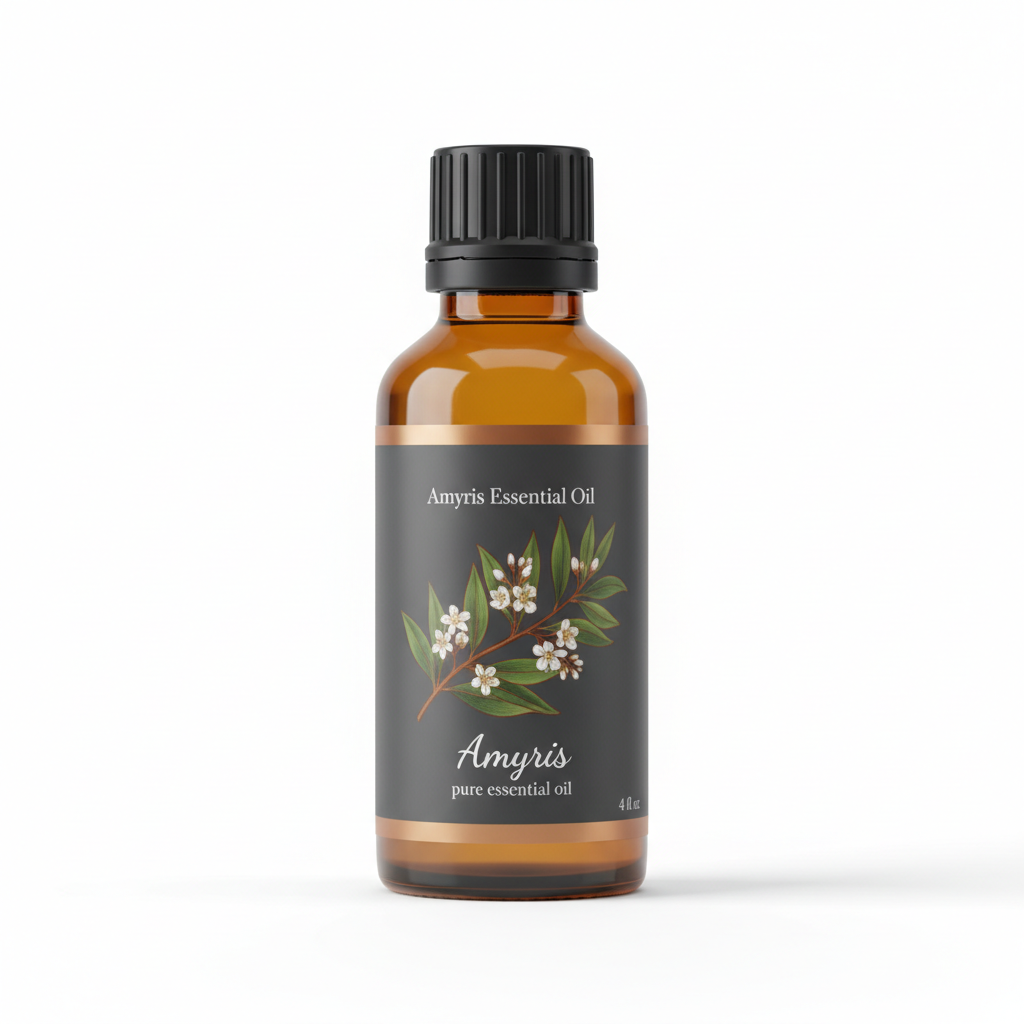
Amyris Essential Oil
Our own Amyris Essential Oil, in sizes from 0.5 oz to bulk.
From $20.99
Shop Now →Four meanings of the word
Steffen Arctander opens his section on fixatives in the 1960 Perfume and Flavor Materials of Natural Origin by defining a fixative as "a material which slows down the rate of evaporation of the more volatile materials in a perfume composition," and then splits the field into four types:
- True fixatives retard the evaporation of other components "by distinct physical effect," which he describes as adsorption owing to the high-molecular structure of the fixative. His natural example is benzoin.
- "Arbitrary" fixatives lend a note throughout all stages of evaporation but "do not significantly influence the evaporation of other perfume materials." His example is oakmoss.
- Exalting fixatives act as odor carriers and synergists, add "wearability," and work through "mere traces." His examples are musk and civet, both animal-derived.
- "So-called" fixatives are odorless or almost odorless, high-boiling crystalline materials or viscous liquids whose effect is "simple increase of the boiling point of the perfume composition." In a way, he writes, they "steal" effect from the perfume, and "such additions represent a direct loss of fragrance." His typical natural example in this group is amyris oil.
Amyris oil is Arctander's example for the last category, and since we sell it, we would rather say so than hide it. His summary line is blunt: "a true physical fixation in terms of a decreased vapor pressure can never be obtained through the addition of fractions of one percent of a certain material." The same book states that to get a true physical fixative effect from olibanum resinoid alone, "it would be necessary to use 4 to 6% or even more of this material." Those are 1960 statements by one author, but they are specific, and they set a bar most "add a few drops of fixative" advice never meets.
What the physics says
The 2021 review by Rodrigues, Nogueira and Faria in Molecules writes the vapor above a liquid mixture with Raoult's law modified by an activity coefficient: the partial pressure of a component equals its mole fraction, times its activity coefficient, times its pure-substance vapor pressure. Two levers follow. Diluting a volatile component with something heavy lowers its mole fraction and so its vapor; and any interaction that changes the activity coefficient changes it further. The authors concede that vapor-liquid equilibrium calculations alone do not describe the "Aura of Aroma" accurately, which is a fair warning against over-reading the equation.
J. Stephan Jellinek, in "Evaporation and the Odor Quality of Perfumes" (1960), defined fixation as slower evaporation caused by adding another substance, and noted that the terms were used loosely: a material with a long-lasting odor is not necessarily a true fixative. He says the mechanism was poorly understood, with one proposed explanation being simple dilution that lowers the partial vapor pressure. His practical rule is the one most blog posts skip: "we should not say that a substance is a 'fixative,' but only that it has fixative action," and a substance that fixes on a blotter may not on skin, in a cream or in an aerosol.
What the amounts look like
This arithmetic is ours, not a published result. Take a 10 mL bottle that holds 1 mL of fragrance concentrate, the oils themselves, with the rest carrier or alcohol. A fixative at 5% of that concentrate is 0.05 mL. At 0.5% it is 0.005 mL, a fraction of a drop. Now apply the dose a skin product can carry. Our shop guidance for amyris on skin is 0.5% to 2% in a carrier oil. In a 10 mL skin roll-on at 2% total essential oil, the whole concentrate is 0.2 mL, so a 5% share is 0.01 mL.
Reasoning from Arctander's figures, the physical effect he describes needs several percent of the composition for a resinoid, and the oils sold to home perfumers are generally used at skin-safe totals far below the amounts that produce it. That does not make them pointless. A material can matter because it is itself tenacious, because it rounds a blend, or because it holds back a bright note. The honest claim is that any lasting-power effect from a small amount of an essential oil is modest and has not been shown on skin by anyone we could cite.
The materials, by what the references say
| Material | Form | Role in Arctander | Note for a home blender |
|---|---|---|---|
| Benzoin | Resin, tincture, resinoid | Natural example of a true fixative | No commercial essential oil; a tincture or resinoid is the usable form |
| Labdanum | Resin absolute, resinoid | "General fixative with a distinct sweetening effect and an ambra-type odor" | Strong odor of its own; changes the blend, not just its length |
| Olibanum (frankincense) | Resinoid | "A valuable fixative"; needs 4 to 6% or more for a true physical effect | Lends "its own peculiar odor"; the oil is a different material |
| Patchouli | Oil; resinoid | Tenacity one of the "typical virtues"; resinoid an "excellent fixative" | Oil sweetness "almost sickening in high concentration" |
| Vetiver | Oil | Used "not only as a fixative, but also as an odor contributor" | Strong earthy character shapes the blend |
| Cedarwood (Atlas, Virginia) | Oil | Atlas: "fixative effect"; Virginia: "fixative and cost-reducer" | Dry woody note; two different oils |
| Sandalwood, East Indian | Oil | "Blender"-fixative with outstanding tenacity | Supply and price limit its use; see sandalwood alternatives |
| Copaiba balsam | Oleoresin | "One of the most inexpensive natural fixatives" | Low-oil grades preferred for fixation; mild odor |
| Guaiacwood | Oil | "A low-cost fixative and modifier" | Soft, sometimes semi-solid oil |
| Amyris | Oil | "So-called" fixative; "mild blender" | Quiet and rounding; small physical effect at skin-safe amounts |
| Musk, civet | Animal-derived | Exalting fixatives, active in traces | We do not discuss these further; sourcing and legality are for the supplier |
For the profile of each oil and how its listed lasting power compares, see base note essential oils; our shop description says amyris helps citrus and floral top notes hold, which is a defensible description of its rounding role but, reasoning from the sources above, is not a physical-fixation claim, and we cannot show it from wear data.
Making a perfume last without leaning on the word
- Choose tenacious materials as the base, then judge them over a day. Arctander says patchouli and vetiver need at least 24 hours of study. See how to blend essential oils for the log method.
- Raise the total fragrance share only within the safe cap. More material gives more to evaporate; for skin, the cap is the limit, and for amyris our guidance is 0.5% to 2%. The IFRA limits a supplier sheet reports for amyris are ceilings for professional products, so where they differ from our figure we recommend the lower one. Our dilution chart has the arithmetic.
- Test on skin, after a patch test. Jellinek's blotter-versus-skin warning is the reason. A patch test comes first: see the patch test guide.
- Expect a trade-off. A heavier base can mute the opening, and Arctander's "steal" wording says as much.
We have an older piece on amyris as a fixative and a perfumery overview in amyris in perfumery; this page is the broader, more cautious account.
Limits
We sell one oil, have no perfumer on staff, and have no wear tests of any material. The sources are a 1960 reference on industrial perfumery, a 1960 research paper and a 2021 modeling review, none of which we know to have tested an amyris-based perfume on skin. We have not covered orris or synthetic musks because we did not open a source on them. If a blend irritates your skin, stop using it and ask a pharmacist or dermatologist.
The useful question for any fixative is a narrow one: what does it do to this blend, on your skin, at this amount? If you cannot answer it with a skin test, you do not yet know.
Amyris Essential Oil
Amyris Essential Oil from our own shop, in sizes from 0.5 oz to bulk.
From $20.99
Shop Now →Sources & Further Reading
- Arctander S., 1960. Perfume and Flavor Materials of Natural Origin (full text). archive.org
- Jellinek J.S., 1960. Evaporation and the Odor Quality of Perfumes. Journal of Cosmetic Science 12(3):168. library.scconline.org
- Rodrigues A.E., Nogueira I., Faria R.P.V., 2021. Perfume and Flavor Engineering: A Chemical Engineering Perspective. Molecules 26(11):3095. pmc.ncbi.nlm.nih.gov
- De Hekserij, 2025. 1Doc 20111, EO Amyris (supplier data sheet, IFRA 51st Amendment limits). hekserij.nl