Amyris Oil for Sleep: What the Evidence Does and Does Not Show
No human trial of amyris oil for sleep turned up when we searched Europe PMC, which indexes PubMed, on 19 October 2026. The only study we found in which amyris oil produced a sedation-like state used fish in immersion baths. So amyris is a reasonable quiet, woody scent for an evening routine, but it is not an evidence-backed sleep aid, and the practical advice below is reasoning, not a result.
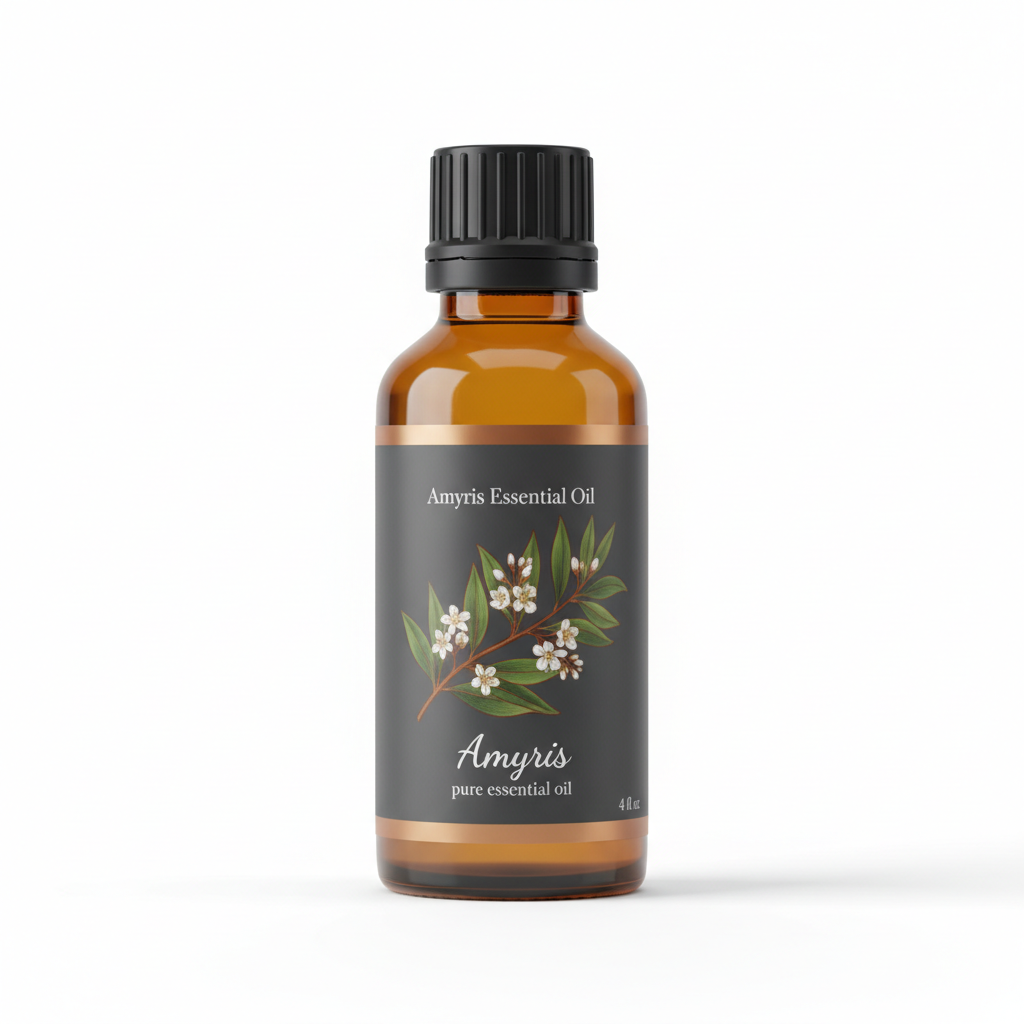
Amyris Essential Oil
Our own Amyris Essential Oil, in sizes from 0.5 oz to bulk.
From $20.99
Shop Now →Where the sleep claim comes from, and where it breaks
The claim runs on chemistry. Abd Algaffar et al. (2024) analysed a commercial amyris sample and reported valerianol (21%), gamma-eudesmol (11%) and beta-eudesmol (12%) as its main constituents. Kucharska et al. (2021) state that valerianol and the eudesmols "are believed to be responsible" for the oil's relaxing properties, and they trace that belief to earlier composition papers, not to a trial of the oil on people. Belief is the operative word: it is an inference from what the oil contains.
The nearest experiment is Lins et al. (2025), who exposed the fish tambaqui to Amyris balsamifera oil in immersion baths at 20, 25, 30, 35 and 40 microliters per liter. They reported a reversible loss of the postural reflex and a dose-dependent drop in heart rate, with lighter anesthetic planes at 20 and 25 and deeper planes at 30 to 40. It shows that the oil is active in at least one animal at tens of microliters per liter of water. It does not show that smelling it at a bedside changes human sleep, because the fish absorbed the oil through the water, the endpoint was anesthesia rather than sleep, and no human dose-response exists. Composition, fish and a plausible mechanism add up to a hypothesis, not a result.
What the sleep-aroma trials actually tested
The better-known evidence is about other oils.
- Shen, Zhang and Zhu (2026) pooled 11 randomized controlled trials with 628 adults on lavender oil and found a standardized mean difference of -0.56 (95% CI -0.96 to -0.17) in sleep measures. The authors say the conclusion is limited by the quantity and quality of the included studies and needs confirming in better trials.
- McDonnell and Newcomb (2019) ran a randomized, double-blind crossover trial in 42 cardiac rehabilitation patients. Cotton balls with a mixture of lavandin, bergamot and ylang ylang or a placebo were placed at the bedside for five nights each. The mean Pittsburgh Sleep Quality Index score was 4.9 with the oils and 8 with placebo (lower is better), but sleep duration and the time taken to fall asleep did not differ between conditions. The abstract does not give the number of drops used.
- The NCCIH page on aromatherapy, last updated January 2020, says "we don't know whether it's helpful because little rigorous research has been done" on aromatherapy for insomnia.
Two things follow. Even for lavender, the evidence is modest and carries caveats from its own authors. And none of these studies tested amyris, so nothing in them transfers to it. If a page cites lavender trials to support amyris for sleep, it is borrowing evidence from a different oil.
Do the basics first
The NHS Every Mind Matters sleep advice puts routine and environment ahead of any product: regular bed and wake times, time to wind down, no smoking, alcohol, tea or coffee in the 6 hours before bed, no exercise in the 4 hours before bed, and a bedroom that is quiet, dark and not too hot or cold. The NHS insomnia page defines insomnia lasting 3 months or longer as long-term, and says to see a GP if changing sleep habits has not helped, if problems have lasted for months, or if insomnia makes daily life hard to cope with. A scent routine is an add-on to those steps, and it cannot stand in for them or for a medical opinion. A physician or a sleep specialist is the right person for persistent sleep problems.
If you still want amyris in the evening: a conservative routine
These are our reasoning from the sources, not trialled advice.
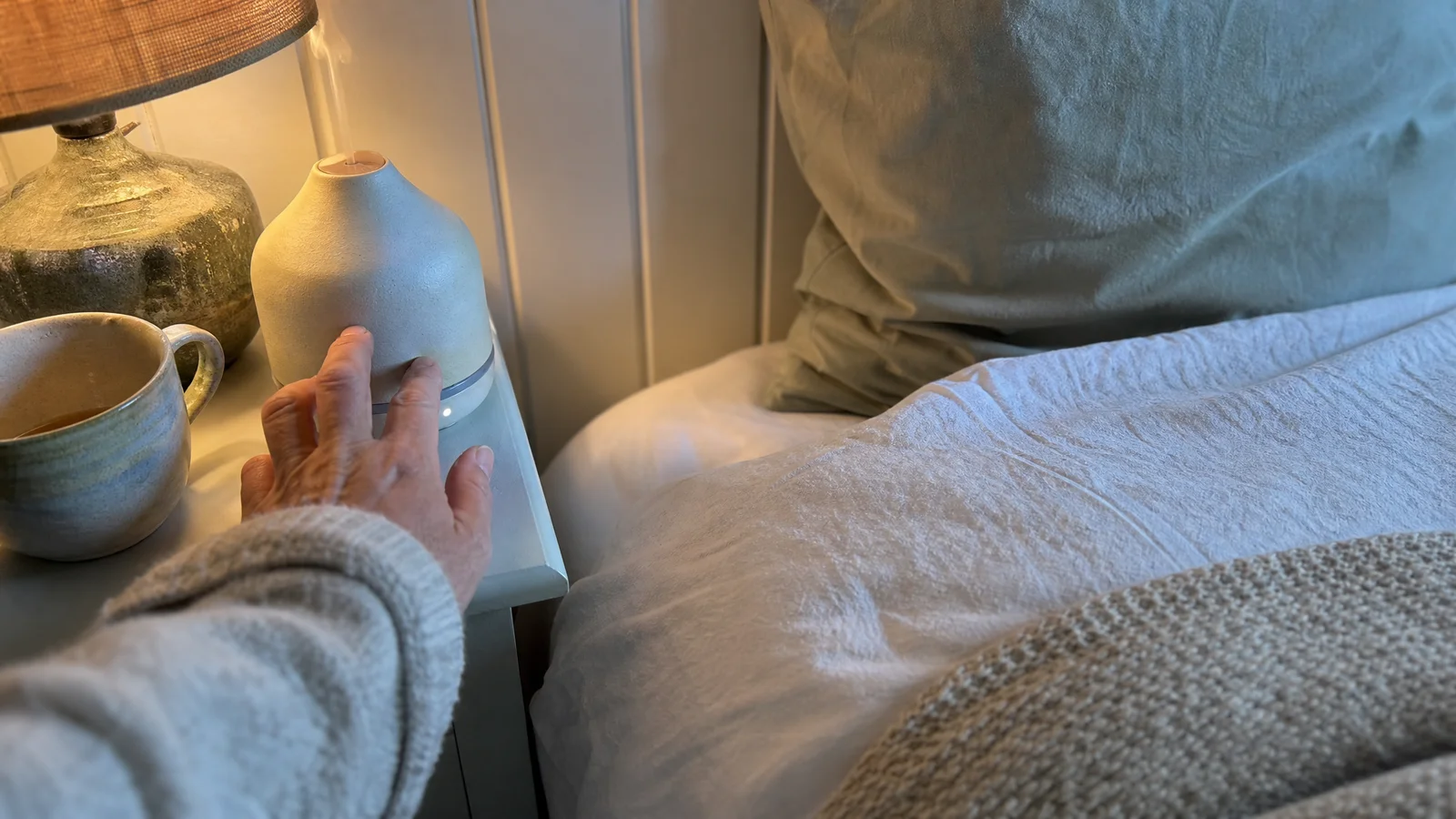
- Diffuse intermittently, not all night. The Tisserand Institute recommends 30 to 60 minutes on and then 30 to 60 minutes off, because the body habituates after about that long, and says benefits do not increase with continuous use. Reasoning from that, run it during your wind-down hour and let it cycle or stop it when you get into bed.
- Start low. The Tisserand Institute support reply from 2020 offers 3 to 5 drops per 100 mL of water as a rule of thumb, starting with less. Begin at 3.
- Keep the room ventilated and stop if you feel off. The same reply says to turn the diffuser off and get fresh air if you notice dizziness, nausea, lightheadedness or chest pain.
- Keep pets out. The Pet Poison Helpline notes that active diffusers emit microdroplets of oil into the air and that pets with breathing problems should be moved into fresh air. We do not have amyris-specific pet data, and our shop guidance is to keep amyris away from pets.
- Judge it against the basics. Note your bedtime and wake time for a couple of weeks with and without the scent. If sleep is no different, the scent is a pleasant habit and nothing more.
| Formula | Drops | Reasoning |
|---|---|---|
| Amyris alone | 3 amyris | The lowest end of the 3 to 5 range; tells you whether you like the scent by itself. |
| Amyris with lavender | 3 amyris, 2 lavender (5 total) | Lavender is the oil in the sleep trials above; amyris supplies the woody base. The trials did not test this blend. |
| Amyris, lavender and bergamot | 2 amyris, 1 lavender, 1 bergamot (4 total) | Echoes the oil families in the 2019 cardiac rehabilitation trial, which also used ylang ylang and lavandin rather than lavender. A diffuser is not a bedside cotton ball, so treat the resemblance as loose. |
We sell only amyris, so lavender and bergamot come from any reputable supplier. If you carry a blend over to skin, bergamot brings a sun-exposure caution covered in phototoxic essential oils. The pairing logic is in our guide to blending amyris with citrus, spice and floral oils, and more drop-count formulas are in amyris diffuser blends.
Who should skip it or ask first
- Anyone with sleep problems that last: see a physician or sleep specialist rather than adding more scent.
- Pregnant or breastfeeding people: ask an OB-GYN or midwife. We found no amyris-specific data.
- Babies and children: ask a pediatrician before diffusing around them. Our shop guidance is to keep amyris away from children.
- Asthma or other breathing conditions: ask a physician first.
- Households with pets, including fish: ask a veterinarian. The fish study above is a reason to keep oil out of aquarium water.
The broader safety picture, including dilution for skin use, is in amyris oil safety basics and is diffusing essential oils safe. For how other oils compare on the sleep evidence, see the best essential oils for sleep.
In short, amyris can be a pleasant quiet scent at the end of the day, used in small amounts and for short periods. Whether it helps you sleep is untested, and the first moves for sleep that does not come are the ones the NHS lists, followed by a doctor.
Amyris Essential Oil
Amyris Essential Oil from our own shop, in sizes from 0.5 oz to bulk.
From $20.99
Shop Now →Sources & Further Reading
- Lins et al., 2025. Amyris balsamifera essential oil promotes anesthesia in Colossoma macropomum, Fish Physiology and Biochemistry. pubmed.ncbi.nlm.nih.gov
- Kucharska et al., 2021. A Comparison of the Composition of Selected Commercial Sandalwood Oils with the International Standard, Molecules. pmc.ncbi.nlm.nih.gov
- Abd Algaffar et al., 2024. Sandalwood Oils of Different Origins Are Active In Vitro against Madurella mycetomatis, Molecules. pmc.ncbi.nlm.nih.gov
- Shen, Zhang and Zhu, 2026. The Sleep-Enhancing Effect of Lavender Essential Oil in Adults: A Systematic Review and Meta-Analysis, Holistic Nursing Practice. pubmed.ncbi.nlm.nih.gov
- McDonnell and Newcomb, 2019. Trial of Essential Oils to Improve Sleep for Patients in Cardiac Rehabilitation, Journal of Alternative and Complementary Medicine. pubmed.ncbi.nlm.nih.gov
- NCCIH, last updated January 2020. Aromatherapy and Essential Oils. nccih.nih.gov
- NHS, undated pages, read October 2026. Every Mind Matters: Sleep; Insomnia. nhs.uk
- Tisserand Institute, undated page, read October 2026. Safety guidelines for diffusion. tisserandinstitute.org
- Tisserand Institute, 2020 support reply. Essential Oil Applications. tisserandinstitute.org
- Pet Poison Helpline, undated page, read October 2026. Updates on Essential Oils. petpoisonhelpline.com