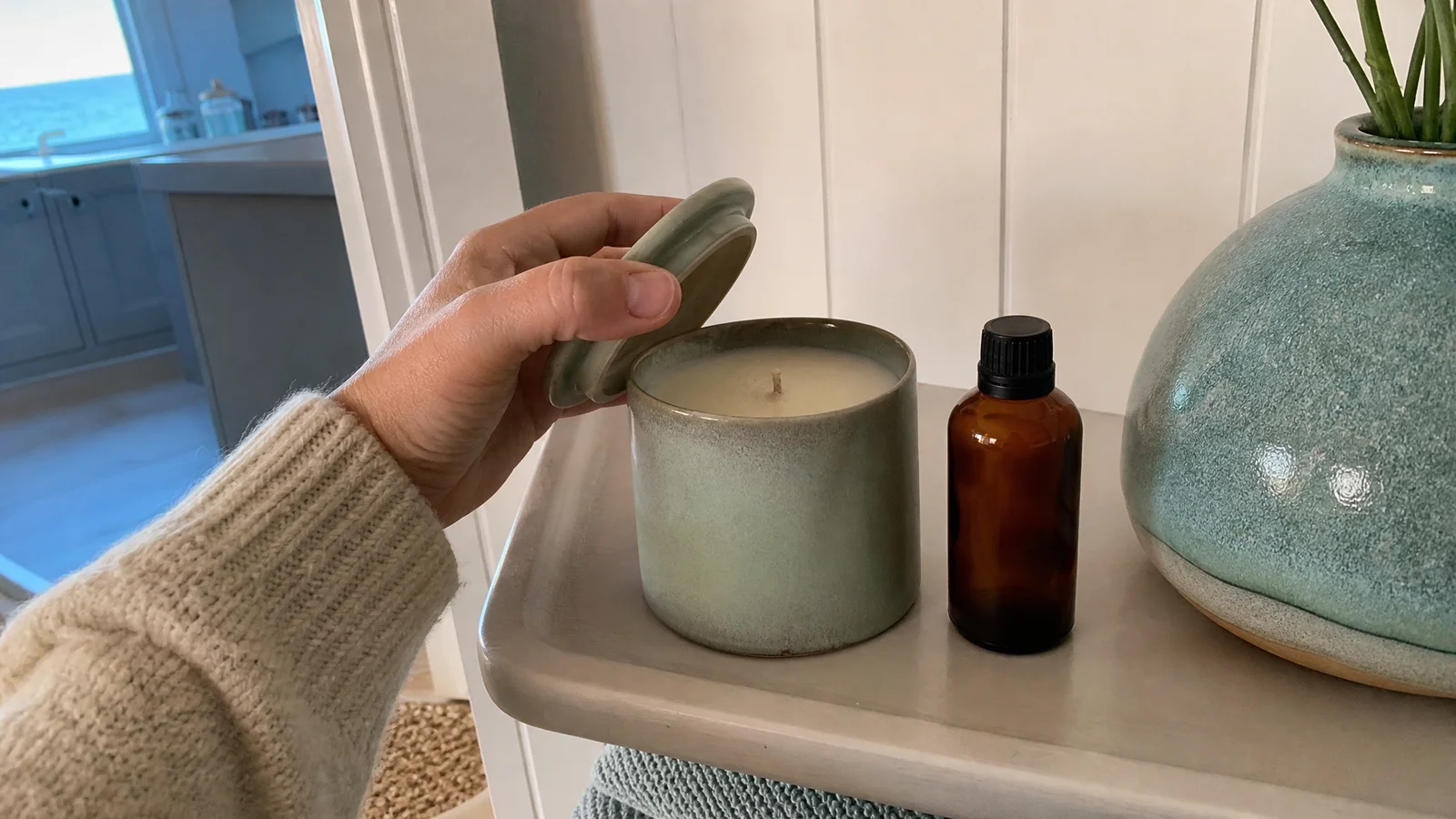
Essential Oil vs Fragrance Oil: What Differs and What Does Not
Quick answer: an essential oil is a distillate or pressing from a named plant, and a fragrance oil is a formulated scent, usually a blend of natural and synthetic ingredients, whose recipe the seller may keep private. Neither is the safer one by category. What separates them is how much you can learn from the label, and the one thing the two share is that the molecules inside obey chemistry, not marketing. We sell only an essential oil, so read this as a comparison from a seller on one side, built on regulator and journal sources.

Amyris Essential Oil
Our own Amyris Essential Oil, in sizes from 0.5 oz to bulk.
From $20.99
Shop Now →What each one is, in terms you can verify
The FDA describes fragrance formulas as "complex mixtures of many different natural and synthetic chemical ingredients," and says that under U.S. labeling rules the individual fragrance ingredients may be listed simply as "fragrance," because those ingredients are the ones most likely to be trade secrets (FDA, Fragrances in Cosmetics, content current as of 02/28/2022). A product labeled "fragrance oil" therefore tells you its purpose, not its contents. An essential oil is defined by its plant, plant part and process, which is why standards such as ISO 4720 exist to give botanical names to the oils (AFNOR listing for ISO 4720:2018). The Tisserand Institute's supplier checklist treats "fragrance oils" sold as essential oils, or essential oils offered from materials that do not yield one, as a red flag (Hana Tisserand, Tisserand Institute, undated page, read October 2026).
| Question | Essential oil | Fragrance oil |
|---|---|---|
| What it is | Material from a named plant, by a named process (for ours, steam distillation of heartwood) | A composed scent; may include natural and synthetic ingredients |
| What the label can tell you | Botanical name, plant part, origin, extraction, lot | Often just "fragrance"; contents may be undisclosed |
| Batch-to-batch variation | Follows the plant, origin and season; real and expected | Can be designed to a target by the maker |
| Allergens and restrictions | Constituents count toward limits and can sensitize | Ingredients count toward the same limits |
| How you verify it | Lot-specific analysis plus the checks in the buying guide | Ask the supplier for the ingredient disclosure and safety documentation |
"Natural" is not a safety category
Two sources make the point from opposite sides. The FDA says plant origin does not guarantee safety, that some plant materials are toxic or irritating, that it has no regulations defining "natural" or "organic" for cosmetics, and that all cosmetic ingredients must meet the same safety standard regardless of source (FDA, Aromatherapy, read October 2026). And in a Gothenburg patch-test series, 2.8% of patients with suspected allergic contact dermatitis reacted to oxidized lavender oil, with oxidized lavender oil among the highest frequencies of contact allergy to the essential oils studied (Hagvall & Bråred Christensson, Acta Dermato-Venereologica, 2016). The mechanism is chemical: the oil's main components, linalool and linalyl acetate, oxidize in air into sensitizing hydroperoxides. An essential oil is a concentrated mixture of reactive compounds, and it should be diluted for skin and kept fresh.
The regulatory trend is the same. The International Fragrance Association (IFRA) states that essential oils "may contain constituents subject to IFRA restrictions" and that makers must account for those contributions when working out the maximum level of an oil in a finished product; its Standards set limits on the finished consumer product, by product category, and are compulsory for IFRA members while not overriding national law (IFRA, IFRA Standards page, read October 2026). One trade-press summary of the EU's 2023 allergen amendment says it lists lavender and other essential oils among the substances to be declared individually above 0.001% in leave-on products (Cosmetics Business, 24 June 2026); we could not open the regulation text itself, so treat that as a pointer. In both systems, natural oils sit under the same constraints as synthetics.
Same molecule, not always the same sample
A fair argument runs: linalool is linalool, whether it came from lavender or a reactor. At the level of connectivity, that is right, and it is why a skin reaction can come from either source. But analytical chemists add a nuance. St-Gelais writes that "GC-MS cannot tell you if a given compound is natural or synthetic," and that for molecules such as linalool, synthetic material is often a mixture of enantiomers (mirror-image forms) that ordinary GC-MS does not distinguish, whereas "plants often produce specific ratios of enantiomers that synthesis may not be able to reproduce" (St-Gelais, Tisserand Institute, undated page, read October 2026). Sadgrove and colleagues make the same point about racemic mixtures (Sadgrove et al., 2022). Reasoning from that, "natural and synthetic are identical" holds for the molecule's identity but not always for the sample, and the difference is detectable only with a specific test, not by smell or a standard report.
The same logic explains the sandalwood cases. In a 2021 comparison of six commercial oils sold as sandalwood, two were judged synthetic mixtures made to imitate sandalwood: one built on synthetic sandalwood-type molecules (javanol and polysantol isomers), another mostly benzyl benzoate at 74.6% (Kucharska et al., 2021). Those were imitation scents sold under an essential-oil-style name. A perfumer might legitimately use such a composition as a fragrance; the problem was the label.
When a fragrance oil is a reasonable choice
There are honest reasons to choose a formulated fragrance. You may want a scent the plant world does not make at all, such as a food, fruit or flower note from materials that yield no oil. You may want a recipe that is the same every time, which is a design property of a composed scent and not of a plant product; the batch variation in the amyris-type oils in the Kucharska paper (valerianol 14.5% in two samples and 8% in a third) shows what a plant product does. You may be making candles or soap, where the finished product has to be assessed against the IFRA category for that product type. We sell no fragrance oils and have not trialled any, so the rule we offer is reasoning, not experience: choose by the document, not by the word. For a fragrance oil, ask the supplier for the ingredient disclosure and the IFRA-category safety documentation for your product type; for an essential oil, ask for the lot report. For soy-candle fragrance loads with amyris specifically, see our separate candle guide.
When an essential oil is the better fit, and when it is not
An essential oil fits when you want one named botanical material and can verify it. Our amyris is pure, undiluted Amyris balsamifera, steam distilled from aged heartwood from Haiti; it is the only product we sell. Amyris is not sandalwood and we do not describe it as such, and it is the wrong oil if you need a different scent, and it is no substitute for medical advice: for pregnancy, children or a health condition, see a physician, midwife or pediatrician. It is also wrong if you need an oil with organic certification, which ours does not have. For method, lot numbers and the checks that apply to any oil, read how to choose essential oils; for blending an oil into a home-scent routine, see the natural home fragrance guide, and for making blends, how to blend essential oils.
The practical summary: ask what is in it, who says so, and for which lot. A plant name and a lot report answer that for an essential oil; an ingredient disclosure and a safety file answer it for a fragrance oil. Neither word on a bottle does the job alone.
Amyris Essential Oil
Amyris Essential Oil from our own shop, in sizes from 0.5 oz to bulk.
From $20.99
Shop Now →Sources & Further Reading
- FDA, 2022. Fragrances in Cosmetics. fda.gov
- FDA, read October 2026. Aromatherapy. fda.gov
- AFNOR, 2018. ISO 4720:2018 Essential oils: Nomenclature (listing). boutique.afnor.org
- Hana Tisserand, Tisserand Institute, undated page, read October 2026. Eight green and red flags when looking for your ideal essential oil supplier. tisserandinstitute.org
- Hagvall L. and Bråred Christensson J., 2016. Patch testing with oxidized lavender oil. Acta Dermato-Venereologica 96(5). medicaljournals.se
- IFRA, read October 2026. IFRA Standards. ifrafragrance.org
- Cosmetics Business, 24 June 2026. The EU's cosmetic labelling shake-up (trade press summary of Regulation (EU) 2023/1545). cosmeticsbusiness.com
- St-Gelais A., Tisserand Institute, undated page, read October 2026. The Highs and Lows of GC-MS in Essential Oil Analysis. tisserandinstitute.org
- Sadgrove N.J. et al., 2022. Fundamental Chemistry of Essential Oils and Volatile Organic Compounds, Methods of Analysis and Authentication. Plants 11(6):789. pmc.ncbi.nlm.nih.gov
- Kucharska M. et al., 2021. A Comparison of the Composition of Selected Commercial Sandalwood Oils with the International Standard. Molecules 26(8):2249. pmc.ncbi.nlm.nih.gov