Elemol in Amyris Oil: The Molecule Behind Its Creamy, Powdery Edge
Smell a bottle of amyris oil next to a bottle of sandalwood and you'll notice something curious: amyris leans softer, rounder, almost powdery at the edges, where sandalwood tends to sit drier and more resinous. That difference has a name, and it's not marketing language. It's a sesquiterpene alcohol called elemol, and it makes up a meaningful share of what you're actually smelling when you open a bottle of amyris.
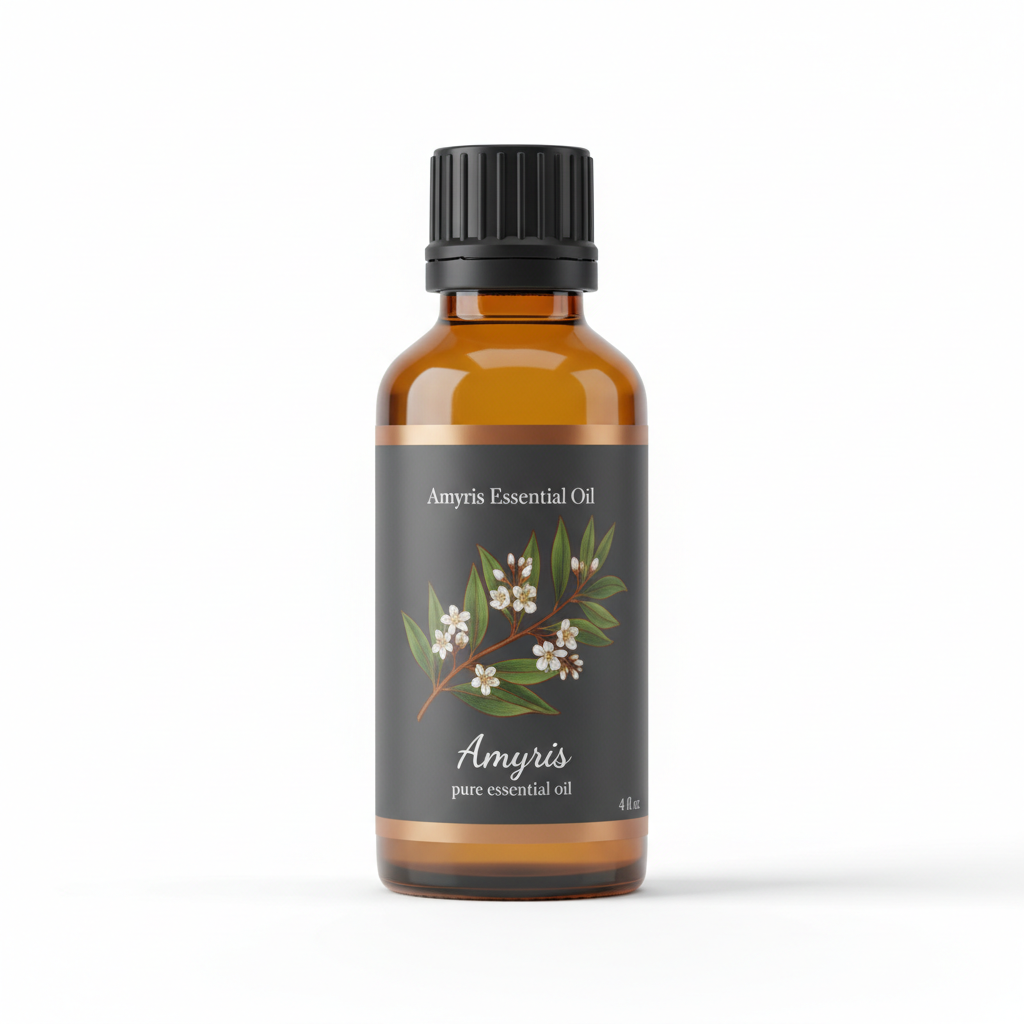
Amyris Essential Oil
Our own Amyris Essential Oil, in sizes from 0.5 oz to bulk.
From $22.99
Shop Now →This piece is a chemistry-first look at amyris oil through the lens of one molecule: what elemol is, how much of it typically shows up in a GC-MS report, what research has actually observed about it (not claimed, observed), how to think about safe use, and what separates a well-sourced amyris oil from a cut one. If you've ever wondered what gives amyris its powdery note, elemol is most of the answer.
What Elemol Actually Is
Elemol is a sesquiterpene alcohol, meaning it's built from three isoprene units (fifteen carbons total) with a hydroxyl group attached. That structural family is worth knowing because sesquiterpene alcohols as a class tend to be heavier, slower to evaporate, and less sharp than the lighter monoterpenes (like limonene or pinene) that dominate citrus and pine oils. That's part of why amyris reads as a base note in perfumery rather than a top note. It doesn't rush off the skin or out of the diffuser; it lingers, and it lingers with a texture that's often described as creamy, waxy, or powdery rather than sharp or bright.
Elemol isn't unique to amyris. You'll also find it in small amounts in eucalyptus, myrrh, and a handful of other aromatic woods and resins. But amyris is unusual for how much of it shows up relative to everything else in the oil. In many commercial amyris samples, elemol is either the single largest peak on a gas chromatograph or a very close second, which is part of why amyris has earned its long-standing (if informal) reputation as a sandalwood substitute in soap and perfume formulation. It doesn't replicate sandalwood's chemistry exactly, but it shares this one important character note.
Amyris Oil's Chemical Profile: Where Elemol Sits
Amyris essential oil is steam-distilled from the wood of Amyris balsamifera, a small tree native to the Caribbean, most commonly Haiti, and it belongs to the citrus family botanically despite smelling nothing like citrus. The oil itself is almost entirely made of sesquiterpenes and sesquiterpene alcohols, which is a fairly narrow compositional range compared to oils like lavender or tea tree that carry dozens of compound classes.
A typical amyris oil chemical profile, based on published GC-MS analyses and the kind of batch reports reputable suppliers make available, looks roughly like this:
| Compound | Chemical Class | Typical Range |
|---|---|---|
| Elemol | Sesquiterpene alcohol | ~25-35% |
| Valerianol | Sesquiterpene alcohol | ~10-20% |
| Beta-eudesmol | Sesquiterpene alcohol | ~5-10% |
| Alpha-eudesmol | Sesquiterpene alcohol | ~3-8% |
| Elemene isomers | Sesquiterpene hydrocarbon | ~2-6% |
| Amyrol and related minor alcohols | Sesquiterpene alcohol | trace-5% |
These numbers shift from batch to batch and lab to lab (distillation method, harvest season, and tree maturity all move the needle), but the pattern holds: amyris is a sesquiterpene alcohol oil through and through, and elemol is consistently at or near the top of that list. Compare that to something like peppermint, where a single monoterpene (menthol) can run 30-50% alongside a much wider spread of minor compounds, and you start to see why amyris smells so structurally simple and grounded rather than layered and shifting.
What Gives Amyris Its Powdery Note
The "powdery" descriptor that shows up constantly in perfumer and formulator notes isn't just poetic language, it maps to something real in how elemol and its neighboring sesquiterpene alcohols interact with the nose. Powdery, in fragrance chemistry, generally describes a soft, slightly dusty, almost cosmetic-adjacent quality, the kind of scent associated with orris root, violet, or iris. Elemol and beta-eudesmol both contribute to that effect, and their combined presence alongside valerianol (which brings a slightly woody, almost mossy undertone) is what gives amyris its particular signature: creamy up front, powdery in the middle, and quietly woody underneath.
This is also why amyris blends so well as a fixative. Because these sesquiterpene alcohols evaporate slowly, they hold onto lighter top notes (citrus, florals) and stretch out the life of a blend, which is a big part of why amyris shows up so often in soap and candle formulations as a low-cost base note.
Formulators often reach for amyris specifically because the elemol-driven powdery quality softens sharper top notes without competing for attention the way stronger woods like cedarwood or vetiver can.
Research Findings: What's Actually Been Observed
It's worth being precise here, because it's easy for ingredient content to drift into overstatement. What follows is a summary of what's been observed in published research on elemol and amyris oil, not a set of outcomes you should expect from using the oil at home.
- Aroma chemistry studies have used GC-olfactometry (a technique that pairs chromatography with a human sniffing the separated compounds as they elute) to confirm that elemol and beta-eudesmol are meaningful contributors to the woody-powdery character of amyris and related woods, supporting what perfumers have described anecdotally for decades.
- Insect-deterrent research on elemol and related sesquiterpene alcohols has been published in entomology journals, with some laboratory studies noting deterrent activity against certain biting insects when the compound was tested in isolation. This research is generally conducted on isolated elemol at specific concentrations under controlled lab conditions, not on amyris essential oil applied to skin, so the findings don't translate directly into a recommendation for personal use.
- Compositional surveys comparing amyris oil from different regions and distillation batches have consistently found elemol as a dominant or co-dominant peak, which is the main reason amyris has held its reputation in the fragrance industry as a sandalwood-adjacent material despite the two oils having quite different full chemical profiles.
Some research suggests sesquiterpene alcohols as a class interact with olfactory receptors differently than lighter terpenes, which may explain why amyris reads as calming or grounding to many people, but this is an area of ongoing study rather than settled science, and individual response to scent is highly subjective. None of this research supports using amyris oil for any medical purpose, and none of it should be read that way.
Safety Profile and Contraindications
Amyris is generally considered one of the gentler essential oils in terms of skin response, largely because it's low in the reactive aldehydes and phenols that cause more sensitization in oils like cinnamon bark or oregano. That said, "gentler" is relative, not a green light to skip basic precautions. Every essential oil, including amyris, is a concentrated plant extract and should be handled with care.
- Always dilute before skin contact. A common starting ratio for adults is a 2% dilution, roughly 12 drops of essential oil per ounce of carrier oil (jojoba, sweet almond, or fractionated coconut oil are common choices). Go lower, around 1%, for facial application or for anyone with sensitive skin.
- Patch test first. Apply a diluted drop to a small area of skin, such as the inner forearm, and wait 24 to 48 hours before broader use. Discontinue if you notice redness, itching, or irritation.
- Never apply undiluted oil directly to skin, and never ingest essential oils. Amyris oil is intended for aromatic and topical (diluted) cosmetic use only.
- Keep away from eyes and mucous membranes. If accidental contact occurs, flush with a carrier oil (not water) and seek guidance from a poison control center or qualified healthcare provider if irritation persists.
- Pregnancy, nursing, and use around children call for extra caution with any essential oil. Consult a qualified healthcare provider before use in these situations, and keep all essential oils out of reach of children and pets.
- People with known sensitivities to sesquiterpene-rich woods (such as sandalwood or vetiver) may want to patch test amyris with particular care, since cross-reactivity between related plant compounds is possible.
This information is educational and does not replace individualized guidance from a qualified healthcare provider, especially if you have existing skin sensitivities or are combining amyris with other topical products.
Sourcing and Quality Indicators
Because amyris is inexpensive relative to true sandalwood, and because its chemical profile is fairly forgiving to work with, it's also a common target for cutting and blending in the lower end of the essential oil market. Knowing what to look for helps you tell a well-sourced oil from a diluted or adulterated one.
Ask for a current GC-MS report
Any supplier confident in their oil's quality should be able to provide a batch-specific gas chromatography and mass spectrometry report, not a generic one pulled from a catalog. Look for elemol in the range discussed above, alongside valerianol and eudesmol isomers. A report showing an unusually low elemol percentage, or a compound profile padded out with cheaper diluents, is a signal to ask more questions.
Check the botanical name and origin
Amyris balsamifera should be listed explicitly. Haiti remains the primary source region, and reputable suppliers are generally willing to name it. Vague labeling ("essential oil blend" or no species name at all) is a red flag.
Note the color and viscosity
Genuine amyris oil tends to run pale yellow to amber and noticeably more viscous than lighter oils like citrus or eucalyptus, a natural consequence of its heavy sesquiterpene alcohol content. An oil that pours thin and watery, or that's unusually colorless, may have been extended with a carrier or a cheaper diluent.
Trust the nose, but verify with paper
A genuine amyris oil should smell soft, woody, and a little powdery from the first sniff, without a strong solvent edge or an overly sharp top note. Scent alone isn't a reliable purity test on its own (skilled blending can mimic a natural profile), which is exactly why pairing your nose with a lab report matters more than either alone.
Distillation method matters
Steam distillation from wood, sometimes wood that includes bark and small branches, is the traditional and most common method for amyris. Some lower-grade material is produced from sawmill waste or offcuts rather than purpose-harvested wood, which can shift the compound ratios and, in some cases, introduce off-notes. Suppliers who disclose their distillation source (purpose-grown wood versus reclaimed sawmill material) are generally more transparent across the board.
Putting the Chemistry to Use
Understanding elemol's role doesn't just satisfy curiosity, it changes how you shop. If you're chasing amyris specifically for its creamy, powdery character in a blend or a personal fragrance, a batch report with a strong elemol showing is a genuinely useful thing to check for, the same way a coffee buyer might check origin and roast date rather than relying on the bag's front-of-pack copy. And if you're comparing amyris against sandalwood or other woody oils for a project, knowing that the resemblance is really about one shared molecule, not an identical chemical twin, sets more realistic expectations for how the final blend will smell and behave.
The takeaway is fairly simple: amyris earns its reputation honestly. It's not dressed up with marketing language it can't back up chemically. The powdery, creamy edge people notice is traceable to a specific, well-documented compound, and a supplier who can show you that on paper is one worth trusting with the rest of their catalog too.